
Law 9 of 21
Foul Play in Rugby: Law 9
Prohibits obstruction, unfair play, dangerous play, and misconduct. Sanctions include penalties, yellow cards (10-minute suspension), and red cards (permanent dismissal).
Law 9 in plain English
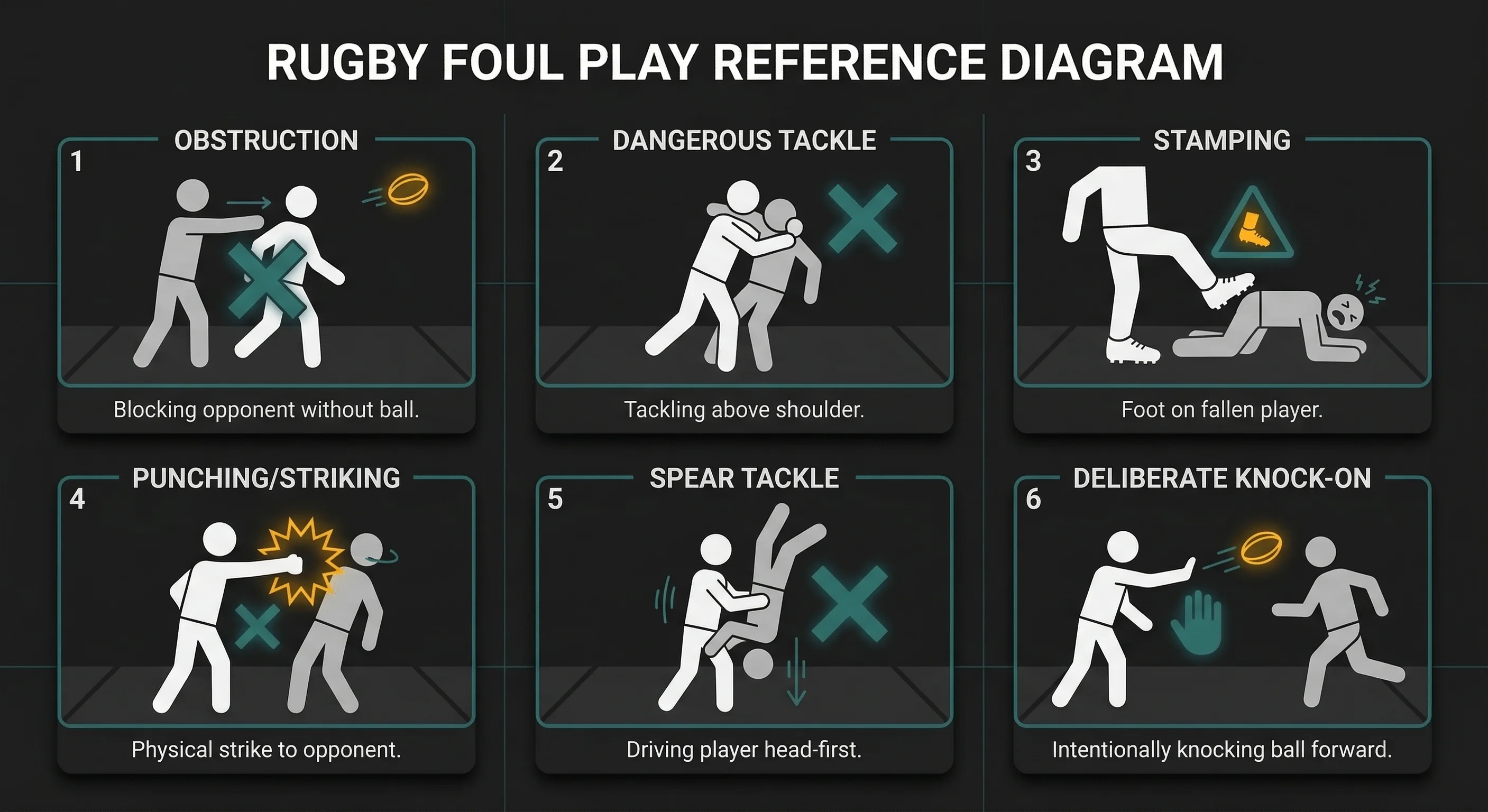
Foul play is anything a player does inside the playing enclosure that breaks Law 9. The law sorts it into five groups:
Obstruction: Getting in an opponent's way unfairly. An offside player must not deliberately block opponents or get involved in play. Nobody may deliberately stop an opponent from tackling the ball carrier or from getting a chance at the ball, and a ball carrier must not run into an offside team-mate to shield themselves. Two players racing for the ball may only bump shoulder to shoulder.
Unfair play: Deliberately breaking any law, deliberately knocking or throwing the ball out of the playing area, trying to fool the match officials into penalising an opponent, and wasting time.
Repeated infringements: A player who keeps breaking the laws, or a team that keeps committing the same offence. When several players in one team keep making the same offence, the referee warns the whole team, and the next player to do it gets a yellow card.
Dangerous play: Anything reckless or dangerous to others, such as leading with the elbow or forearm, jumping into or over a tackler, physical or verbal abuse (biting, punching, contact with the eyes, striking, stamping, tripping, kicking), early, late or dangerous tackles, tackles that lead to head contact or go above the sanction line, tackling a player without the ball or in the air, lifting a player and dropping them on their head or upper body, dangerous play in scrums, rucks and mauls, retaliation, and the flying wedge.
Misconduct: Anything against the spirit of good sportsmanship, and not respecting the referee, for example by arguing with decisions or playing on after the whistle.
Sanctions:
- Penalty: the sanction for almost every Law 9 offence. Wasting time and not lowering a lifted team-mate safely give a free-kick instead.
- Caution or card: on top of the penalty, a player who commits foul play must be cautioned (warned), shown a yellow card or sent off. Law 9 does not say which act gets which, apart from the yellow card after a team warning (above) and the red card for a second yellow (below).
- Yellow card: the player is suspended for 10 minutes of playing time and waits in the sin-bin (two minutes in sevens and tens). A second yellow-card offence by the same player means they are sent off.
- Red card: the player is sent off and takes no further part in the match. Normally the team cannot replace them. In elite rugby, a replacement may come on after 20 minutes, unless the red card was for an intentional and highly dangerous act.
Foul play that stops a probable try also leads to a penalty try (Law 8.3).
Law 9 section by section
Shoulder to Shoulder Only
When two opposing players are both running for the ball, neither may barge or shove the other, other than shoulder to shoulder. Sanction: Penalty.
Offside Player Obstructing
An offside player must not deliberately block an opponent or get involved in play. Sanction: Penalty.
Blocking a Tackler
Nobody may deliberately stop an opponent from tackling, or trying to tackle, the ball carrier. Sanction: Penalty.
Denying Access to the Ball
It is obstruction to deliberately stop an opponent from getting a chance to play the ball, unless you are doing it by competing for the ball yourself. Sanction: Penalty.
Running Into a Team-Mate
A ball carrier must not deliberately run into a team-mate who is offside in order to block the opposition. Sanction: Penalty.
Obstruction When Ball Is Dead
While the ball is dead, nobody may obstruct an opponent or interfere with them in any way. Sanction: Penalty.
Unfair Play
Players must not do any of the following:
- (a) deliberately break any law of the game. Sanction: Penalty.
- (b) deliberately knock, place, push or throw the ball out of the playing area with a hand or arm. Sanction: Penalty.
- (c) do anything that could make the match officials think an opponent has infringed. Sanction: Penalty.
- (d) waste time. Sanction: Free-kick.
Team Repeating an Offence
A team must not keep committing the same offence. Sanction: Penalty.
Player Repeatedly Infringing
Individual players must not keep breaking the laws. Sanction: Penalty.
General Team Warning
When several players from the same team keep committing the same offence, the referee gives the team a general warning. If the offence happens again after that, the referee shows a yellow card to the player or players responsible.
Reckless or Dangerous Acts
Players must not do anything reckless or dangerous to others. This includes leading with the elbow or forearm, and jumping into or over a tackler. Sanction: Penalty.
Physical or Verbal Abuse
Nobody may abuse anyone, physically or verbally. Physical abuse includes, among other things, biting, punching, contact with the eye or the area around it, hitting someone with the arm, shoulder, head or knee, stamping, trampling, tripping and kicking. Sanction: Penalty.
Dangerous Tackling
Tackles must not be early, late or dangerous. Dangerous tackling includes, among other things, any tackle or attempted tackle that results in contact with the head. It also includes tackling, or trying to tackle, above the relevant sanction line while either player is in open play. That line is the shoulders in elite rugby, and the waist or base of the sternum in community rugby (see Law 14.1).
From 1 November 2026, World Rugby adds the hip-drop tackle to the examples of dangerous tackling. That is when the tackler grasps and tackles the ball carrier from the side or behind, and then swings round or through them, drops their hips or body weight on to the ball carrier's legs as they go to ground, or does both.
Sanction: Penalty.
Tackling Without the Ball
Only the ball carrier may be tackled. Tackling an opponent who does not have the ball is not allowed. Sanction: Penalty.
Off-the-Ball Holding or Pushing
Outside a scrum, ruck or maul, a player who does not have the ball may not hold, push, charge or block an opponent who is also without it. They must not push a team-mate either, whether or not that team-mate has the ball. Sanction: Penalty.
Charging Without Grasping
Nobody may charge into or knock down a ball carrier without trying to grasp them. Sanction: Penalty.
Player in the Air
When an opponent's feet are off the ground, nobody may tackle, charge, pull, push or grab them. Sanction: Penalty.
Lifting and Dropping
Lifting an opponent off the ground and then dropping or driving them so that their head or upper body, or both, hit the ground is not allowed. Sanction: Penalty.
Dangerous Play in a Scrum
In a scrum:
- (a) a front row must not set up some distance away from the opponents and then rush at them.
- (b) no front-row player may pull an opponent.
- (c) no front-row player may deliberately lift an opponent off their feet, or force them up and out of the scrum.
- (d) no front-row player may deliberately collapse the scrum.
Sanction: Penalty.
Dangerous Ruck and Maul Play
In a ruck or maul:
- (a) nobody may charge in. Any contact made without binding on to another player in the ruck or maul counts as charging.
- (b) no contact with an opponent may be above the shoulder line.
- (c) nobody may deliberately collapse the ruck or maul.
- (d) a player may move a jackler (a player trying to steal the ball) out of the tackle area by pushing or driving them backwards, including by grabbing a knee or leg. Rolling, pulling or twisting an opponent is not allowed.
- (e) no player may drop their body weight on an opponent or go for an opponent's lower limbs.
Sanction: Penalty.
No Retaliation
Players must never retaliate. Sanction: Penalty.
The Flying Wedge
Teams must not use the flying wedge: an attack, usually close to the try line, where several team-mates bind on to a moving ball carrier before hitting the defence, often in a wedge shape with some of them in front of the ball carrier. One player bound on beforehand is allowed, as long as that player meets the duties of an arriving player at a tackle. Sanction: Penalty.
Kicking Ball From Hands
Nobody may try to kick the ball out of the ball carrier's hands. Sanction: Penalty.
Hand-Offs and Excessive Force
A ball carrier may hand off an opponent, as long as they do not use excessive force. Sanction: Penalty.
Late Charge on the Kicker
A player who has just kicked the ball must not be deliberately charged, obstructed or tackled late. Sanction: Penalty, at whichever of these places the non-offending team chooses:
- where the offence happened.
- where the ball lands or is next played, but at least 15 metres in from the touchline.
- if the kick went straight into touch, on the 15-metre line opposite where the ball crossed the touchline.
- if the ball landed in in-goal or touch-in-goal, or on or beyond the dead-ball line, five metres out from the try line, opposite where it crossed that line, and at least 15 metres in from the touchline.
- if the ball hit a goal post or the crossbar, where it lands.
Lifting a Team-Mate
During open play, players are allowed to lift or support a team-mate. Anyone who does must bring that player safely back to the ground as soon as either team wins the ball. Sanction: Free-kick.
Good Sportsmanship
Nothing a player does may go against the spirit of good sportsmanship. Sanction: Penalty.
Respecting the Referee
Players must accept the referee's authority and must not argue with the referee's decisions. When the referee blows the whistle to stop play, they must stop playing at once. Sanction: Penalty.
Yellow Card
When the referee cautions a player and suspends them for 10 minutes, the referee shows them a yellow card. If that player later commits another offence worth a yellow card, they must be sent off. Play restarts with a penalty. In sevens and tens, the suspension is two minutes instead of 10.
Red Card
When the referee sends a player off, they show a red card. The player takes no further part in the match, and the team cannot replace them.
In elite rugby, a player sent off for an intentional and highly dangerous act still cannot be replaced. For any other red card, the team may bring on a replacement once 20 minutes of playing time have passed (see Law 3.33f). This became full law on 1 July 2026.
Real-World Examples
Scenario
A defending winger runs across the field without the ball to block the path of an attacker who is chasing a kick.
Outcome
Obstruction. The winger is deliberately stopping the attacker from getting a chance to play the ball without competing for it (Law 9.4). The attacking team gets a penalty where it happened, and as with any foul play the winger must also be cautioned, shown a yellow card or sent off.
Scenario
A flanker makes multiple infringements at the breakdown, coming in from the side, not releasing the ball, and offside, over the course of several minutes despite the referee's warnings.
Outcome
Each offence is a penalty, and a player who keeps breaking the laws commits foul play (Law 9.9). Having already been warned, the flanker can be shown a yellow card and suspended for 10 minutes of playing time (Law 9.29).
Scenario
A prop attempts to tackle the opposing fly-half and makes contact above the shoulder line, hitting the fly-half in the head area.
Outcome
Dangerous tackle. A tackle that leads to head contact, or goes above the sanction line in open play, breaks Law 9.13. The fly-half's team gets a penalty, and the prop must also be cautioned, shown a yellow card or sent off. Law 9 does not say which of these a given tackle gets; the referee decides.
Scenario
A defensive player picks up a ball carrier, lifts them to beyond horizontal, and drives them into the ground head-first.
Outcome
This breaks Law 9.18, which bans lifting a player and then dropping or driving them so their head or upper body hits the ground. The ball carrier's team gets a penalty, and the tackler must be cautioned, shown a yellow card or sent off. A player who is sent off takes no further part and cannot be replaced, except in elite rugby, where a replacement may come on after 20 minutes unless the act was intentional and highly dangerous (Law 9.30).
Scenario
A scrum-half whose team leads with 30 seconds left picks the ball up at a ruck and deliberately throws it into touch.
Outcome
Unfair play: deliberately throwing the ball out of the playing area breaks Law 9.7(b). The opposing team gets a penalty where she threw it, but no closer than 15 metres to the touchline (Law 20.1). She must also be cautioned, shown a yellow card or sent off. Doing it again would also be a repeated infringement (Law 9.8, 9.9).
Common questions
What is the difference between a yellow card and a red card in rugby?
A yellow card means the player has been cautioned and suspended, usually for 10 minutes of playing time (two minutes in sevens and tens), and must wait in the sin-bin before returning. A red card means the player is sent off and takes no further part in the match, and normally the team cannot replace them. In elite rugby, the team may bring on a replacement after 20 minutes, unless the red card was for an intentional and highly dangerous act.
What is a high tackle in rugby?
A high tackle is a tackle above the sanction line in Law 14.1: the shoulders in elite rugby, and the waist or base of the sternum in community rugby. Law 9.13 also treats any tackle that leads to head contact as dangerous. The sanction is a penalty, and the tackler must also be cautioned, shown a yellow card or sent off.
What is a tip tackle in rugby?
Tip tackle is the common name for what Law 9.18 bans: lifting an opponent off the ground and then dropping or driving them so that their head or upper body hits the ground. The laws do not use the term itself. The sanction is a penalty, and the tackler must also be cautioned, shown a yellow card or sent off.
What is obstruction in rugby?
Obstruction is unfairly getting in an opponent's way. Law 9 bans an offside player deliberately blocking an opponent or joining in play, deliberately stopping an opponent from tackling the ball carrier or getting a chance at the ball, a ball carrier running into an offside team-mate to shield themselves, and obstructing anyone while the ball is dead. Charging or obstructing a player who has just kicked is also banned (Law 9.25). The sanction is a penalty.
Can you shoulder charge in rugby?
Not on a ball carrier. Law 9.16 bans charging into or knocking down a ball carrier without trying to grasp them. The only charge allowed is shoulder to shoulder between two players running for the ball (Law 9.1). The sanction is a penalty, and the player must also be cautioned, shown a yellow card or sent off.