
Law 17 of 21
Mark (Fair Catch) in Rugby: Law 17
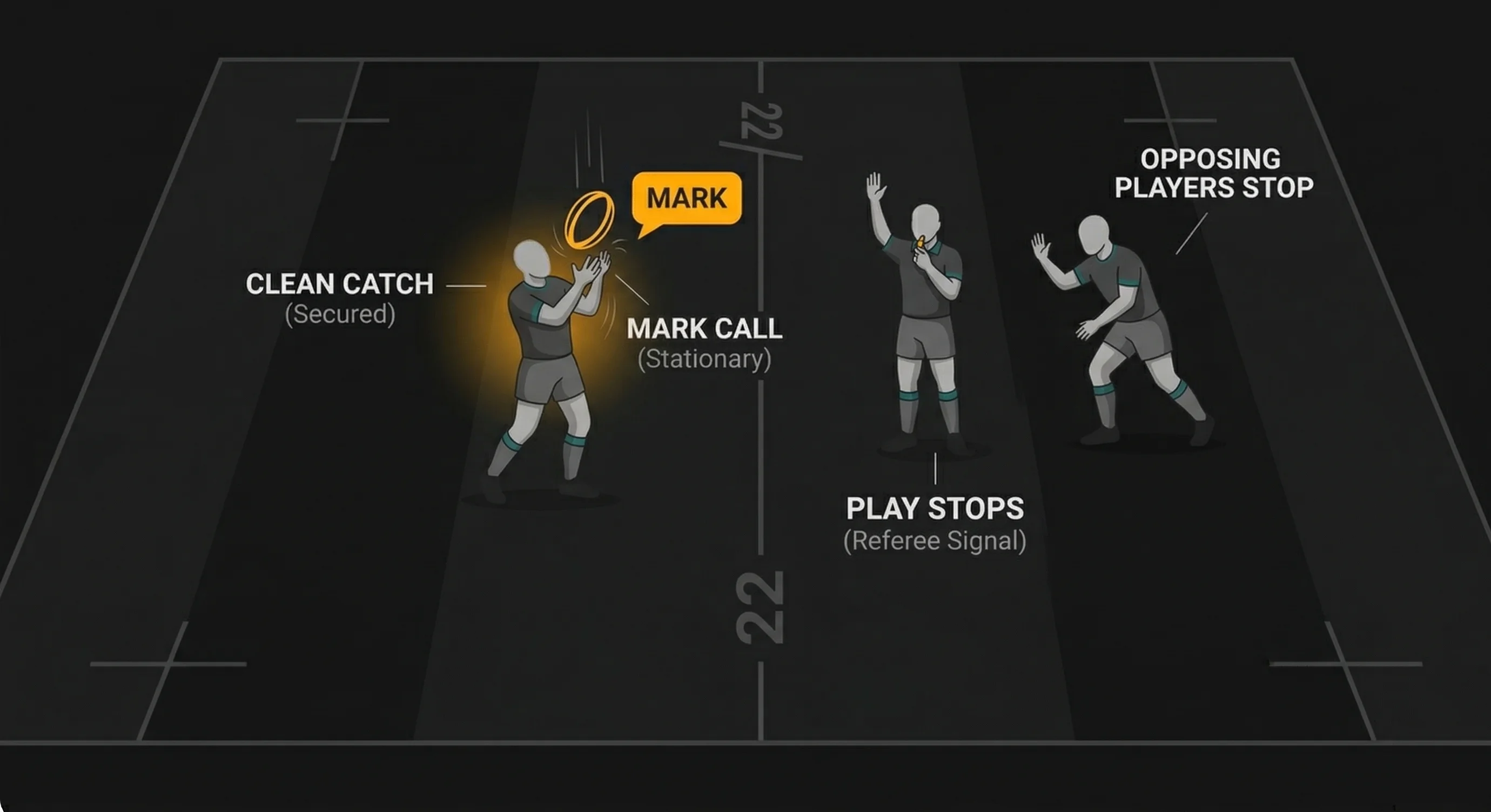
A player who catches an opponent's kick directly in their own 22 or in-goal and calls "mark" wins a free-kick. The referee stops play at once.
Law 17 in plain English
A mark is a way to stop play by catching an opponent's kick directly while you are in your own 22 or in-goal. Your team is then given a free-kick.
How to claim a mark:
- Have at least one foot on or behind your own 22-metre line when you catch the ball, or when you land after catching it in the air.
- Catch the ball straight from an opponent's kick, after it has reached the plane of the 22-metre line and before it touches the ground or another player. A ball that hits a goal post or the crossbar first can still be marked.
- Call "mark" at the same moment as you catch it.
You cannot claim a mark from a kick-off, or from a restart kick after a score. You can claim one from a penalty kick at goal or a drop kick at goal.
What happens next:
- The referee stops play straight away and gives a free-kick to the team in possession.
- The player who made the mark takes the free-kick. If they were hurt making the mark and cannot take it within one minute, a team-mate may take it.
- For a mark inside the 22, the kick is taken at the mark, but no closer than five metres to the try line. For a mark in in-goal, it is taken on the five-metre line, opposite the mark.
- The free-kick then follows Law 20: the opposition must retreat 10 metres (Law 20.12), and they may charge once the kicker starts to kick (Law 20.16).
If any condition is missing, there is no mark and play simply continues.
Law 17 section by section
Claiming a Mark
To claim a mark, a player has to meet all three of these conditions:
- (a) At least one of their feet is on or behind their own 22-metre line at the moment of the catch, or when they land after catching the ball in the air.
- (b) The ball comes straight from an opponent's kick, has reached the plane of the 22-metre line, and is caught before touching the ground or another player.
- (c) The player calls "mark" at the same moment.
Ball Hitting the Posts
A mark can still be claimed if the ball strikes a goal post or the crossbar before it is caught.
Free-Kick for a Mark
Once a mark has been correctly called, the referee stops play at once and gives a free-kick to the team in possession.
Which Kicks Count
A mark cannot come from a kick-off, or from a restart kick after a score. It can come from a penalty kick at goal or from a drop kick at goal.
Who Takes the Kick
The free-kick is taken by the player who claimed the mark, following Law 20.
Injured Catcher
If the player gets hurt while claiming the mark and is not able to kick within one minute, another player from the same team may take the free-kick.
Where the Kick Is Taken
Where the free-kick is taken depends on where the mark was made:
- Mark made inside the 22: at the place of the mark, but no closer than five metres to the try line, in line with the mark.
- Mark made in in-goal: on the five-metre line, opposite the place where the mark was made.
Real-World Examples
Scenario
A fullback with one foot inside her own 22 catches a high kick from the opposing fly-half directly and calls "Mark!" as she catches it.
Outcome
Mark. The referee stops play and gives her team a free-kick at the place of the mark (Laws 17.3 and 17.7), which she takes herself (Law 17.5). The opposition must retreat 10 metres (Law 20.12). She may kick from the mark or from anywhere behind it on a line through the mark (Law 20.2).
Scenario
A winger catches an opponent's kick directly in his own 22 but only calls "Mark" after he has taken a step.
Outcome
No mark. The call has to come at the same moment as the catch (Law 17.1c). Since it came later, play simply carries on.
Scenario
A player catches a kick with both feet in front of his own 22-metre line, then steps back into the 22 and calls "Mark".
Outcome
No mark. When he caught the ball he needed at least one foot on or behind his own 22-metre line (Law 17.1a), and the call must be made with the catch (Law 17.1c). Stepping back afterwards does not help.
Scenario
A fullback catches the ball in her own 22 from an opponent's kick, but on the way down it glanced off a team-mate's shoulder.
Outcome
No mark. The ball has to come straight from the opponent's kick without touching the ground or another player first (Law 17.1b), and that includes team-mates. Only a goal post or the crossbar is allowed (Law 17.2).
Common questions
What is a mark in rugby?
A mark is a way to stop play by catching an opponent's kick directly while in your own 22 or in-goal and calling "mark" at the same moment. The referee stops play and gives the catcher's team a free-kick, which the catcher takes.
Where can you call a mark in rugby?
Only in your own 22 or in-goal. At least one foot must be on or behind your own 22-metre line when you catch the ball, or when you land after catching it in the air, and the ball must have reached the plane of the 22-metre line. Catching it in front of the 22 and then stepping back does not count.
Do you have to shout "mark" out loud?
Yes. The player must call "mark" at the same moment as the catch. A late call means there is no mark and play carries on.
Can you score directly from a mark?
No. A mark gives a free-kick, and a penalty goal can only be scored from a penalty (Law 8.18). A team awarded a free-kick also cannot score a dropped goal until the ball next goes dead, or an opponent has played or touched the ball or tackled the ball-carrier (Law 8.29). Since July 2024 there is no scrum option at a free-kick (Law 20.3).
Can you call a mark off a teammate's kick?
No. The ball must come directly from an opponent's kick and be caught before it touches the ground or any other player, team-mates included. The one exception is a ball that hits a goal post or the crossbar, which can still be marked (Law 17.2).