
Rugby term
Red card
Definition
A red card means a player is sent off and takes no further part in the match, usually for serious foul play or after a second yellow card.
When a referee shows a red card
A red card is the most serious sanction in rugby. Law 9 says a player who commits foul play must be cautioned, shown a yellow card or sent off, and the referee decides which, depending on how serious the offence was.
The law names one case where a sending-off is required: a player who has already been shown a yellow card and commits another yellow-card offence must be sent off (Law 9). For other foul play, such as striking or stamping on an opponent, contact with the eyes, a dangerous lifting tackle or a tackle that leads to head contact, the referee decides between a yellow and a red card (Law 9).
What the referee does and signals
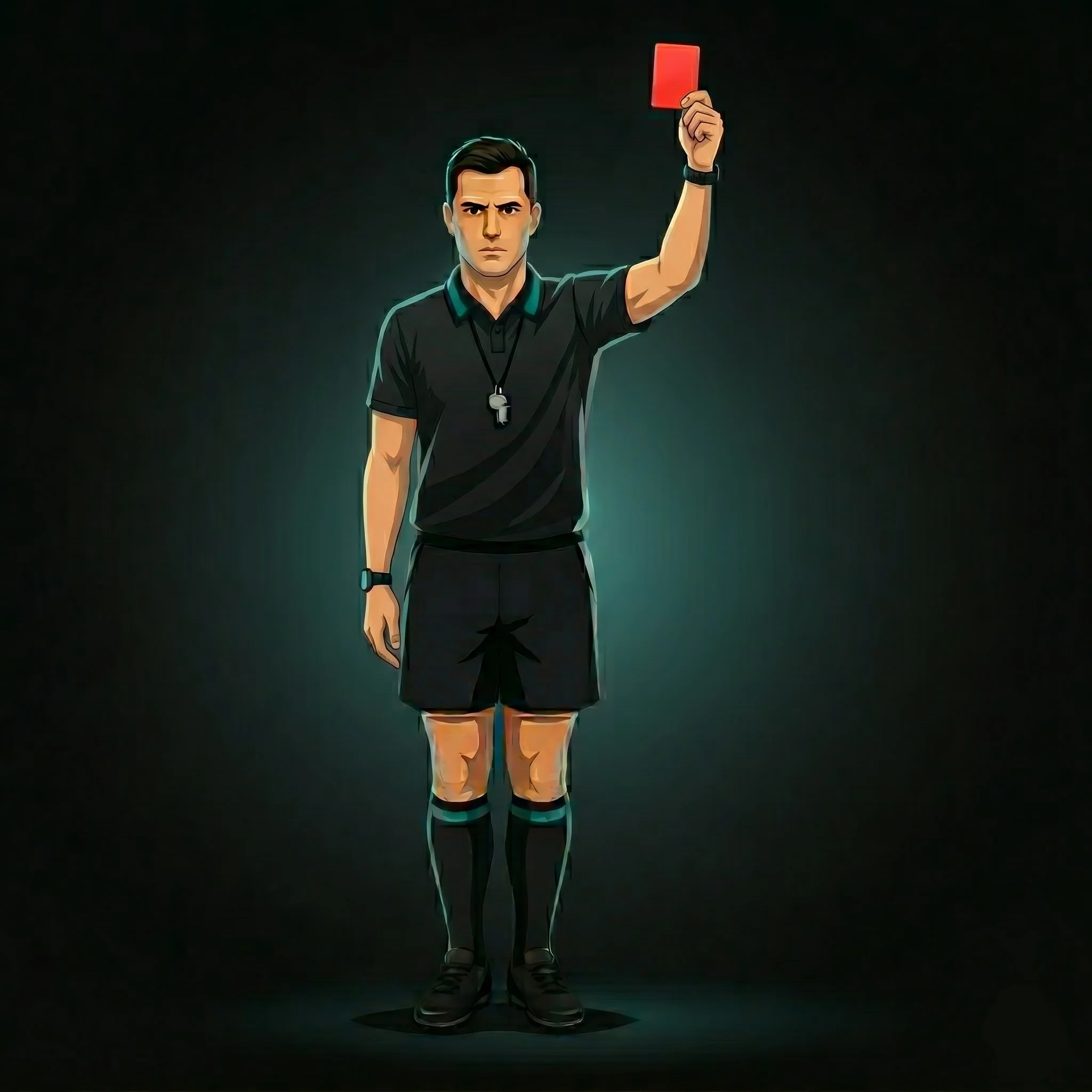
The referee blows the whistle to send the player off (Law 6) and holds the red card up above their head. The player must leave the field straight away. The other team is normally awarded a penalty kick for the offence as well.
After the match the referee gives the match organiser a written report on the foul play as soon as possible (Law 6).
What happens to the team
A player who is sent off takes no further part in the match. Under the standard law they may not be replaced, so the team plays with one fewer player for the rest of the game (Law 9).
If the player sent off is a front-row player and the team cannot contest scrums with the players left, it takes another player off so a front-row replacement can come on (Law 3). If no front-row cover is left, the referee orders uncontested scrums, played with eight players on each side (Law 3).
The 20-minute red card in elite rugby
In elite rugby, the 20-minute red card replacement became full law on 1 July 2026, after a global law trial. The player sent off still takes no further part. For intentional and highly dangerous actions, the player cannot be replaced. For other red cards, a replacement may come on once 20 minutes of playing time have passed (Laws 3 and 9).
Elite rugby means the professional level, as each union or competition defines it. Everywhere else the standard law applies and the team stays a player short.
A common misconception
A red card is not only for violent play. Two yellow cards in the same match also add up to a sending-off (Law 9), even if neither offence was serious on its own.
Referee signal
Common questions
What does a red card mean in rugby?
It means the player is sent off and takes no further part in the match. Under the standard law they may not be replaced, so their team plays with one fewer player for the rest of the game (Law 9).
Can a player with a red card be replaced?
Not under the standard law (Law 9). In elite rugby, a replacement may come on after 20 minutes of playing time, unless the red card was for an intentional and highly dangerous action.
What is the difference between a red card and a yellow card in rugby?
A yellow card sends a player to the sin bin for 10 minutes of playing time, after which they can return. A red card sends the player off for the rest of the match.
Do two yellow cards make a red card in rugby?
Yes. A player who has been shown a yellow card and commits another yellow-card offence in the same match must be sent off (Law 9).
Updated