
Law 12 of 21
Kick-Off Rules in Rugby: Law 12
Specifies how the game is started and restarted after scoring. Kick-offs are drop kicks from the centre; restart kicks follow scoring or the ball going dead.
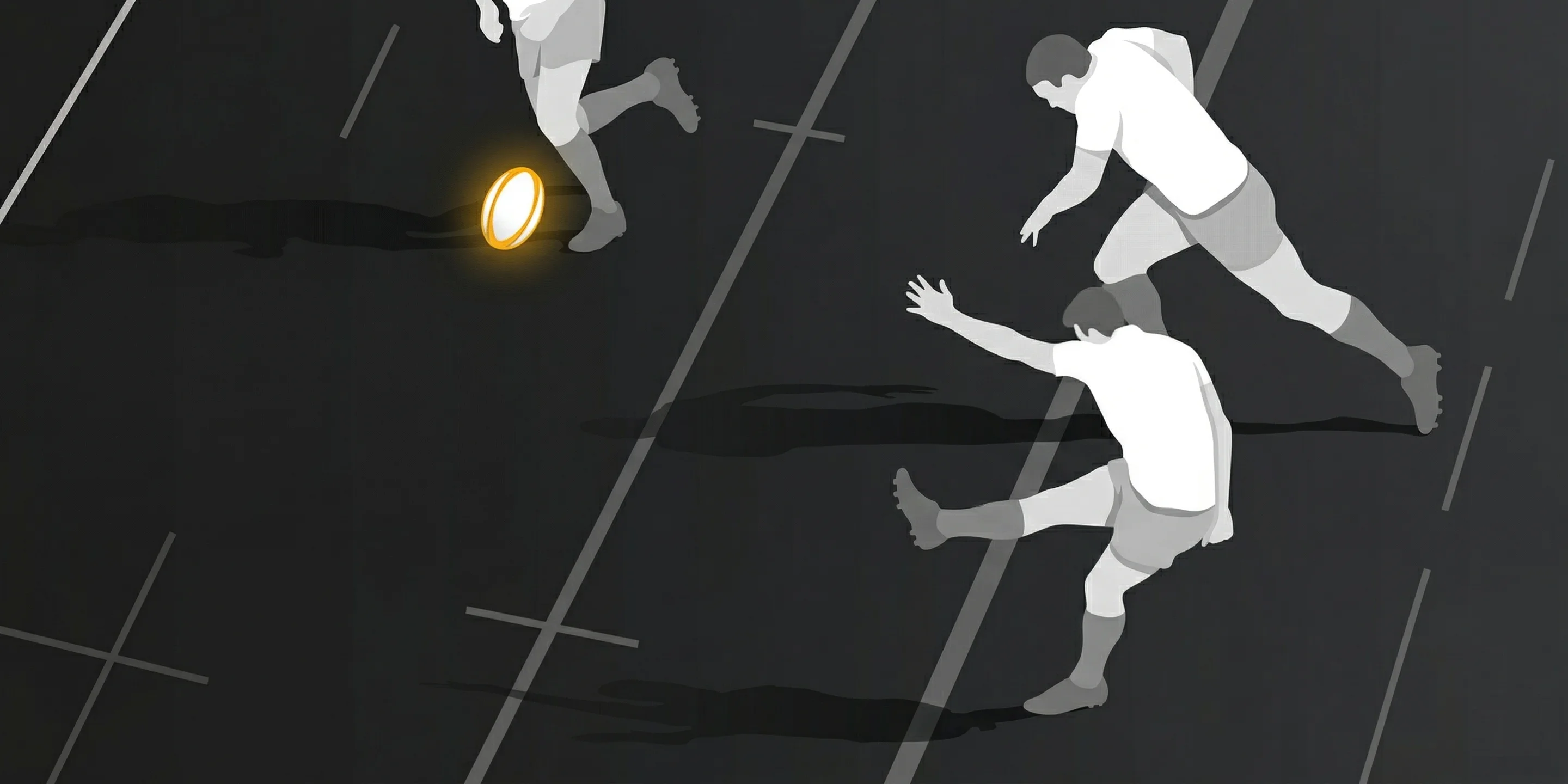
Law 12 in plain English
Kick-off: Each half, and each period of extra time, starts with a drop kick from the centre of the halfway line or from behind it. The team that did not kick off the match kicks off the second half. After a score, the team that conceded restarts play the same way.
Key rules for kick-offs:
- The kicker's team-mates must be behind the ball when it is kicked
- Opponents must be on or behind the 10-metre line in their half, or the kick is retaken
- The ball must reach that 10-metre line. If it gets there and is blown back, or an opponent plays it before it gets there, play continues
- If the kick is not a drop kick, is taken from the wrong place, has a team-mate in front of the ball or falls short of the 10-metre line, the opponents choose a retake or a scrum in the middle of the halfway line
- If the ball goes directly into touch, the opponents choose a retake, a scrum, a lineout or a quick throw
- If the kick goes into the opponents' in-goal untouched and they ground it straight away, or it goes dead, they choose a retake or a scrum. If they delay, play restarts with a try line drop-out
Restarts when the ball goes dead in in-goal without a score:
- Try line drop-out: the attackers played, kicked or carried the ball into in-goal and it was made dead there (including when the ball-carrier is held up), or they carried it off the playing area; an attacker knocked the ball forward in in-goal; or an attacker charged down a kick and the ball went dead through in-goal
- 22-metre drop-out: a missed penalty goal or drop goal was touched down by the defenders or went dead, or a kick from the field of play went dead through in-goal (the defenders may choose a scrum where it was kicked instead)
- 5-metre scrum, attacking team's throw-in: the defenders took or played the ball into their own in-goal and it was made dead
Drop-outs: A 22-metre drop-out is kicked from on or behind the 22 and must cross the 22. A try line drop-out is kicked from on or behind the try line and must cross the 5-metre line. If it falls short, the opponents choose a retake or a scrum, although the referee may play advantage. If it goes directly into touch, they choose a retake, a scrum on the sanction line, a lineout or a quick throw. Opponents must not cross the sanction line before the kick (free-kick), and any opponent in front of it must not delay or obstruct the kick (penalty).
Law 12 section by section
Drop Kicks Only
Every kick-off and every restart kick must be a drop kick. Sanction: The non-kicking team chooses a retake or a scrum.
Kick-off Position
A kick-off is taken from the centre of the halfway line, or from a point behind it. Sanction: The non-kicking team chooses a retake or a scrum.
Second-Half Kick-off
The second half is started by the team that did not kick off at the start of the match.
Restart After a Score
When a team scores, the other team restarts play from the centre of the halfway line, or from a point behind it. Sanction: The non-kicking team chooses a retake or a scrum.
Player Positions at the Kick
At the moment the ball is kicked:
- (a) The kicker's team-mates must all be behind the ball. Sanction: The non-kicking team chooses a retake or a scrum.
- (b) The opponents must be on or behind the 10-metre line in their own half. Sanction: The kick is taken again.
Reaching the 10-Metre Line
The kick must travel at least as far as the 10-metre line. Sanction: The non-kicking team chooses a retake or a scrum.
Blown Back or Played Early
Play continues if the ball reaches the 10-metre line and the wind then carries it back. Play also continues if a receiver plays the ball before it gets that far.
Kick-off Directly into Touch
If the kick goes straight into touch, the non-kicking team picks one of these:
- (a) A retake.
- (b) A scrum.
- (c) A lineout.
- (d) A quick throw.
Into the Opponents' In-goal
If the kick goes into the opponents' in-goal without touching anyone, and an opponent grounds it straight away or the ball goes dead beyond the in-goal, the non-kicking team chooses a retake or a scrum. If the opponents delay, they are treated as having accepted the kick, and play restarts with a try line drop-out (see Law 12.12).
Into Own In-goal
If the kick goes into the kicking team's own in-goal and a defender makes it dead, or the ball goes dead beyond that in-goal, a five-metre scrum goes to the non-kicking team.
22-Metre Drop-out
Play restarts with a 22-metre drop-out when:
- (a) A penalty goal or dropped goal attempt fails and the defending team grounds the ball or makes it dead in in-goal, or the kick carries on through in-goal and goes dead.
- (b) A team kicks the ball from the field of play through the opponents' in-goal and it goes dead. The defending team may instead choose a scrum where the ball was kicked (see Law 21.11).
Try Line Drop-out
Play restarts with a try line drop-out when:
- (a) An attacking player plays, kicks (in open play) or carries the ball into in-goal, no score follows, and the ball is made legally dead in in-goal, or the attacker carries it off the playing area (see Law 21.11).
- (b) A kick-off or restart kick reaches in-goal and the defenders do not make it dead at once (see also Law 12.9).
- (c) An attacking player knocks the ball forward in the opponents' in-goal.
- (d) An attacking player charges down a kick in the field of play and the ball goes dead beyond the in-goal.
Where each drop-out is taken, and the line it must cross (the sanction line):
- 22-metre drop-out: taken anywhere on or behind the defending team's own 22-metre line. Sanction line: the 22-metre line.
- Try line drop-out: taken anywhere on or behind the defending team's own try line. Sanction line: the five-metre line.
Drop-out Requirements
A drop-out:
- (a) Must be taken from the place given in the table in Law 12.12. Sanction: Scrum.
- (b) Must be taken without delay. Sanction: Free-kick.
- (c) Must cross the sanction line given in that table. Sanction: The non-kicking team chooses a retake or a scrum.
- (d) Must not go straight into touch. Sanction: The opponents choose a retake, a scrum on the sanction line level with the spot the ball was kicked from, a lineout or a quick throw.
Opponents Advancing Early
Opponents must not move in front of the sanction line until the ball has been kicked. Sanction: Free-kick.
Delaying the Drop-out
Any opponent still in front of the sanction line must not delay or obstruct the drop-out. Sanction: Penalty.
Drop-out Blown Back
If the drop-out crosses the sanction line and the wind then blows it back, play continues.
Drop-out Falling Short
If a drop-out does not cross the sanction line, the referee may play advantage.
Drop-out into In-goal
If a drop-out travels into the opponents' in-goal without touching anyone, and an opponent grounds it straight away or the ball goes dead beyond the in-goal (into touch-in-goal, or reaching or crossing the dead-ball line), the kicking team's opponents choose a retake or a scrum. If they delay, the kick counts as accepted and play restarts with a try line drop-out (see Law 12.12).
Kicker's Team-mates in Front
When a drop-out is kicked, the kicker's team-mates must be behind the ball. A team-mate who is in front of the ball at that moment can be sanctioned, unless they retreat and stay out of play until a team-mate's action puts them onside. Sanction: Scrum.
Real-World Examples
Scenario
The kick-off is taken and the ball only travels 8 metres, falling short of the opponents' 10-metre line.
Outcome
The kick has not reached the 10-metre line, so the receiving team chooses a retake or a scrum (Law 12.6). If they take the scrum, it is set in the middle of the halfway line and they throw in (Law 19.1). Had one of the receivers played the ball before it reached the line, play would simply have continued (Law 12.7).
Scenario
An attacking winger chases a grubber kick into the opponents' in-goal. A defender gets there first and touches the ball down.
Outcome
Play restarts with a try line drop-out (Law 12.12a). The attackers kicked the ball into in-goal, did not score, and the ball was made dead there. The defending team kicks from on or behind their own try line, and the ball must cross the 5-metre line.
Scenario
A fullback takes a try line drop-out, but the kick only travels 3 metres and does not cross the 5-metre line.
Outcome
The drop-out has not crossed its sanction line, so the opponents choose a retake or a scrum (Law 12.13c). The referee may play advantage first if the opponents gain from the short kick (Law 12.17). For a 22-metre drop-out, the line to cross would be the 22.
Scenario
At kick-off, two players from the kicking team are clearly in front of the kicker when the ball is struck.
Outcome
Infringement at the kick-off. The kicker's team-mates must be behind the ball when it is kicked, so the receiving team chooses a retake or a scrum in the middle of the halfway line (Law 12.5a, 19.1).
Common questions
How does a rugby match start?
A rugby match starts with a kick-off: a drop kick from the centre of the halfway line, or from behind it. The kicking team must be behind the ball, the receiving team must be on or behind the 10-metre line in their half, and the ball must reach that 10-metre line (Law 12.1 to 12.6).
What is a 22-drop in rugby?
A 22-drop, or 22-metre drop-out, is a drop kick taken from on or behind the defending team's own 22-metre line, and it must cross that line. It is used when a missed penalty goal or drop goal is touched down by the defenders or goes dead, and when a kick from the field of play goes dead through in-goal, where the defenders may choose a scrum at the place of the kick instead. Most other in-goal restarts are a try line drop-out (Law 12.11 to 12.13).
What happens if a kick-off does not reach the 10-metre line?
The receiving team chooses either a retake or a scrum in the middle of the halfway line with their own throw-in. If a receiver plays the ball before it gets to the 10-metre line, play continues (Law 12.6, 12.7, 19.1).
What if the kick-off goes directly into touch?
The receiving team picks one of four options: the kick is retaken, a scrum, a lineout, or a quick throw. A lineout is taken where the ball crossed the touchline or on the halfway line, whichever is nearer the kicker's try line (Law 12.8, 18.8).
When is a 5-metre scrum awarded instead of a drop-out?
A 5-metre scrum, with the attacking team throwing in, is awarded when the defending team plays or takes the ball into their own in-goal and it is made dead there, or when it is unclear which team grounded the ball first in in-goal. If the attackers took or kicked the ball into in-goal and a defender touches it down, or an attacker who carried it in is held up, play restarts with a try line drop-out instead (Law 12.12, 19.1, 21.16, 21.17).