
Law 18 of 21
Lineout and Touch Rules in Rugby: Law 18
Covers when the ball is in touch, how to take a quick throw-in, and all lineout rules including formation, throw-in, offside, and lifting.
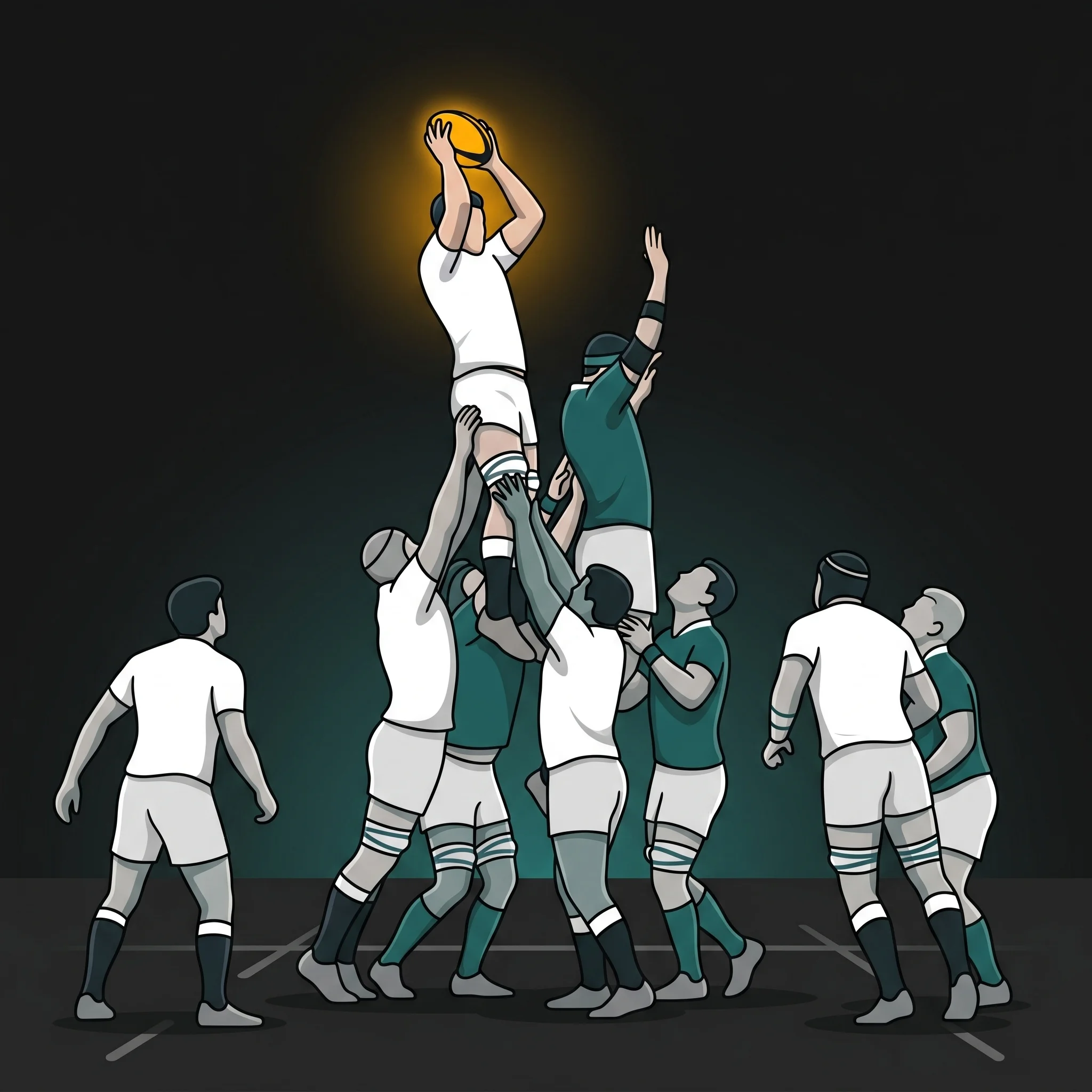
Law 18 in plain English
Touch is the area beside the field of play, from the touchline outwards. Once the ball, or the player carrying it, reaches the touchline or beyond, the ball is in touch and play stops. This law covers three related topics: what counts as "in touch", how to take a quick throw, and the full lineout rules.
---
TOUCH: When is the ball in touch?
- A loose ball is in touch when it touches the touchline or anything beyond it
- A ball being carried is in touch when the ball, or the player holding it, touches the touchline or the ground beyond
- A player standing in touch who catches the ball takes it into touch only if the ball had not yet reached the plane of touch (the space directly above the touchline)
- A player who jumps, catches the ball and lands back in the playing area keeps it in play, even if the ball was above touch when caught
- A player who jumps from the field and knocks the ball back in before landing in touch also keeps it in play
---
QUICK THROW
- Before a lineout forms, the team that would throw in at the lineout may take a quick throw instead
- It must be the same ball, and nobody apart from the thrower or the player who carried it out may have touched it since it went into touch
- The thrower has both feet outside the field of play and stands anywhere between the mark of touch and their own try line
- The ball goes in straight or angled back towards the thrower's own try line, and must reach the 5-metre line before it lands or hits a player
---
LINEOUT A lineout restarts play after the ball goes into touch and no quick throw is taken.
Who throws in:
- Normally the opponents of the team that put the ball into touch
- After a penalty kicked to touch, the kicking team throws in
- After a 50:22 (a kick from inside your own half that goes into touch, but not on the full, in the opposition's 22; see 18.8(a) for the conditions), the kicking team throws in
Where:
- Usually where the ball crossed the touchline, but never within 5 metres of a try line
- A kick that goes out on the full (without landing or touching anyone first) gains no ground: the lineout is level with where it was kicked if that is closer to the kicker's own try line
- Exceptions include penalty kicks, a free-kick awarded inside the kicker's 22, and kicks from inside your own 22 when your team did not take the ball back into the 22 yourselves, or a tackle, ruck or maul happened there, or an opponent touched the ball there
Formation:
- At least 2 players from each team
- The throwing team sets the maximum number; the other team may have fewer but not more, unless the ball is thrown in the moment the lineout forms
- Each team stands in a single line, half a metre from the mark of touch on its own side, between the 5-metre and 15-metre lines
- The team not throwing in must have a player between the touchline and the 5-metre line
- Each team may have one receiver, standing 2 metres away from its lineout
- Under a global law trial, teams have 30 seconds to form the lineout
Throwing in:
- The thrower stands at the mark of touch, feet on or behind the touchline, and must not step into the field until the ball has gone
- The throw must travel straight down the mark of touch to a lineout player, and get as far as the 5-metre line before it lands
- No faking a throw, no delay, and no blocking the throw
- Not straight: under a global law trial, play goes on if the other team did not lift a jumper to compete. If they did, they choose a lineout or a scrum
Lifting:
- Lifters may grip a jumper before the throw, but not lower than the shorts at the back or lower than the thighs at the front
- Nobody may jump, lift or support until the ball has left the thrower's hands
- A lifted player must be brought back to the ground safely as soon as either team wins the ball
Leaving the lineout:
- Once the lineout has started, a lineout player may leave it to get into position to receive the ball, as long as they stay within 10 metres of the mark of touch and keep moving
- Once the ball is thrown, lineout players may go past the 15-metre line, but must come straight back if the ball does not go that far
- Otherwise nobody may leave until the lineout has ended
Offside at the lineout:
- Lineout players: the mark of touch, until the throw has touched a player or the ground, then a line through the ball
- Players not in the lineout: at least 10 metres back from the mark of touch (or their try line if that is closer)
- Once the ball is thrown in, the throwing team's other players may move up, and then their opponents may too
Ending a lineout:
- The ball, or a player holding it, leaves the lineout, goes into the gap between the touchline and the 5-metre line, or goes past the 15-metre line
- A ruck or maul forms and every player's feet in it move past the mark of touch
- The ball becomes unplayable
Sanctions: Contact with an opponent before the throw, offside, leaving the lineout early and bringing down a jumper in the air are penalties. Most formation, lifting and timing offences are free-kicks. A throw-in from the wrong place, or one that falls short, gives the other team the choice of a lineout or a scrum, and so does a throw that is not straight when they contest it.
Law 18 section by section
Ball in Touch
The ball is in touch, or in touch-in-goal, when:
- (a) a loose ball that nobody is holding touches the touchline, the touch-in-goal line or anything beyond them. If the ball is being held, it is in touch once the ball, or the player carrying it, touches one of those lines or the ground beyond.
- (b) a player who is already in touch, by touching the touchline, the touch-in-goal line or the ground beyond, then catches or holds the ball. If the ball had already reached the plane of touch when caught, the catcher is not treated as having taken it into touch. If it had not reached the plane of touch when caught or picked up, the catcher is treated as having taken it into touch, whether the ball was moving or still.
Ball Not in Touch
The ball is not in touch, or in touch-in-goal, when:
- (a) it reaches the plane of touch but a player who is inside the playing area catches, knocks or kicks it.
- (b) a player jumps, from inside or outside the playing area, catches the ball and comes down inside the playing area. It makes no difference whether the ball had reached the plane of touch.
- (c) a player who has jumped from the playing area knocks the ball back in, or catches it and lets it go back in, before landing in touch or touch-in-goal. Again, it makes no difference whether the ball had reached the plane of touch.
- (d) a player standing in touch kicks or knocks the ball, without holding it, before the ball has reached the plane of touch.
Releasing the Ball in Touch
A player who carries the ball into touch must let go of it straight away, so that a quick throw can be taken. Sanction: Penalty.
Taking a Quick Throw
At a quick throw, the ball must be thrown in:
- (a) anywhere from the mark of touch back to the thrower's own try line;
- (b) either straight in, parallel to the try line, or angled back towards the thrower's own try line;
- (c) far enough to reach the five-metre line before it lands or hits a player; and
- (d) by a player with both feet outside the field of play.
Sanction: Option of a lineout or a scrum to the opposition.
Quick Throw Disallowed
A quick throw is not allowed, and the same team throws in at a lineout instead, if:
- (a) the lineout had already formed;
- (b) anyone apart from the thrower, or the player who took the ball into touch, touched it after it went out; or
- (c) the thrower uses a different ball from the one that went into touch.
Quick Throw Distance
At a quick throw, nobody may play the ball until it has reached the five-metre line, and no player may stop it travelling five metres. Sanction: Free-kick.
Quick Throw Inside the 22
If the mark of touch falls outside the 22, the defending team can still take the quick throw from inside their own 22. If they do, they are treated as having taken the ball into the 22 themselves (see Law 18.8(d) for why that matters when the ball is then kicked straight into touch).
Who Throws In and Where
Where a lineout takes place (the mark of touch) and which team throws in depend on how the ball went into touch. Unless an item says otherwise, "the opposition" means the opponents of the team that put the ball into touch.
(a) General play
- 50:22. A player kicks from inside their own half and the ball goes into touch indirectly (not on the full) inside the opposition's 22. It counts if the kicker's team did not bring the ball back into their own half, or if a tackle, ruck or maul happened in that half, or an opponent touched the ball there. It never applies to a kick-off or any other restart kick (see 50:22 in the definitions). Lineout: where the ball crosses the touchline. Throw-in: the kicking team.
- A player carrying the ball goes into touch, or a player's kick goes into touch indirectly (apart from a kick from their own half into touch in the opposition's 22). Lineout: where the player or the ball first touches the touchline or the ground beyond it. Throw-in: the opposition.
- A player accidentally knocks, passes or throws the ball into touch. Lineout: where the ball crosses the touchline. Throw-in: the opposition.
- The ball hits a player and goes straight into touch. Lineout: where the ball crosses the touchline, or the point on the touchline nearest to where it hit the player, whichever is closer to that player's own try line. Throw-in: the opposition.
- The ball hits a player and then bounces into touch. Lineout: where the ball crosses the touchline. Throw-in: the opposition.
- A player standing in touch catches or picks up the ball after it has reached the plane of touch. Lineout: where the ball reached the plane of touch. Throw-in: the team that did not kick it, unless parts (b) to (f) say otherwise.
- A player standing in touch catches or picks up the ball before it has reached the plane of touch. Lineout: where that player is standing. Throw-in: the opposition.
(b) Kicked straight into touch from a kick-off or restart kick
- A kick-off, or the restart kick taken after points are scored, goes directly into touch and the non-kicking team opts for a throw from touch (see Law 12.8). Lineout: where the ball crosses the touchline or on the halfway line, whichever is closer to the kicker's own try line. Throw-in: the non-kicking team.
- A drop-out goes directly into touch and the non-kicking team opts for a throw from touch (see Law 12.13). Lineout: where the ball crosses the touchline or on the drop-out's sanction line (the 22-metre line for a 22-metre drop-out, the five-metre line for a try line drop-out, see Law 12.12), whichever is closer to the kicker's own try line. Throw-in: the non-kicking team.
(c) Kicked from a penalty
- The ball is kicked into touch, either on the full, or after bouncing in the field of play, or after hitting an opponent or the referee. Lineout: where the ball crosses the touchline. Throw-in: the kicking team.
- A player standing in touch catches the ball, whether or not it has reached the touchline. Lineout: where the ball crosses the touchline or, if it had not got that far, where the catcher is standing. Throw-in: the kicking team.
- A player standing in touch picks up the ball before it has reached the plane of touch. Lineout: where that player is standing. Throw-in: the kicking team.
- A genuine kick at goal from a penalty goes into touch. Lineout: where the ball crosses the touchline, but not within five metres of the try line. Throw-in: the non-kicking team.
(d) Kicked straight into touch from inside the kicker's own 22 or in-goal
No gain in ground applies when the defending team took the ball into their own 22 themselves, with no tackle, ruck or maul there and no opponent touching the ball inside the 22. A player standing inside their own 22 who picks up a ball lying outside it, or catches it before it crosses the plane of the 22-metre line, and then kicks it straight into touch from inside the 22, counts as having taken the ball back into the 22.
- No gain in ground: a player kicks the ball directly into touch. Lineout: where the ball crosses the touchline, or the point on the touchline level with where it was kicked, whichever is closer to the kicker's own try line. Throw-in: the non-kicking team.
- No gain in ground: an opposing player standing in touch catches the ball. Lineout: worked out as in the item above. Throw-in: the non-kicking team.
Gain in ground applies when the ball was not taken into the 22 by the defending team, or a tackle, ruck or maul happened inside the 22, or an opponent touched the ball inside the 22.
- Gain in ground: a player kicks the ball directly into touch. Lineout: where the ball crosses the touchline. Throw-in: the non-kicking team.
- Gain in ground: an opposing player standing in touch catches the ball. Lineout: where the ball crosses the touchline. Throw-in: the non-kicking team.
- Gain in ground: a player kicks from a free-kick given inside the 22. Lineout: where the ball crosses the touchline. Throw-in: the non-kicking team.
(e) Kicked straight into touch from outside the 22
- A kick from open play or from a free-kick goes directly into touch. There is no gain in ground. Lineout: where the ball crosses the touchline, or level with where it was kicked, whichever is closer to the kicker's own try line. Throw-in: the non-kicking team.
(f) Lineout options
- After an incorrect throw. Lineout: where the original lineout was. Throw-in: the opponents of the team that threw in.
- After a disallowed quick throw. Lineout: where the lineout would have formed if nobody had tried the quick throw. Throw-in: the same team.
- After an incorrect quick throw. Lineout: where that throw was taken. Throw-in: the opponents of the thrower's team.
- After the ball goes into touch from a knock forward or throw forward. Lineout: where the ball crossed the touchline. Throw-in: the opponents of the player who knocked or threw it forward.
- A penalty or free-kick is awarded for a lineout offence and a lineout is chosen instead (see Law 20.4). Lineout: where the original lineout was. Throw-in: the team that did not offend.
Where a Lineout Forms
A lineout takes place on the mark of touch, which can never be within five metres of a try line.
Two Lines and the Gap
Each team lines up in a single line on its own side, parallel to the mark of touch and half a metre from it, between the five-metre and 15-metre lines. That leaves a gap between the two lines, which must be kept until the ball is thrown in. Sanction: Free-kick.
Minimum Lineout Players
A lineout needs at least two players from each team.
Time to Form a Lineout
Under a global law trial, both teams have 30 seconds from the mark being made to form the lineout. Sanction: Free-kick.
Throwing Team Sets Numbers
The team throwing in decides the most players that either team may have in the lineout.
Matching Lineout Numbers
Unless the throw is taken the moment the lineout forms, the team not throwing in may use fewer lineout players than the throwing team, but not more. Sanction: Free-kick.
Opponent Near the Touchline
The team not throwing in must have one player between the touchline and the five-metre line. That player stands on their own team's side of the lineout, two metres back from the mark of touch and two metres short of the five-metre line. Sanction: Free-kick.
The Receiver
A team may choose to have a receiver. The receiver's place is between the five-metre and 15-metre lines, standing two metres clear of their team-mates in the lineout. No team may have more than one receiver. Sanction: Free-kick.
Leaving a Formed Lineout
Once the lineout has formed:
- (a) players of the throwing team may not leave it, except to swap places with other participating players. Sanction: Free-kick.
- (b) players of the non-throwing team may leave it only so that their numbers do not exceed the throwing team's. Sanction: Free-kick.
Changing Places
Before the ball is thrown, participating players may swap positions in the lineout.
Pre-Gripping a Jumper
Lineout players who are going to lift or support a jumping team-mate may take hold of that team-mate before the throw. From behind they may not hold below the shorts, and from the front they may not hold below the thighs. Sanction: Free-kick.
No Early Jumping or Lifting
No player may jump, or be lifted or supported, until the ball has left the thrower's hands. Sanction: Free-kick.
No Contact Before the Throw
Until the ball has been thrown in, players must not make contact with any opponent. Sanction: Penalty.
Thrower's Position
The thrower takes up position on the mark of touch, with their feet on the touchline or behind it. They may not step into the field of play before the ball has been thrown. Sanction: Option of a lineout or a scrum to the opposition.
A Correct Throw
The throw-in must:
- (a) travel straight down the mark of touch to one of the lineout players. Sanction: Under a global law trial, play goes on if the team not throwing in has not lifted a player to contest the throw. If they have lifted a player to contest it, they may choose a lineout or a scrum, as in (b).
- (b) get as far as the five-metre line before touching the ground. Sanction: Option of a lineout or a scrum to the opposition. If they choose the lineout and that throw is not straight either, the team that threw in originally gets a scrum.
- (c) be thrown without delay once the lineout has formed. Sanction: Free-kick.
No Fake Throw
The thrower must not fake a throw. Sanction: Free-kick.
No Blocking the Throw
No player may block the throw or stop the ball from travelling five metres. Sanction: Free-kick.
When the Lineout Starts
The lineout begins as soon as the ball leaves the thrower's hands.
Thrower and Opponent Options
Once the lineout has begun, the thrower and their immediate opponent are free to:
- (a) join the lineout;
- (b) drop back to their own team's offside line for players not taking part in the lineout;
- (c) stay within five metres of the touchline; or
- (d) move into the receiver position if nobody is in it.
Thrower and Opponent Offside
If the thrower or their immediate opponent goes anywhere else, they are offside. Sanction: Penalty.
What Lineout Players May Do
Once the lineout has begun, a participating player in the lineout is allowed to:
- (a) contest the ball.
- (b) catch the ball or deflect it. Jumpers may use their outside arm for this only when both hands are above their head. Sanction: Free-kick.
- (c) lift a team-mate or support them. They must bring that player back to the ground safely as soon as either team wins the ball. Sanction: Free-kick.
- (d) leave the lineout to get into position to receive the ball, as long as they stay within 10 metres of the mark of touch and keep on the move until the lineout ends. Sanction: Free-kick.
- (e) take hold of an opponent who has the ball and bring them to ground, as long as that opponent is not in the air and no maul has formed. Sanction: Penalty.
Onside at the Lineout
Lineout players are onside as long as they stay on their own side of the mark of touch until the throw has touched a player or the ground.
Jumpers Crossing the Mark
A jumper who crosses the mark of touch and does not catch the ball must go straight back to their own side. Sanction: Penalty.
Lineout Players' Offside Line
Lineout players have the mark of touch as their offside line until the throw has touched a player or the ground. From then on, it moves to a line through the ball.
Ruck or Maul at Lineout
If a ruck or maul forms on the mark of touch, each participating player has two choices:
- (a) become part of the ruck or maul; or
- (b) retreat to their offside line, at the hindmost foot of their team in the ruck or maul.
Moving Beyond 15 Metres
Once the throw has been made, lineout participants are allowed past the 15-metre line. If the ball itself stays short of that line, they must get back into the lineout straight away.
Players Not in the Lineout
Players not involved in the lineout must keep at least 10 metres back from the mark of touch, on their own side, or stay behind their try line if that is closer. A player who is not yet onside when the ball is thrown in is not sanctioned if they retreat to an onside position straight away. Nobody else's action can put them onside.
Moving Up After the Throw
Once a team-mate has thrown the ball in, players of that team who are not in the lineout may move forward. When they do, their opponents may move forward too. If the throw does not travel past the 15-metre line, they escape sanction by returning at once to their offside lines. Sanction: Penalty.
Leaving Before It Ends
No player may leave the lineout before it has ended, except to move into an empty receiver position or to take the ball from a lineout player. Sanction: Penalty.
How a Lineout Ends
The lineout is over when:
- (a) the ball, or a player holding it, leaves the lineout, goes into the channel between the touchline and the five-metre line, or goes past the 15-metre line;
- (b) the lineout produces a ruck or maul and every foot of every player in it has moved past the mark of touch; or
- (c) the ball becomes unplayable.
Real-World Examples
Scenario
A winger leaps from inside the field near the touchline and catches a high kick while the ball is above touch. She lands with both feet inside the field of play.
Outcome
The ball is not in touch, so play carries on. A player who jumps, catches the ball and lands in the playing area keeps it in play, even if the ball had crossed the plane of touch (Law 18.2).
Scenario
The opposition kick the ball into touch. A ball-boy hands the winger a different ball and she takes a quick throw-in.
Outcome
The quick throw is disallowed, because it must be taken with the ball that went into touch. Her team still throws in, but at a lineout where it would have formed (Law 18.5 and 18.8).
Scenario
At a lineout, the hooker's throw drifts towards her own team's side instead of going straight along the mark of touch. The other team had lifted a jumper to contest it.
Outcome
Not a free-kick. Under a global law trial (Law 18.23), the other team may choose a lineout with their own throw, or a scrum 15 metres in from the mark of touch with their own put-in. Had they not lifted anyone to contest the throw, play would simply have carried on.
Scenario
A prop lifts a jumper before the ball has left the hooker's hands.
Outcome
Free-kick to the other team. Nobody may jump, lift or support a jumper until the ball has left the thrower's hands (Law 18.20).
Scenario
A defending winger is not in the lineout. She is still walking back and is only 8 metres from the mark of touch when the ball is thrown in.
Outcome
No sanction as long as she retreats to 10 metres straight away. Players not in the lineout must stay 10 metres back, but a player caught short when the ball is thrown in is not sanctioned if she goes back at once, and no other player can put her onside (Law 18.35).
Common questions
When is the ball in touch in rugby?
A loose ball is in touch when it touches the touchline or anything beyond it, and a carried ball is in touch when the ball or the player holding it touches the touchline or the ground beyond. A player standing in touch who catches the ball takes it into touch only if it had not yet reached the plane of touch. A player who jumps, catches and lands back in the playing area keeps the ball in play. Normally the opponents of the team that put the ball out throw in at the lineout.
How many players are in a rugby lineout?
At least two from each team. The team throwing in sets the maximum, and the other team may have fewer players but not more, unless the throw is taken the moment the lineout forms. Each team stands in a single line half a metre from the mark of touch, between the 5-metre and 15-metre lines. Each team may also have one receiver, and the team not throwing in must have a player between the touchline and the 5-metre line.
How far must a lineout throw travel?
The throw must reach the 5-metre line before it hits the ground, and no player may block it or stop it travelling 5 metres. It must also travel straight down the mark of touch to a lineout player. If it falls short, the other team may choose a lineout or a scrum. If it is not straight, under a global law trial play goes on when the other team did not lift anyone to compete, and they get the lineout or scrum option when they did.
What is a quick throw-in in rugby?
A quick throw is a throw from touch taken before the lineout forms, by the team that would have thrown in at the lineout. It must be the same ball, and nobody but the thrower or the player who carried it out may have touched it since it went into touch. The thrower keeps both feet outside the field of play, stands anywhere between the mark of touch and their own try line, and throws straight in or back towards their own try line so that the ball reaches the 5-metre line before it lands or hits a player.
What is the offside line at a lineout?
For players in the lineout, the offside line is the mark of touch until the throw has touched a player or the ground, and after that it is a line through the ball. Players not in the lineout must stay at least 10 metres back from the mark of touch, or behind their try line if that is closer. Once the ball is thrown in, the throwing team can move up, and then their opponents can too. A player still retreating when the ball is thrown in is not sanctioned if they get back at once.