
Law 19 of 21
Scrum Rules in Rugby: Law 19
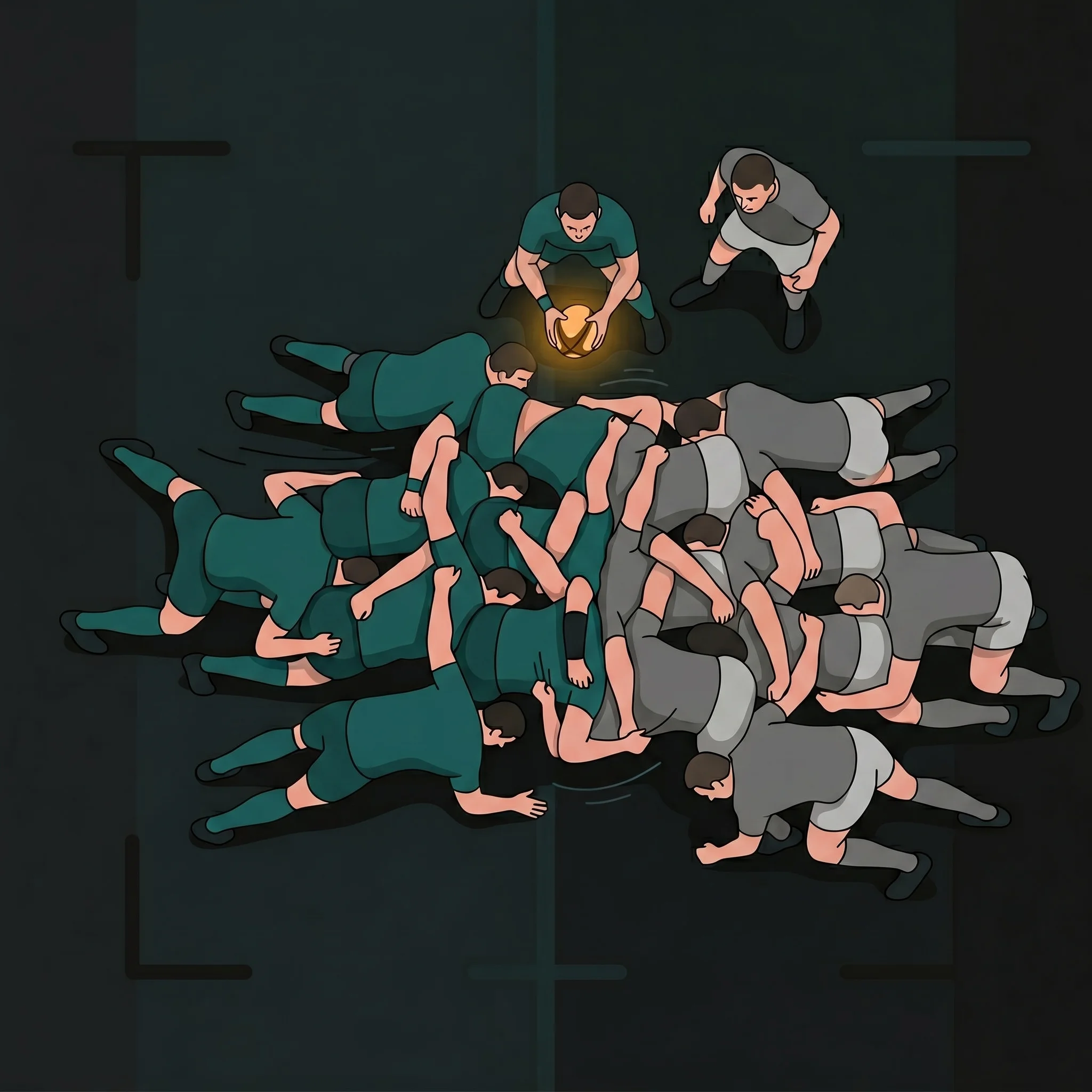
A scrum is a set piece where 8 forwards from each team bind together and contest for the ball. It is used to restart play after minor infringements. The engagement sequence is: crouch, bind, set.
Law 19 in plain English
The scrum restarts play with a contest for the ball after a minor infringement or stoppage. Forwards from both teams bind together and push against each other while the ball is thrown in between them.
When is a scrum awarded?
- After a knock forward or throw forward
- When a tackle, ruck or maul becomes unplayable, or a maul ends unsuccessfully
- When a team chooses a scrum instead of a penalty, after offside in open play or after a faulty kick-off
- When a team does not "use it" at a scrum, ruck or maul
- When the defending team takes the ball into in-goal and it is made dead (the attacking team throws in)
- After a stoppage for injury
Formation:
- With 15 players, each team packs down with eight: a hooker between two props, two locks behind them, then three back-row players
- A team with fewer than 15 players may use fewer in the scrum, but never fewer than five
- Props bind to the hooker, the hooker binds with both arms, the locks bind to the props in front and to each other, and every other player binds onto a lock with at least one arm
Engagement sequence: The referee calls: "Crouch… Bind… Set", each time only when both packs are square, stable and stationary.
- Crouch: The front rows crouch with heads and shoulders no lower than their hips, each head to the left of the opponent's. Hookers set a "brake" foot to keep the scrum steady
- Bind: The loosehead prop puts the left arm inside the opposing tighthead's right arm. The tighthead puts the right arm outside the opposing loosehead's left upper arm. Both grip the back or side of the jersey
- Set: The hookers lift the brake foot and the packs engage, forming the tunnel
- Engaging before "Set" is a free-kick. A front row charging into the opposition is dangerous play and a penalty
Feeding the ball:
- The scrum-half chooses which side to throw in from
- The throw must be straight, quick, without delay and in one forward movement, and the ball must land first inside the tunnel. The scrum-half may line up a shoulder on the middle line of the scrum
- Front-row players may strike for the ball only once it has touched the ground in the tunnel, and the throwing team's hooker must strike
- No one may push until the ball has left the scrum-half's hands
Playing the ball:
- Players in the scrum may play the ball only with their feet or lower legs, and must not lift it
- Pushing must be straight and parallel to the ground
- The scrum ends when the ball comes out (other than through the tunnel), when the player at the back picks it up or the scrum-half plays it there, when the number 8 picks it up from a lock's feet, when it reaches the try line, or when the referee blows for an infringement
- If the scrum has stopped moving and the ball has sat ready at the back for three to five seconds, the referee calls "use it" and the ball must come out at once
Scrum offside:
- Players not in the scrum must stay at least 5 metres behind their team's hindmost foot. If that foot is in in-goal or within 5 metres of their try line, the try line is their offside line instead
- Before the throw, the scrum-half not throwing in stands next to the opposing scrum-half on their own side of the middle line, or at least 5 metres back
- Once play starts, the scrum-half with the ball keeps at least one foot level with or behind it. The other scrum-half stays close to the scrum with neither foot past the centre line of the tunnel (a global law trial), or retires for good to the offside line at the hindmost foot, or at least 5 metres back
Collapsed scrum: If a scrum collapses, or a player is lifted or forced up out of it, the referee must blow the whistle at once so the pushing stops. If no one infringed, the scrum is reset and the same team throws in. Deliberately collapsing a scrum is dangerous play and a penalty.
Uncontested scrums: If a team cannot field a suitably trained front row, or the referee orders it, scrums become uncontested (Law 3.13). The team throwing in wins the ball without a contest and neither side may push.
Sanction: A penalty for binding faults, crooked pushing, dangerous play and offside. A free-kick for technical faults such as a bad throw, engaging or pushing early, striking too soon or being slow to form the scrum.
Law 19 section by section
Scrum Location and Throw-In
This table sets out where the scrum goes and which team throws in. "Nearest point" means the spot in the scrum zone that is closest to the place named.
- Knock forward or throw forward in the field of play, other than at a lineout: nearest point to the offence. The non-offending team throws in.
- Knock forward or throw forward at a lineout, a faulty lineout throw or a faulty quick throw: 15 metres infield from the mark of touch. The non-offending team throws in.
- Offside in open play, when the scrum option is chosen: nearest point to where the offenders last played the ball. The non-offending team throws in.
- A penalty, when the scrum option is chosen: nearest point to the infringement. The non-offending team throws in.
- The defending team plays or carries the ball into in-goal and it is made dead: nearest point to where it was made dead. The attacking team throws in.
- An unplayable tackle or ruck: nearest point to the tackle or ruck. The team that was last moving forward throws in.
- A maul that ends unsuccessfully: nearest point to where the maul ended. The team that did not have the ball when the maul began throws in. If the referee cannot tell which team had it, the team last moving forward before the maul stopped throws in.
- A maul that becomes unplayable after an opponent's kick in open play: nearest point to the maul. The team that had the ball when the maul began throws in.
- A faulty kick-off or restart kick, when the scrum option is chosen: in the scrum zone, as close as possible to the middle of the line the kick was taken from behind. The non-kicking team throws in.
- Failure to "use it" at a scrum, ruck or maul: nearest point to where it happened. The team without the ball throws in.
- The ball or ball-carrier hits the referee and either team gains an advantage: nearest point to the incident. The throw-in goes to the team that played the ball last.
- Play stopped for an injury: in the scrum zone at the spot where the ball was last played. The team that last had the ball throws in.
- A scrum reset with no infringement: the same place as the first scrum. The team first awarded the scrum throws in.
- A penalty kick at goal not taken within the time limit: nearest point to where the penalty was given. The non-offending team throws in.
- The ball kicked dead through in-goal, when the scrum option is chosen: nearest point to where it was kicked. The non-kicking team throws in.
- A penalty kick or free-kick not taken properly, or not taken as first indicated: at the place of the infringement. The non-offending team throws in.
- A scrum given for any other reason the laws do not cover: nearest point to where play stopped. The team last moving forward throws in.
Forming at the Mark
The scrum forms in the scrum zone, on a mark the referee shows.
The Middle Line
The referee's mark sets the scrum's middle line. That line runs parallel to the try lines.
Thirty Seconds to Form
Once the mark is made, both teams have 30 seconds to be ready to form the scrum. Sanction: Free-kick.
Eight-Player Formation
When both teams have 15 players, each side packs down with eight players bound together in the formation shown in World Rugby's diagram (subject to Law 19.7(d)). The front row is two props and one hooker, the second row is two locks, and three back-row players make up the rest. Sanction: Penalty.
Scrums With Fewer Players
If a team is down to fewer than 15 players for any reason, the number of players in the scrum may be cut to match. When one team makes an allowed cut, the other team does not have to do the same. A team's scrum must always have at least five players (see also Law 3.15).
How Players Bind
Players in the scrum bind like this:
- (a) Each prop binds onto the hooker.
- (b) The hooker binds using both arms, going either over or under the props' arms.
- (c) Each lock binds to the prop directly in front and to the other lock.
- (d) Every other player in the scrum binds onto a lock's body using at least one arm.
Sanction: Penalty.
Packs Face Each Other
The two packs face each other, one on each side of the middle line and parallel to it.
Front Rows at the Mark
The front rows stand no more than an arm's length apart, with both hookers on the mark.
The Crouch Call
The referee calls "crouch" once both packs are square, stable and stationary.
- (a) The front rows take up a crouched position if they are not in one already. Their heads and shoulders must be no lower than their hips, and they hold that position for the whole scrum.
- (b) Each front-row player crouches with their head to the left of their direct opponent's head, so that no head touches an opponent's neck or shoulders.
- (c) Each hooker places a 'brake' foot to keep the scrum stable and to avoid axial loading.
Sanction: Free-kick.
The Bind Call
The referee calls "bind" once both packs are again square, stable and stationary.
- (a) Each loosehead prop puts the left arm inside the opposing tighthead's right arm. Sanction: Penalty.
- (b) Each tighthead prop puts the right arm outside the opposing loosehead's left upper arm. Sanction: Penalty.
- (c) Each prop grips the back or the side of the opponent's jersey. Sanction: Penalty.
- (d) Every player keeps their bind, in the position it started in, until the scrum is over. Sanction: Penalty.
- (e) A hooker may adjust the brake foot, as long as it still acts as a brake. Sanction: Free-kick.
The Set Call
The referee calls "set" once both packs are square, stable and stationary and each hooker is still using the brake foot.
- (a) Only after this call may the hooker take the brake foot away and the packs engage. Engaging completes the scrum and forms the tunnel the ball goes into.
- (b) Every player must be in place and ready to push forward.
- (c) Every front-row player keeps both feet on the ground and their weight firmly on at least one foot.
- (d) Both of a hooker's feet are level with, or behind, the front foot of their own team's props.
Sanction: Free-kick.
Choosing the Side
The scrum-half decides which side of the scrum to throw the ball in from.
Holding the Ball
The scrum-half holds the ball in the way World Rugby's diagram shows.
Throwing In the Ball
The scrum-half throws the ball in once both packs are square, stable and stationary. The throw must be:
- (a) From the side the scrum-half chose.
- (b) From outside the tunnel.
- (c) Made without delay.
- (d) A single forward movement.
- (e) Quick.
- (f) Straight. The scrum-half may line up their shoulder on the scrum's middle line, which means standing a shoulder-width nearer their own side of the scrum.
- (g) Aimed so that the ball's first contact with the ground is inside the tunnel.
Sanction: Free-kick.
When the Scrum Begins
The scrum starts as soon as the ball leaves the scrum-half's hands.
No Early Pushing
Neither team may push until the scrum has begun. Sanction: Free-kick.
Winning the Ball by Pushing
A team may win the ball by driving its opponents backwards and off it.
Pushing Straight
Players may push, as long as they push straight and parallel to the ground. Sanction: Penalty.
Striking for the Ball
Front-row players may strike for the ball to win it, but only after it has touched the ground in the tunnel. Sanction: Free-kick.
One Foot at a Time
A front-row player striking for the ball may use either foot, but not both feet together. Sanction: Penalty.
Hooker Must Strike
The hooker of the team that threw the ball in must strike for it. Sanction: Free-kick.
Kicking Out of the Tunnel
A front-row player must not deliberately kick the ball back out of the tunnel on the side it was thrown in from. Sanction: Free-kick.
Feet Only in the Scrum
Any player in the scrum may play the ball, but only with the feet or lower legs, and must not lift it. Sanction: Penalty.
Collapsed or Lifted Scrum
If the scrum collapses, or a player in it is lifted or forced up out of it, the referee must blow the whistle at once so that everyone stops pushing.
Use It Call
Once the scrum has stopped moving and the ball has sat available at the back for three to five seconds, the referee calls "use it". The team with the ball must then get it out of the scrum straight away. Sanction: Scrum, thrown in by the team not in possession (see Law 19.1).
Staying Onside
Players must stay onside for the whole of the scrum. Sanction: Penalty.
Scrum-Half Before the Throw
Before play in the scrum starts, the scrum-half of the team not throwing in must stand either:
- (a) Next to the opposing scrum-half, on their own team's side of the middle line, or
- (b) Five metres or more behind the hindmost foot of the last player in their team's scrum, staying there until the scrum is over.
Sanction: Penalty.
Scrum-Half in Possession
Once play in the scrum has started, the scrum-half of the team with the ball keeps at least one foot either level with the ball or behind it.
Scrum-Half Not in Possession
Once play in the scrum has started, the scrum-half of the team without the ball must do one of these:
- (a) Under a global law trial, stay near the scrum with neither foot past the centre line of the tunnel, or
- (b) Move back for good to a point on the offside line at their team's hindmost foot, or
- (c) Move back for good to a point five metres or more behind the hindmost foot.
Sanction: Penalty.
Other Players Five Metres Back
Every player not taking part in the scrum stays at least five metres behind their team's hindmost foot. Sanction: Penalty.
Scrums Near the Try Line
If a team's hindmost foot is in its in-goal, or within five metres of its own try line, the offside line for that team's other players is the try line. Sanction: Penalty.
Offside Ends With the Scrum
Offside lines stop applying the moment the scrum ends.
Resetting the Scrum
If nobody has infringed, the referee stops play and resets the scrum when:
- (a) The scrum-half throws the ball in and it comes out of either end of the tunnel.
- (b) The scrum breaks up or collapses before ending in some other way.
- (c) The scrum is wheeled more than 90 degrees, so the middle line has turned past parallel with the touchline.
- (d) Neither team wins the ball.
- (e) The ball is kicked out of the tunnel by accident. If the ball keeps being kicked out, the referee must treat it as deliberate. Sanction: Penalty.
Throw-In After a Reset
After a reset, the team that threw in last time throws in again.
When the Scrum Ends
The scrum is over when:
- (a) The ball leaves the scrum in any direction except through the tunnel.
- (b) The ball reaches the hindmost player's feet and that player picks it up, or their team's scrum-half plays it.
- (c) The number eight picks the ball up from a second-row player's feet.
- (d) The referee blows the whistle for an infringement.
- (e) The ball in the scrum is on or over the try line.
Dangerous Play in a Scrum
These all count as dangerous play in a scrum (see also Law 9.19):
- (a) A front row charging into the opposition.
- (b) Pulling an opponent.
- (c) Deliberately lifting an opponent off their feet, or forcing them up and out of the scrum.
- (d) Deliberately collapsing the scrum.
- (e) Deliberately falling or kneeling.
Sanction: Penalty.
Other Restricted Practices
Other practices that are not allowed at a scrum:
- (a) Falling on or over the ball just after it comes out of the scrum. Sanction: Penalty.
- (b) The scrum-half kicking the ball while it is still in the scrum. Sanction: Penalty.
- (c) A player outside the front row holding or pushing an opponent. Sanction: Penalty.
- (d) Returning the ball into the scrum after it has come out. Sanction: Free-kick.
- (e) Players outside the front row playing the ball while it is in the tunnel. Sanction: Free-kick.
- (f) The scrum-half trying to fool an opponent into thinking the ball is out when it is still in the scrum. Sanction: Free-kick.
Under-19 Scrum Variations
A union may use World Rugby's under-19 scrum law variations at chosen levels of the game in its own territory.
Real-World Examples
Scenario
A centre knocks the ball forward. The referee stops play and awards a scrum to the defending team.
Outcome
The scrum forms in the scrum zone at the point nearest the knock-on, and the defending team throws in as the non-offending team (Law 19.1). The referee calls crouch, bind and set, then the defending team's scrum-half throws the ball into the tunnel.
Scenario
During engagement, the loosehead prop pushes into the opposing front row before the referee calls "Set."
Outcome
Free-kick to the opposition. The packs may engage only once the referee calls "set" (Law 19.12). If the front row charges into the opposition, that is dangerous play and the sanction is a penalty (Law 19.37).
Scenario
The scrum-half feeds the scrum, but the ball enters the tunnel angled towards her own hooker's feet.
Outcome
Free-kick to the opposition. The throw must be straight (Law 19.15). The scrum-half may line up a shoulder on the scrum's middle line, but may not angle the ball towards their own side.
Scenario
The ball reaches the number 8's feet at the back of the scrum. The blindside flanker, still bound in, reaches down and picks it up before the number 8 does.
Outcome
Penalty to the opposition. While the ball is still in the scrum, players may play it only with their feet or lower legs and must not lift it (Law 19.24). The scrum would have ended legally if the number 8 had picked it up or the scrum-half had played it (Law 19.36).
Scenario
A defending loosehead prop deliberately drops to one knee to bring down the scrum.
Outcome
Penalty to the opposition. Deliberately kneeling and deliberately collapsing a scrum are both dangerous play (Law 19.37). The referee must blow the whistle as soon as the scrum collapses (Law 19.25).
Common questions
How many players are in a rugby scrum?
When both teams have 15 players, each side puts eight players in the scrum: two props and a hooker in the front row, two locks in the second row and three back-row players. A team with fewer than 15 players may use fewer in the scrum, but never fewer than five. Every player must bind in the way Law 19.7 sets out.
What is the engagement sequence in a rugby scrum?
The referee calls "crouch", then "bind", then "set", each time only once both packs are square, stable and stationary. On crouch, the front rows crouch with heads and shoulders no lower than their hips. On bind, each loosehead puts the left arm inside the opposing tighthead's right arm, each tighthead puts the right arm outside the loosehead's left upper arm, and both grip the back or side of the jersey. On set, the hookers lift their brake foot and the packs engage. Engaging before "set" is a free-kick, and a front row charging into the opposition is a penalty.
Who feeds the scrum in rugby?
The scrum-half of the team throwing in feeds it, from whichever side of the scrum they choose. The throw must be straight, quick, without delay and in one forward movement, and the ball must land first inside the tunnel. The scrum-half may line up a shoulder on the scrum's middle line. A faulty throw is a free-kick to the opposition.
What is an uncontested scrum in rugby?
Scrums become uncontested when a team is unable to field a suitably trained front row, or when the referee orders it. The team throwing in wins the ball without a contest, and neither side may push. Uncontested scrums caused by a sending off, a yellow card or an injury must still have eight players per side.
What happens if a scrum collapses?
The referee must blow the whistle straight away so the players stop pushing. If no one infringed, the scrum is reset and the same team throws in again. Deliberately collapsing a scrum is dangerous play and a penalty to the other team. It is also foul play under Law 9.19, so the player must at least be cautioned and can be shown a yellow or red card.