
Law 10 of 21
Offside Rule in Rugby: Law 10
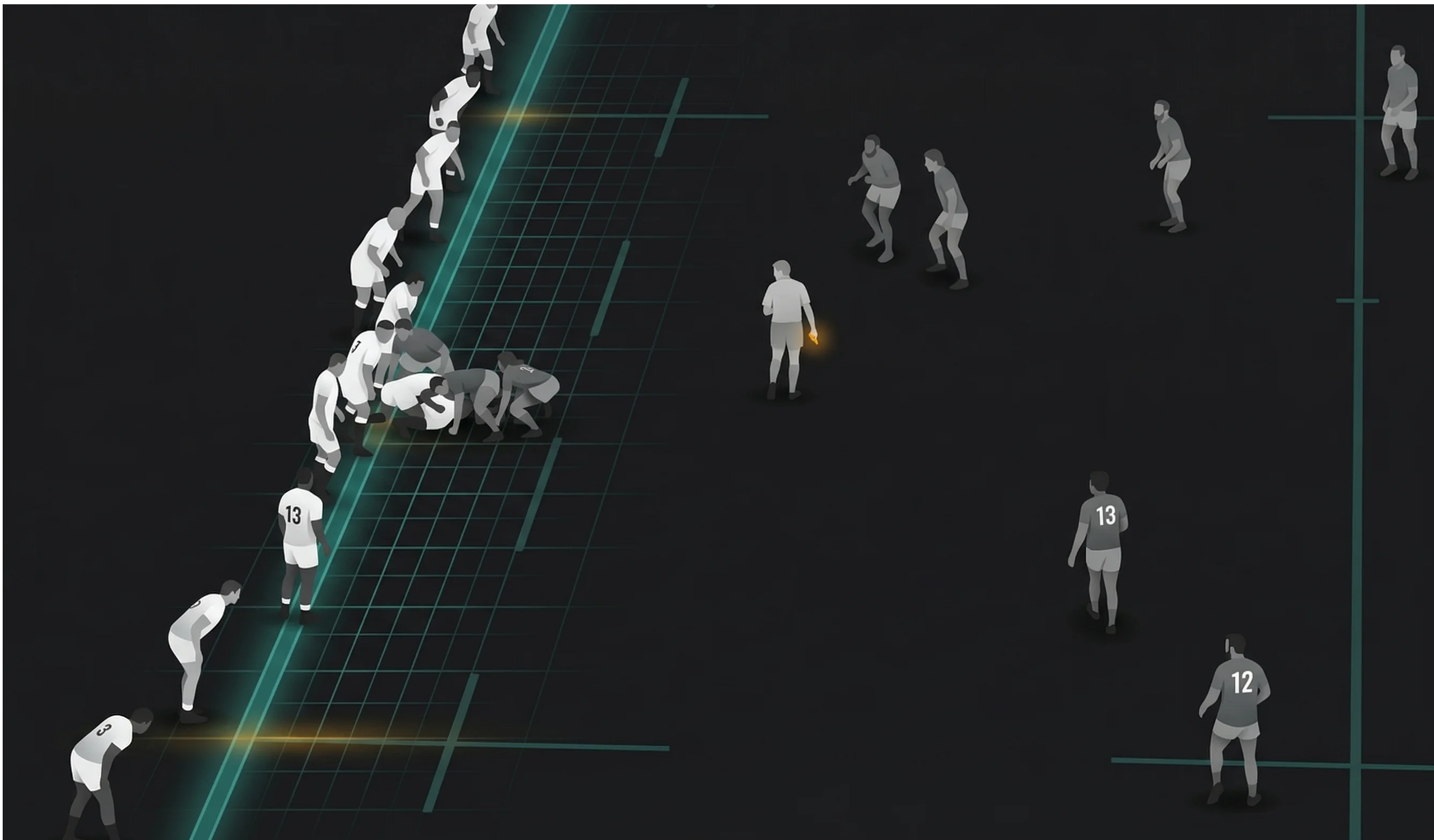
A player is offside if they are in front of the ball when it was last played by a teammate. An offside player must not interfere with play.
Law 10 in plain English
Offside is one of rugby's most important laws. It's also one of the most misunderstood.
The basic rule: In open play you are offside if you are in front of a team-mate who has the ball, or who played it last. "In front" means nearer the opponents' try line. When the last action was a kick, the kicker's kicking foot marks the line.
Being offside isn't always an offence. You can stand in an offside position, but you must not take part in play. You can be penalised if you:
- Play the ball, tackle the ball-carrier or stop the opponents playing the way they want to
- Loiter in an offside position, or make no effort to get back and then get involved
- Move towards the ball
- Fail to retreat after a team-mate's kick when the 10-metre law applies (below)
Getting back onside: You are put onside when:
- You get behind the team-mate who last played the ball, or behind a team-mate who is onside
- An onside team-mate runs past you
- An opponent kicks the ball, or deliberately touches it without gaining possession
- The ball goes into touch, as long as you were keeping to the laws until then
Since July 2024, an opponent running 5 metres with the ball, or passing it, no longer puts you onside in open play. Running 5 metres still counts for players who are offside after a ruck, maul, scrum or lineout (Law 10.10).
The 10-metre law for kicks: If you are in front of a team-mate who kicks, you must immediately retreat behind an onside team-mate or behind an imaginary line 10 metres from where the ball lands or is caught. While this applies, a team-mate running past you or an opponent kicking or touching the ball does not put you onside. Only getting behind an onside team-mate, or a charge-down, does.
Sanction: For offside in open play, the non-offending team chooses a penalty where the offence happened or a scrum at the place the offending team last played the ball. Accidental offside is a scrum. A player still offside after a ruck, maul, scrum or lineout gives away a penalty if they interfere, move towards the ball, or are slow to retreat and gain from it.
Law 10 section by section
Offside in Open Play
In open play, a player is offside when they are in front of a team-mate who has the ball or who played it last. When the last action was a kick, the kicker's kicking foot marks the offside line. An offside player must not take part in play. This covers:
- (a) Playing the ball.
- (b) Tackling the player with the ball.
- (c) Stopping the opponents from playing the way they want to.
- (d) Loitering, meaning staying in an offside position.
Where Offside Applies
Offside applies in every part of the playing area, which means the field of play and both in-goal areas.
Unintentional Throw Forward
A player who receives an accidental forward pass from a team-mate is not offside because of it. The forward pass itself is dealt with under Law 11.
When Offside Is Penalised
An offside player can be penalised if they:
- (a) Make no effort to get back and then interfere with play; or
- (b) Move towards the ball; or
- (c) Were in front of a kicking team-mate and do not immediately retreat behind an onside team-mate, or behind an imaginary line across the pitch 10 metres on their own side of where the ball is caught or lands. This applies even if the ball first hits a goal post or the crossbar. When more than one player is involved, the player nearest the landing or catching point is the one penalised. This is called the 10-metre law. A kick that is charged down, or touched by someone attempting a charge-down, does not trigger it.
Sanction: The non-offending team chooses either a penalty where the offence happened or a scrum at the place the offending team last played the ball.
Accidental Offside
A player is accidentally offside when they are touched by the ball, or by a team-mate carrying it, and could not avoid it. The referee stops play only when the offending team benefits. Sanction: Scrum.
Moving Back Onside
Any offside player can make themselves onside by:
- (a) Getting behind the team-mate who last played the ball; or
- (b) Getting behind a team-mate who is onside.
Put Onside by Others
Apart from a player caught by the 10-metre law (see Law 10.4c), an offside player is also put onside when:
- (a) An onside team-mate runs past them and is inside the playing area, or has come back into it.
- (b) An opponent (i) kicks the ball, or (ii) deliberately touches the ball without gaining possession of it.
- (c) The ball has gone into touch, provided the player had kept to the laws until then.
Ten-Metre Law and Opponents
A player caught by the 10-metre law (see Law 10.4c) cannot be put onside by anything an opponent does, except a charge-down.
Offside After a Phase Ends
Being offside at a ruck, maul, scrum or lineout does not stop when that phase ends. The player stays offside after the ruck, maul, scrum or lineout is over.
Onside After a Phase
That player can only be put onside if:
- (a) They immediately retreat behind the offside line that applies; or
- (b) An opponent carries the ball 5 metres in any direction; or
- (c) An opponent kicks the ball.
Penalties After a Phase
That offside player can be penalised if they:
- (a) Are slow to retreat and gain from being put onside in a better position; or
- (b) Interfere with play; or
- (c) Move towards the ball.
Sanction: Penalty.
Real-World Examples
Scenario
A fly-half kicks the ball upfield. Three of her backs were in front of her at the moment she kicked. They run forward toward the ball.
Outcome
These three players are offside, and moving towards the ball is an offence in itself (Law 10.4). They should stop and retreat. They are put onside if they get behind the kicker or another onside team-mate, if an onside team-mate runs past them, or if an opponent kicks the ball or deliberately touches it. Any of them within 10 metres of where the ball lands are caught by the 10-metre law: for them, only getting behind an onside team-mate, or a charge-down, helps (Law 10.4c, 10.8). If they keep moving towards the ball, the opponents choose a penalty or a scrum where the kick was taken.
Scenario
A winger is 5 metres in front of the kicker when a chip kick is made. The ball lands 8 metres in front of the winger.
Outcome
The winger is within 10 metres of where the ball lands, so the 10-metre law applies. They must immediately retreat behind an imaginary line 10 metres on their side of where the ball lands, or behind an onside team-mate. Nothing the opponents do puts them onside, apart from a charge-down (Law 10.4c, 10.8).
Scenario
A centre is in an offside position following a kick, well away from where the ball lands. The opposition fullback catches the ball and runs forward more than 5 metres.
Outcome
The centre is still offside. Since July 2024, an opponent running 5 metres with the ball no longer puts an open-play offside player onside. The centre must not loiter or get involved, and stays offside until they get behind an onside team-mate, an onside team-mate runs past them, or an opponent kicks or deliberately touches the ball (Law 10.1, 10.7).
Scenario
During open play, a prop passes the ball backward to the scrum-half. Three teammates who were in front of the prop have jogged back and are behind the scrum-half when she catches it.
Outcome
They are onside. In open play a player is offside only when in front of the team-mate who has the ball or who last played it. Once the scrum-half holds the ball, anyone behind her is onside, and an offside player who moves behind that team-mate is put onside (Law 10.1, 10.6).
Common questions
What is offside in rugby?
In open play, a player is offside when they are in front of a team-mate who has the ball or who last played it. Standing in an offside position is not an offence in itself. It becomes one when the player takes part in play, for example by playing the ball, tackling, loitering in the way of the opponents or moving towards the ball (Law 10.1, 10.4).
What is the 10-metre rule in rugby?
When a team-mate kicks, any player in front of the kicker who is within 10 metres of where the ball lands or is caught must immediately retreat behind an onside team-mate or behind an imaginary line across the pitch 10 metres from that spot. It still applies if the ball hits a post or the crossbar first, but not when the kick is charged down. If several players are caught, the one nearest the ball is penalised (Law 10.4c).
How do you get put onside in rugby?
In open play you are put onside when you move behind the team-mate who last played the ball or behind an onside team-mate, when an onside team-mate runs past you, when an opponent kicks the ball or deliberately touches it without gaining possession, or when the ball goes into touch and you had kept to the laws until then. If the 10-metre law applies to you after a team-mate's kick, only getting behind an onside team-mate or an opponent's charge-down puts you onside (Law 10.6, 10.7, 10.8).
What is the penalty for offside in rugby?
For offside in open play, the non-offending team chooses either a penalty where the offence happened or a scrum at the place the offending team last played the ball. Accidental offside, by a player who could not avoid being hit by the ball or by a team-mate carrying it, leads to a scrum, and only if the offending team gains an advantage. A player still offside after a ruck, maul, scrum or lineout gives away a penalty if they interfere, move towards the ball, or are slow to retreat and gain from it (Law 10.4, 10.5, 10.11).
Can an opponent put you onside?
Yes. In open play, an opponent puts you onside by kicking the ball or by deliberately touching it without gaining possession. Since July 2024, an opponent running 5 metres or passing no longer does. If you are caught by the 10-metre law after a team-mate kicks, nothing an opponent does puts you onside except a charge-down (Law 10.7, 10.8).