
Law 20 of 21
Penalty Kick and Free Kick: Law 20
Penalties are awarded for serious infringements and allow the kicker to attempt a goal or kick to touch. Free-kicks are for minor infringements and cannot score directly.
Law 20 in plain English
Penalties and free-kicks restart play after the other team breaks a law. A penalty is for a more serious offence and gives more options.
---
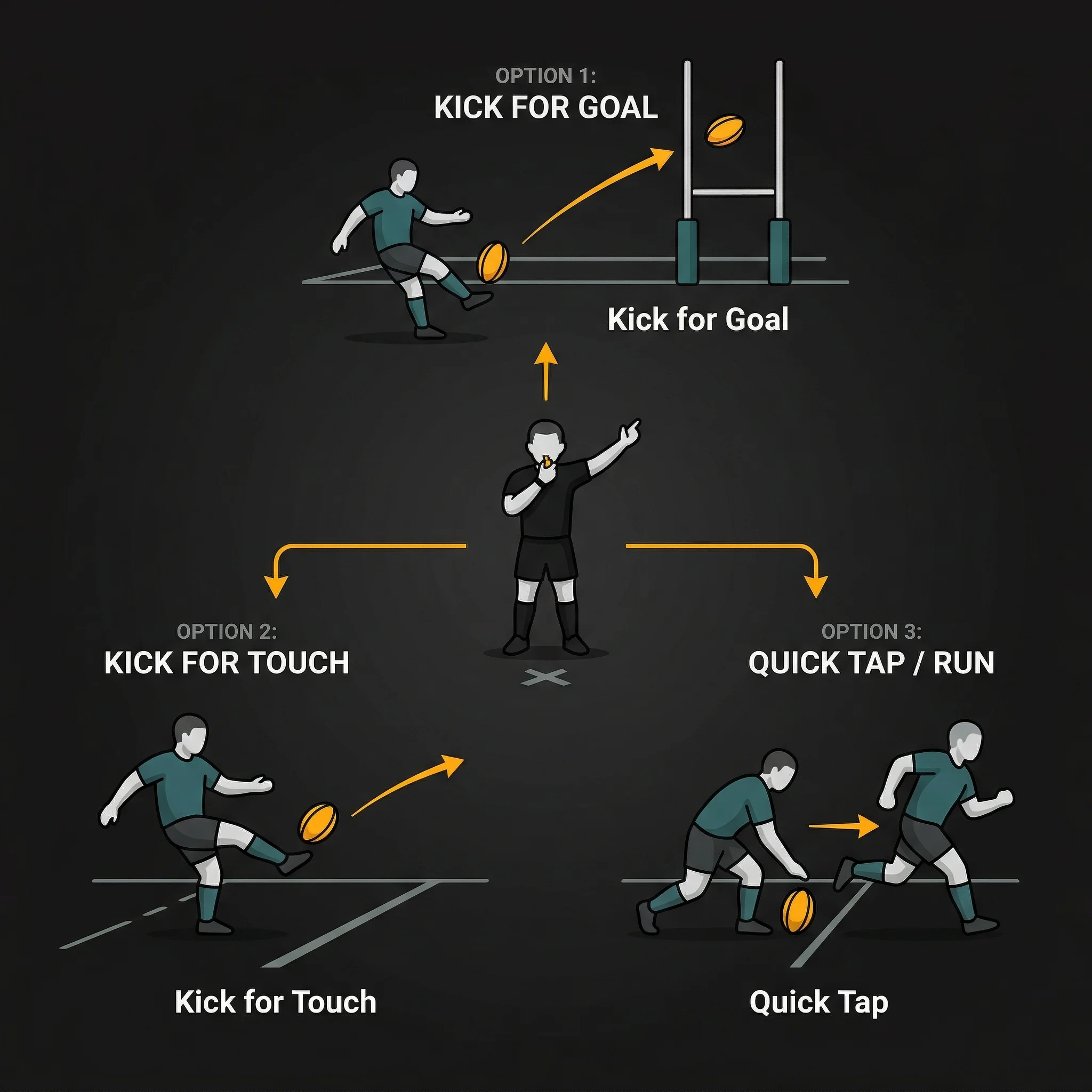
PENALTY KICK The team awarded a penalty can choose to:
1. Kick at goal: A place-kick or drop-kick that goes over the crossbar and between the posts scores a penalty goal worth 3 points (Law 8.1, 8.4). A punt can never score a goal, because World Rugby defines a goal as a place-kick or drop-kick. 2. Kick to touch: The kicking team throws in at the lineout, where the ball crossed the touchline, whether it went out on the full or bounced first (Law 18.8). A place-kick cannot be used to find touch (Law 20.8). If a genuine kick at goal goes into touch, the other team throws in. 3. Tap and go: Kick the ball a short but visible distance and play on (Law 20.11). 4. Scrum: Take a scrum instead (Law 20.3). At a lineout, the team may also take a lineout instead (Law 20.4).
The kick is taken at the mark or further back, on a line through the mark parallel to the touchlines (Law 20.2).
---
FREE-KICK A free-kick is for a less serious offence, or is won by calling a mark (Law 17). The team can kick for position or tap and go, but:
- No scrum option. Since July 2024 a free-kick cannot be swapped for a scrum. At a lineout, the team may take a lineout instead (Law 20.4).
- No goal straight away. The team cannot score a dropped goal before the ball has next gone dead, or before an opponent has played or touched the ball or tackled the ball-carrier. An earlier attempt is treated as unsuccessful and play continues (Law 8.29). A penalty goal can only come from a penalty (Law 8.18).
- Touch gives the throw away. If a free-kick is kicked directly into touch, the other team throws in at the lineout (Law 18.8).
- Opponents may charge. As soon as the kicker starts the kicking movement, opponents may rush the kicker and try to tackle them or block the kick (Law 20.16).
---
AT EVERY PENALTY AND FREE-KICK
- The kick must be taken without delay, using the ball that was in play (Law 20.5, 20.7)
- The kicker's team-mates stay behind the ball until it is kicked, apart from a placer (Law 20.10)
- Opponents must at once retreat 10 metres towards their own try line, or to that try line if it is nearer (Law 20.12)
- Quick taps: Opponents must keep retreating even when the kick is taken quickly, and cannot take part until they have. If the kick was so quick they had no chance to retreat, they are not penalised, but they still cannot take part until they are 10 metres back or a team-mate who was 10 metres back has gone past them (Law 20.13, 20.14)
- Opponents must not delay the kick, obstruct the kicker, or take, throw or kick the ball away (Law 20.15)
Penalty try: If foul play stops a probable try, or stops a try being scored in a better position, the referee awards a penalty try between the posts. It is worth 7 points, no conversion is taken, and the offender must be shown a yellow card or sent off (Law 8.3).
Sanctions: If the opponents do not retreat or they delay the kick, the mark moves 10 metres forward for a second penalty or free-kick. If the team awarded the kick delays it, uses a different ball, has players in front of the ball or does not kick it a visible distance, the other team gets a scrum (Law 20.5, 20.7, 20.10, 20.11). A kick taken from the wrong place is simply taken again (Law 20.2).
Law 20 section by section
Where the Mark Is
The mark for a penalty or free-kick is always in the field of play and never closer than 5 metres to the try line. Where it goes depends on the offence:
- Offence while the ball is in play, other than a late charge on a kicker: at the place of the offence.
- Offence while the ball is dead: where play would have restarted. If that spot is within 15 metres of the touchline, or on it, the mark moves to the 15-metre line opposite. Where the restart would have been a drop-out, the non-offending team picks any point on its sanction line.
- Offence committed off the playing area during play: on the 15-metre line opposite the offence. If it happened in touch-in-goal or past the dead-ball line, the mark is on the 5-metre line opposite the offence, at least 15 metres in from the touchline.
- Offence at a lineout: on the mark of touch, 15 metres in from the touchline.
- Offside at a phase of play: on the offending team's offside line.
- A further offence by the same team after the first penalty or free-kick is given but before it is taken: 10 metres further forward than the original mark.
- Late charge on the kicker: the non-offending team chooses between the place of the offence, where the ball landed, and where it was next played before landing. A late charge in the kicker's in-goal gives a penalty 5 metres out from the try line, opposite the offence and at least 15 metres in from the touchline. The landing or next-played option is never less than 15 metres in from the touchline. So if the ball lands in touch, or lands or is played within 15 metres of the touchline, the mark moves to the 15-metre line opposite that spot. A ball landing in in-goal or touch-in-goal, or on or beyond the dead-ball line, gives an option 5 metres out, opposite the point where the ball crossed the try line, again at least 15 metres in from the touchline. If the ball strikes a goal post or the crossbar, the option is where it comes down.
- Throwing or knocking the ball into touch on purpose: from the playing area into touch, touch-in-goal or over the dead-ball line, the mark is at the offence, but at least 15 metres from the touchline and 5 metres from the try line. From in-goal into touch or touch-in-goal, it is on the 5-metre line, at least 15 metres in from the touchline. From in-goal over the dead-ball line, it is on the 5-metre line opposite the offence.
- Any offence in in-goal or within 5 metres of a try line: 5 metres out from the try line in the field of play, opposite the offence.
Taking It From the Mark
The kicker takes the penalty or free-kick at the mark or further back, anywhere on a line through the mark that runs parallel to the touchlines. If it is taken from the wrong place, it has to be taken again.
Scrum Instead of a Penalty
A team given a penalty can choose to take a scrum instead (see Law 19.1). This option exists only for a penalty, not for a free-kick.
Options at a Lineout
When the offence happens at a lineout:
- A team given a penalty may instead choose a lineout or a scrum on the same mark.
- A team given a free-kick may instead choose a lineout on the same mark.
Take It Without Delay
The team must take the penalty or free-kick without delay. Sanction: Scrum.
Who Takes the Kick
Any player of the non-offending team may take it. The exception is a free-kick won by calling a mark, which the player who claimed the mark takes (see Law 17.5 and 17.6).
Use the Match Ball
The kicker has to use the ball that was in play. A different ball is only allowed if the referee rules that ball defective. Sanction: Scrum.
Types of Kick Allowed
The kicker may punt, drop-kick or place-kick the ball, except that a place-kick cannot be used to kick for touch. Only a place-kick or a drop-kick can score a goal (World Rugby's definition of a goal), so a punt cannot be a penalty goal.
Kick in Any Direction
The ball may be kicked in any direction.
Kicker's Team Stays Behind
Apart from a placer holding the ball for a place-kick, the kicker's team-mates must stay behind the ball until it is kicked. Sanction: Scrum.
Kick a Visible Distance
The ball must be kicked a clearly visible distance. A ball kicked from the hands must clearly leave them, and a ball kicked from the ground must clearly leave the mark. After a properly taken kick, the kicker is allowed to play the ball again. Sanction: Scrum.
Opponents Retreat 10 Metres
As soon as a penalty or free-kick is given, the opposing team must retreat at once 10 metres towards their own try line, or as far as that try line if it is nearer. Sanction: A further penalty or free-kick, moved 10 metres forward from the original mark. It cannot be taken until the referee has set the new mark.
Keep Retreating
Opponents must keep retreating the full distance even when the kick is taken quickly and the kicker's team is already playing the ball. Until they have retreated, they may not take part in play. Sanction: A further penalty or free-kick, moved 10 metres forward from the original mark. It cannot be taken until the referee has set the new mark.
Kick Taken Very Quickly
If the kick is taken so fast that the opponents had no chance to retreat, they are not penalised for that. They still may not take part in play until they are 10 metres back, or until a team-mate who started 10 metres back has run in front of them. Sanction: A further penalty or free-kick, moved 10 metres forward from the original mark. It cannot be taken until the referee has set the new mark.
No Delaying the Kick
The opposing team must not hold up the kick or obstruct the kicker. That includes deliberately taking the ball, or throwing or kicking it, out of reach of the team given the penalty. Sanction: A further penalty or free-kick, moved 10 metres forward from the original mark. It cannot be taken until the referee has set the new mark.
Charging a Free-Kick
At a free-kick, the opposing team may charge as soon as the kicker starts the movement to kick. They may try to stop the kick being taken by tackling the kicker, or try to block it.
Fair Charge Stops the Kick
If the opponents charge fairly and stop the free-kick being taken, the kick does not count. Play restarts with a scrum at the mark, and the charging team throws in.
Real-World Examples
Scenario
A team is awarded a penalty 35 metres out in front of the posts. The fly-half places the ball on a kicking tee and kicks it between the posts and over the crossbar.
Outcome
3 points scored. A successful penalty goal.
Scenario
A team receives a penalty on their own 40-metre line. Instead of kicking at goal, the scrum-half quickly taps the ball with her foot before any opponent has retreated.
Outcome
Legal quick tap, and play continues. Opponents who had no chance to retreat are not penalised for being close, but they must keep retreating and cannot take part until they are 10 metres back or a team-mate who was 10 metres back has run in front of them. If one of them tackles the scrum-half straight away, the referee awards a second penalty 10 metres further forward (Law 20.13, 20.14).
Scenario
A fly-half attempts a drop goal directly from a free-kick awarded because the opposition closed the gap at a lineout.
Outcome
No score. A team awarded a free-kick has to wait for the ball to go dead, or for an opponent to play or touch the ball or tackle the ball-carrier, before a dropped goal can count. The kick is treated as unsuccessful and play continues (Law 8.29).
Scenario
A team is awarded a penalty on their own 22. They kick to touch, and the ball bounces into touch on the opposition's 10-metre line.
Outcome
The kicking team throws in at the lineout on the opposition's 10-metre line, where the ball crossed the touchline. After a penalty kicked to touch, the kicking team keeps the throw whether the ball went out on the full or bounced first. The only exception is a genuine kick at goal that goes into touch, when the other team throws in (Law 18.8).
Common questions
What is the difference between a penalty and a free-kick in rugby?
A penalty is given for a more serious offence. The team can kick at goal for 3 points, kick to touch and keep the lineout throw, tap and go, or take a scrum. A free-kick is for a lesser offence or for a mark. The team cannot score a dropped goal from it until the ball is dead or an opponent has played, touched or tackled, it has no scrum option, opponents may charge it, and if it is kicked directly into touch the other team throws in.
How many points is a penalty goal in rugby?
A successful penalty goal is worth 3 points. It must be a place-kick or a drop-kick, and the ball must go over the crossbar and between the posts without touching a team-mate or the ground first.
What is a tap penalty in rugby?
A tap penalty is when the team given a penalty kicks the ball a short but visible distance and plays on at once, instead of kicking at goal or to touch. It is taken at the mark or behind it. Opponents must keep retreating 10 metres. If the tap is so quick they had no chance, they are not penalised, but they cannot take part until they are 10 metres back or a team-mate who was 10 metres back has run in front of them.
Can you score a drop goal from a free-kick?
Not straight away. A dropped goal only becomes possible for the team given a free-kick once the ball has gone dead, or once an opponent has played or touched the ball or tackled the ball-carrier. An earlier attempt counts as unsuccessful and play continues. This applies even if the team chose a lineout instead of the free-kick.
How far must opponents retreat from a penalty?
All opponents must retreat at once 10 metres from the mark towards their own try line, or to that try line if it is closer. They must keep retreating even if the kick is taken quickly, and they may not take part until they have retreated. Failing to retreat, or delaying the kick, gives a second penalty or free-kick 10 metres further forward.