
Law 16 of 21
Maul Rules in Rugby: Law 16
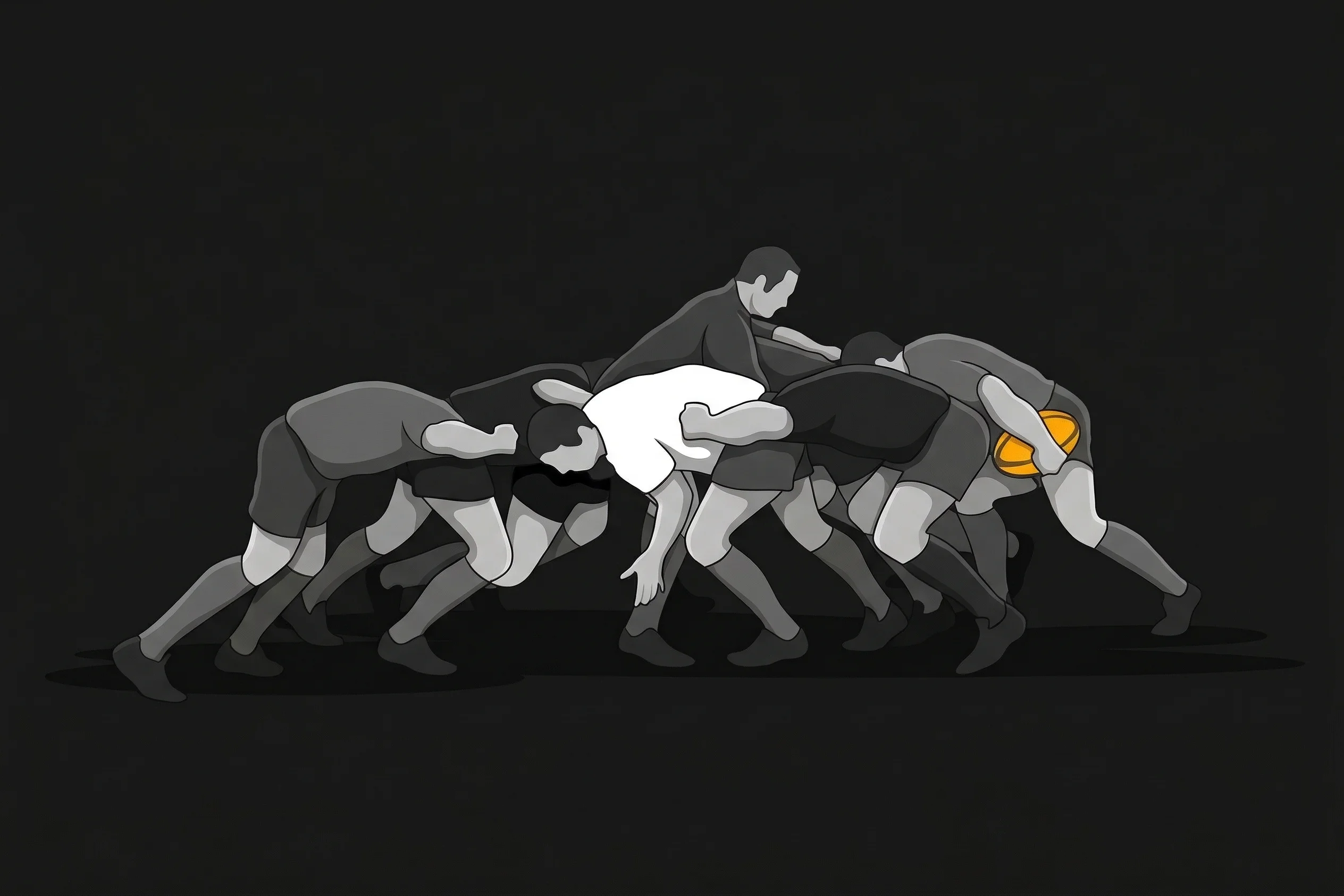
A maul forms when the ball carrier is held by opponents while at least one teammate also binds on. Unlike a ruck, the ball is carried off the ground. The maul must keep moving or the referee calls "use it".
Law 16 in plain English
A maul is different from a ruck because the ball is off the ground: a player is carrying it, and that ball-carrier is bound together with at least one opponent and at least one team-mate, all on their feet.
Key requirements:
- A maul can only form in the field of play, never in in-goal (Law 16.1)
- It needs the ball-carrier plus at least one player from each side, bound together (Law 16.2)
- The ball is held in the carrier's hands, not on the ground
- Everyone in the maul must try to stay on their feet. The ball-carrier may go to ground only if the ball is made available at once (Law 16.8, 16.9)
- Once formed, the maul must move towards a try line (Law 16.3)
Joining a maul: Players must come from an onside position and bind onto the hindmost player in the maul. Binding on further forward at the side is not allowed, and a joining player's head and shoulders must be no lower than their hips (Law 16.7). Each team's offside line runs through the hindmost foot in the maul nearest its own try line (Law 16.4).
Ending a maul: A maul ends and play goes on when:
- The ball or the ball-carrier comes out of the maul
- The ball is on the ground
- The ball is on or over the try line
Use it or lose it: A maul that stops moving towards a try line has five seconds to get going again (Law 16.15). If it stays still for more than five seconds and the ball is being moved where the referee can see it, the referee calls "use it" and the team must play the ball within five seconds of the call. If the ball is not coming out at all, the maul ends unsuccessfully and a scrum is awarded (Law 16.14, 16.17).
Scrum after an unsuccessful maul: The scrum goes to the team that did not have the ball when the maul began. If the referee cannot tell, it goes to the team last moving forward (Law 19.1). If the maul formed straight after a player caught an opponent's kick on the full in open play, the catcher's team gets the scrum (Law 16.19).
Sanction: Most maul offences give a penalty. Joining with the head and shoulders below the hips, or pretending the maul has ended, gives a free-kick. A maul that ends unsuccessfully gives a scrum.
Law 16 section by section
Field of Play Only
A maul can only happen in the field of play. It cannot form in in-goal.
What Makes a Maul
A maul needs the ball-carrier plus at least one player from each side, all bound together and on their feet. A player who rips the ball from the ball-carrier must keep in contact with that player until the ball has been transferred. The ball cannot be handed on at arm's length to another player (no long-arm transfer). Sanction: Penalty.
Moving Towards a Try Line
Once a maul has formed, it must move towards a try line.
Offside Line at a Maul
Each team has its own offside line. It runs parallel to the try line through the hindmost foot of the players in the maul, taking the foot closest to that team's own try line. Where that foot is already on the try line or beyond it, the try line itself is the offside line.
Join or Retire
A player must either join the maul from an onside position or get back behind their offside line straight away. Sanction: Penalty.
Leaving a Maul
A player who comes out of a maul must get back behind the offside line at once. They are allowed to join the maul again. Sanction: Penalty.
How to Join a Maul
A player joining a maul must:
- Come in from an onside position. Sanction: Penalty.
- Bind onto the hindmost player in the maul. Sanction: Penalty.
- Keep their head and shoulders at or above the height of their hips. Sanction: Free-kick.
Ball-Carrier Going to Ground
The ball-carrier in a maul is allowed to go to ground, as long as they make the ball available immediately. Sanction: Scrum.
Staying on Their Feet
Every other player in the maul must try to stay on their feet. Sanction: Penalty.
Bound In, Not Alongside
Every player in a maul must be caught in it or bound to it, not just standing next to it. The player holding the ball must not slide or move backwards through the maul. Sanction: Penalty.
Banned Actions in a Maul
Players must not:
- Deliberately collapse a maul, or jump on top of one. Sanction: Penalty.
- Try to pull or drag an opponent out of a maul. Sanction: Penalty.
- Do anything to make opponents think the maul is over when it is not. Sanction: Free-kick.
Defenders All Leave the Maul
If the players of the team without the ball deliberately leave the maul, so that none of them are left in it, the maul still carries on.
Rejoining After Leaving
If every player of the team without the ball has deliberately left the maul, they may join it again. The first of them to rejoin must bind onto the frontmost player of the team that has the ball. Sanction: Penalty.
Stopped Maul: Use It
If a maul stalls and makes no progress towards a try line for over five seconds, but the ball is moving and visible to the referee, the referee tells the players to use it. The team with the ball must then play it within a reasonable time. Sanction: Scrum.
Restarting a Stopped Maul
A maul that has stopped may get going towards a try line again, but only within five seconds. If it then stops again and the ball is moving and visible to the referee, the referee tells the team to use it. The team with the ball must then play it within a reasonable time. Sanction: Scrum.
Maul Ends, Play Continues
A maul is over and play goes on when:
- The ball or the ball-carrier comes out of the maul.
- The ball is on the ground.
- The ball is on the try line or over it.
Maul Ends Unsuccessfully
A maul ends unsuccessfully when:
- The ball becomes unplayable.
- The maul collapses, other than through foul play.
- The maul has not moved towards a try line for more than five seconds and the ball has not come out.
- The ball-carrier goes down and the ball is not available straight away.
- The ball is available, the referee has called "use it", and nobody has played it within five seconds of the call.
Sanction: Scrum (Law 19.1 sets which team throws in).
Opponent Playing It Away
Under a global law trial, a player who is in the maul, or has been part of it, must not play an opponent who is near the maul (within 1 metre) and is trying to play the ball away. Sanction: Penalty.
Maul After a Caught Kick
If a maul forms straight after a player catches an opponent's kick in open play before it touches anyone else or the ground, any scrum awarded under the clauses above goes to the catcher's team.
Real-World Examples
Scenario
A winger catches a high kick from the opposition on the full. An opposing player grabs her and she stays on her feet, then two of her forwards bind onto her. The ball stays in her hands.
Outcome
A maul has formed. Other players must join from an onside position and bind onto the hindmost player. The maul must move towards a try line. Because it formed straight after she caught an opponent's kick on the full, any scrum from an unsuccessful end goes to her team (Law 16.19).
Scenario
A driving maul from a lineout approaches the try line. The defending team stops it moving forward for more than five seconds.
Outcome
If the ball is moving and visible to the referee, the referee calls "use it" and the attacking team must play the ball within five seconds of the call. If they do not, or if the ball is not coming out at all, the maul ends unsuccessfully. The scrum goes to the team that did not have the ball when the maul began, here the defending team (Law 16.14, 16.17, 19.1).
Scenario
A prop joins the maul by running around the side and binding onto a team-mate at the front of the maul.
Outcome
Penalty. A player joining a maul must come from an onside position and bind onto the hindmost player in the maul (Law 16.7).
Scenario
In a maul, a defender deliberately collapses it by pulling a maul player to the ground.
Outcome
Penalty to the attacking team. Players must not intentionally collapse a maul (Law 16.11), and doing so is also dangerous play under Law 9.20, so the referee can caution the player or show a card. If a maul collapses without foul play, it simply ends unsuccessfully and a scrum is awarded (Law 16.17).
Common questions
What is a maul in rugby?
A maul is made up of the ball-carrier, at least one team-mate and at least one opponent, all bound together and upright, with the ball held off the ground. It can only form in the field of play, and once formed it must move towards a try line.
What is the difference between a ruck and a maul?
In a ruck the ball is on the ground and players compete for it with their feet. Once a ruck forms, nobody may handle the ball unless they got their hands on it before the ruck formed and stay on their feet (Law 15.11). In a maul the ball is off the ground in the carrier's hands and the players stay upright, bound together. Each has its own offside line and its own offences.
What does "use it" mean in rugby?
"Use it" is the referee's call when a maul has stalled short of a try line but the ball is moving and visible. The team with the ball must then play it within five seconds of the call. If they do not, the maul ends unsuccessfully and a scrum is awarded to the team that did not have the ball, unless the maul formed straight after a catch from an opponent's kick (Law 16.19).
Can you collapse a maul in rugby?
No. Players must not deliberately pull a maul down or jump on top of it. The sanction is a penalty, and because it is also dangerous play under Law 9.20, the player can be cautioned, shown a yellow card or sent off. If a maul collapses without foul play, it ends unsuccessfully and a scrum is awarded.
How do you join a maul legally?
Come from an onside position, behind the offside line that runs through the hindmost foot in the maul nearest your own try line. Bind onto the hindmost player in the maul and keep your head and shoulders no lower than your hips. Joining offside or not binding onto the hindmost player is a penalty, and a head below the hips is a free-kick.