
Law 5 of 21
Rugby Match Time and Half-Time: Law 5
Governs match duration, half-time, time-keeping, and conditions for ending a half.
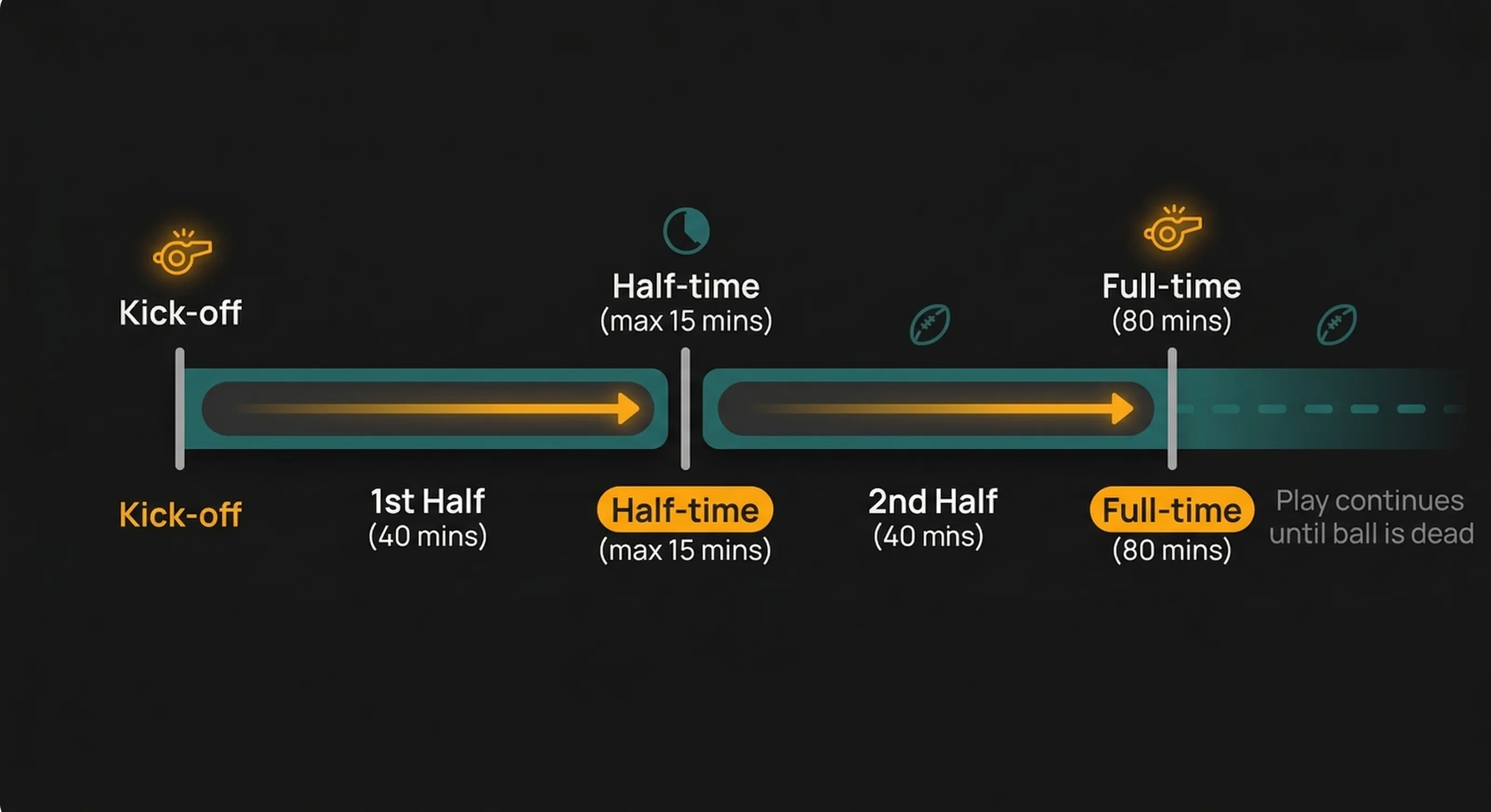
Law 5 in plain English
A full match lasts no more than 80 minutes: two halves of up to 40 minutes each, plus any time lost to stoppages. Extra-time is only played in a drawn knock-out match, and only when the match organiser has authorised it. Half-time lasts up to 15 minutes. Outside international rugby, a match can be made shorter.
The referee keeps the time, or hands the job to the assistant referees or an official time-keeper. The referee can stop play and allow time for an injured player (up to one minute, or longer for a serious injury) or to talk to other match officials. Once the ball is already dead, time can also be allowed for replacements, fixing kit, re-tying a boot-lace or fetching the ball.
A half does not end the moment the clock runs out. It ends when the ball next becomes dead, unless a scrum, lineout or restart kick awarded before time ran out still has to be completed, the referee awards a penalty or free-kick, a penalty is kicked into touch, a try needs its conversion, or play was stopped for player safety (play then restarts with a scrum).
In exceptionally hot or humid weather, the referee may allow a two-minute water break around the middle of each half. The referee can also end or suspend a match at any point if carrying on would be unsafe.
Law 5 section by section
Match Length
A match lasts at most 80 minutes, played as two halves of no more than 40 minutes each plus any time lost. The only exception is extra-time in a drawn knock-out match, when the match organiser has authorised it.
Half-Time Interval
The break between the halves lasts no more than 15 minutes, as set by the match organiser. The teams and the match officials may leave the playing enclosure during the break.
Shorter Matches
Outside international matches, the match organiser may shorten a match. If the organiser makes no decision, the two teams agree the length. If they cannot agree, the referee sets it.
Keeping Time
The referee is responsible for the time but may hand the job to one or both assistant referees, to an official time-keeper, or to both. The referee then signals every stoppage to them. Where there is no official time-keeper and the referee is unsure of the time, the referee asks one or both assistant referees first. Anyone else may be asked only if the assistant referees cannot help.
Stopping the Clock
The referee may stop play and allow time for:
- (a) An injured player, for up to one minute. For a serious injury, the referee may allow longer so the player can be taken off the playing area.
- (b) Talking to the other match officials.
Time Allowed When Dead
While the ball is already dead, the referee may also give time for:
- (a) Bringing on replacements.
- (b) Repairing or changing a player's clothing.
- (c) Re-tying a boot-lace.
- (d) Getting the ball back.
End of a Half
Once time has expired, the half ends the next time the ball becomes dead, except when:
- (a) A scrum, lineout or restart kick was awarded before time ran out, is not yet complete and the ball has not got back into open play. This includes a lineout or restart kick taken incorrectly, and any case where the ball does not reach open play.
- (b) The referee awards a penalty or a free-kick.
- (c) A penalty kick is aimed at touch and the ball goes dead, provided it was not tapped first and no other player touched it.
- (d) A try has been scored. Time is allowed for the conversion to be kicked.
- (e) Play was stopped for a player safety reason. Play then restarts with a scrum.
Taking or Declining Conversions
The scoring team may take the conversion or turn it down.
- (a) To turn it down, the team must tell the referee "no kick" once the try has been awarded.
- (b) If the conversion is kicked or turned down before time is up, the referee awards a restart kick.
- (c) When the conversion is kicked, time is judged from the moment the ball is struck.
Water Breaks
In exceptionally hot or humid weather, the referee may allow a water break. It lasts two minutes and should be timed for the middle of the half, either after a score or at a dead ball close to the halfway line. Where World Rugby's Heat Guidelines are followed, extreme conditions can justify longer breaks and a longer half-time.
Ending or Suspending a Match
The referee may end or suspend the match at any point if the referee believes it would be unsafe to carry on.
Real-World Examples
Scenario
The 40-minute hooter sounds while the ball is in open play and the attacking team is building phases towards the try line.
Outcome
The half does not end yet. It ends the next time the ball becomes dead (Law 5.7), for example when it goes into touch or the referee stops play for an infringement. If that infringement brings a penalty or free-kick, play goes on (Law 5.7b). If it brings only a scrum, such as for a knock forward after time is up, the half ends, because that scrum was awarded after time expired.
Scenario
A scrum is awarded with ten seconds left. The clock runs out while the packs are setting, and the scrum collapses and has to be reset.
Outcome
Play continues. The scrum was awarded before time expired, it has not been completed and the ball has not reached open play, so the half cannot end yet (Law 5.7a). It ends when the ball next becomes dead after the scrum, unless another exception applies.
Scenario
A try is scored with two seconds left on the clock. The kicker takes 55 seconds to strike the conversion.
Outcome
The conversion goes ahead, because the referee allows time for it after a try (Law 5.7d). Time is judged from the moment the ball is struck (Law 5.8c). By then time has expired, so there is no restart kick and the half is over once the kick has been taken (Law 5.8b).
Scenario
It is an exceptionally hot day of 38°C. The referee wants to give the players water during each half.
Outcome
Under Law 5.9, the referee may allow a two-minute water break in the middle of each half, taken after a score or at a dead ball close to the halfway line. If World Rugby's Heat Guidelines are being followed in extreme heat, longer breaks may be allowed.
Common questions
How long is a rugby match?
A match lasts no more than 80 minutes, made up of two halves of up to 40 minutes each plus any time lost to stoppages. Half-time lasts up to 15 minutes. Extra-time is only played in a drawn knock-out match when the match organiser allows it.
Does the rugby clock stop?
Yes. The referee may stop play and allow time for an injured player (up to one minute, or longer for a serious injury) and to talk to other match officials. When the ball is already dead, time can also be allowed for replacements, repairing kit, re-tying a boot-lace and getting the ball back.
Does a half end immediately when time runs out?
No. The half ends when the ball next becomes dead after time is up. Play goes on if a scrum, lineout or restart kick awarded before time ran out has not been completed, if the referee awards a penalty or free-kick, if a penalty is kicked into touch, if a try needs its conversion, or if play was stopped for player safety, in which case it restarts with a scrum.
Can a conversion be taken after time has expired?
Yes. After a try the referee allows time for the conversion. The team can also decline it by telling the referee "no kick" once the try is awarded. If the kick is struck, or declined, before time is up, the referee awards a restart kick.
When can the referee allow a water break in rugby?
Under Law 5.9, when it is exceptionally hot or humid the referee may allow a two-minute water break in the middle of the half, either after a score or at a dead ball close to the halfway line. In extreme conditions, World Rugby's Heat Guidelines can allow longer breaks.