
Law 11 of 21
Knock-On and Forward Pass: Law 11
The ball must not be knocked or thrown forward (toward the opponents' dead-ball line). Accidental knock-ons result in a scrum; intentional ones are penalised.
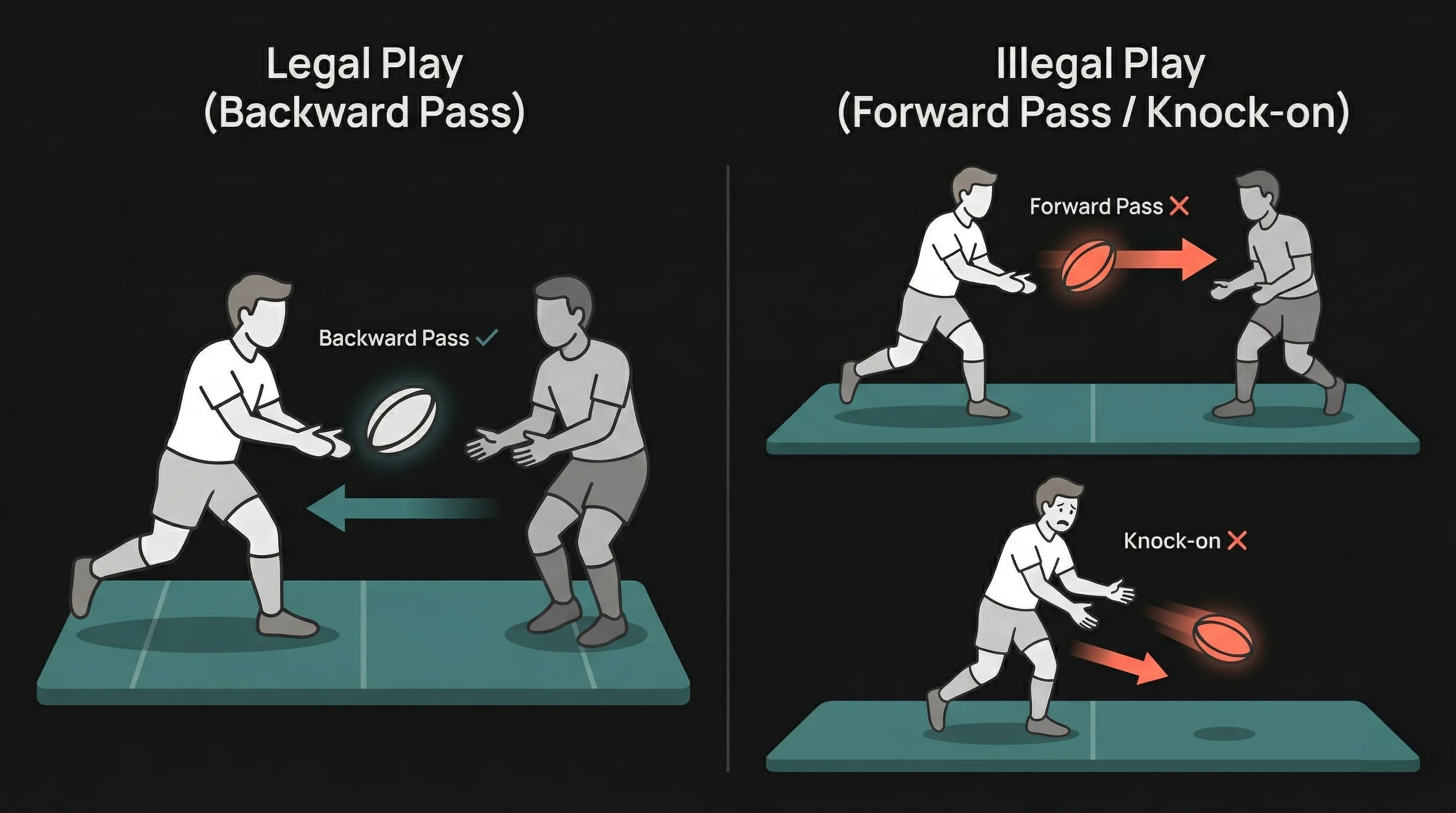
Law 11 in plain English
Knock forward (the laws' name for a knock-on): A player drops or loses the ball and it travels forward, or the ball comes forward off their hand or arm, and it hits the ground or another player before they can catch it. "Forward" means towards the opponents' dead-ball line.
Forward pass (the laws call it a throw forward): A player throws or passes the ball forward. The laws judge this by the passer's arms: it is a throw forward if the arms move forward.
The ball can only be passed sideways or backwards. Players move it forward by running with it or kicking it.
Sanction for an accidental knock-on or forward pass: A scrum to the non-offending team. If the ball went into touch, they can choose a lineout or a quick throw instead. A knock-on or forward pass at a lineout gives a scrum 15 metres in from the mark of touch (Law 19.1). An attacking player who knocks on in the opponents' in-goal gives away a try line drop-out (Law 12.12c).
Sanction for an intentional knock-on or forward pass: A penalty to the non-offending team. Breaking a law on purpose is also foul play, so the player must be cautioned, shown a yellow card or sent off (Law 9). If it stops a probable try, the referee awards a penalty try (see Law 8.3).
No sanction, play continues:
- A player charges down an opponent's kick and the ball goes forward off them straight away (a charge-down).
- A player rips or knocks the ball out of a ball carrier's hands and it goes forward off the carrier's hand or arm.
- A player fumbles the ball forward but catches it again before it touches the ground or another player.
Law 11 section by section
Knock Forward Anywhere
A knock forward can happen in any part of the playing area. It is when a player drops or loses the ball and it travels forward, or the ball comes forward off a player's hand or arm, and it then hits the ground or another player before that player can catch it. Sanction: Scrum. If the ball has gone into touch, the non-offending team may choose a quick throw or a lineout instead. See also Law 12.12(c): a knock forward by an attacker inside the opponents' in-goal leads to a try line drop-out.
Knock Forward When Tackling
If a player who is tackling an opponent, or trying to, touches the ball and it goes forward, that is a knock forward. Sanction: Scrum. If the ball has gone into touch, the non-offending team may choose a quick throw or a lineout instead.
Intentional Knock Forward
Nobody may deliberately knock the ball forward with a hand or arm. Sanction: Penalty.
Trying to Catch the Ball
A knock forward is not intentional when it happens as the player tries to catch the ball, as long as the player could reasonably have expected to win possession.
No Sanction: Charge-Down or Rip
Play goes on, with no sanction, when:
- (a) a player knocks the ball forward straight after an opponent has kicked it (a charge-down).
- (b) a player rips or knocks the ball away from a ball carrier and it goes forward off that ball carrier's hand or arm.
Throw Forward Anywhere
A throw forward can happen in any part of the playing area. It is when a player throws or passes the ball forward, which the laws judge by whether the passer's arms move forward. Sanction: Scrum. If the ball has gone into touch, the non-offending team may choose a quick throw or a lineout instead.
Intentional Throw Forward
Nobody may deliberately throw or pass the ball forward. Sanction: Penalty.
Real-World Examples
Scenario
A centre receives a pass and, under pressure, fumbles it. The ball bounces off their hands and rolls forward along the ground toward the opponents' line.
Outcome
Knock forward (knock-on). The non-offending team throws in at a scrum, in the scrum zone at the point closest to where the knock-on happened (Law 19.1).
Scenario
A fly-half deliberately bats the ball forward with his palm to prevent the opposition scrum-half picking it up after a breakdown.
Outcome
Intentional knock-on (Law 11.3). A penalty is awarded to the non-offending team. Deliberately breaking a law is also foul play (Law 9.7a), so the fly-half must be cautioned, shown a yellow card or sent off.
Scenario
A winger receives a pass that she juggles but manages to regather without the ball touching the ground.
Outcome
No infringement. If the player catches the ball before it hits the ground or another player, there is no knock-on, even if the ball moved forward for a moment.
Scenario
A defender sees a pass about to reach a winger with a clear run to the try line. The defender sticks out an arm and deliberately knocks the ball forward to stop it.
Outcome
Penalty try. The intentional knock-on is foul play, and the referee judges that a try would probably have been scored. 7 points are awarded, and the defender must be shown a yellow card or sent off (Law 8.3).
Scenario
A fly-half kicks for touch from her own 22. A chasing flanker blocks the kick with her arms and the ball goes forward off them.
Outcome
No sanction. When the ball goes forward off a player straight after an opponent has kicked it, that is a charge-down and play continues (Law 11.5a).
Common questions
What is a knock-on in rugby?
A knock-on (the laws now say knock forward) is when a player loses the ball and it goes forward, or the ball goes forward off their hand or arm, and it touches the ground or another player before they can catch it.
What is the difference between a knock-on and a forward pass?
A knock-on is when the ball goes forward off a player's hand or arm, or after they lose it. A forward pass (throw forward) is when a player throws or passes the ball forward, judged by whether the passer's arms move forward. Accidental ones result in a scrum, intentional ones a penalty.
What is the penalty for a knock-on?
For an accidental knock-on or forward pass, the referee awards a scrum to the non-offending team, who may choose a lineout or quick throw instead if the ball went into touch. For an intentional one, a penalty is awarded, and a penalty try if it prevents a probable try.
Is a charge-down a knock-on?
No. When the ball goes forward off a player straight after an opponent has kicked it, there is no sanction and play continues. The same applies when a player rips the ball forward out of a ball carrier's hands.
Can you regather your own knock-on?
Yes, but only if you can catch the ball before it touches the ground or another player. If you juggle the ball forward and re-catch it without it hitting anything else, there is no infringement.