
Law 21 of 21
In-Goal and Grounding the Ball: Law 21
The in-goal area is behind each goal-line. Scoring a try requires grounding the ball in the opposition in-goal. This law defines grounding, touch-in-goal, the dead-ball line, and what happens in various situations.
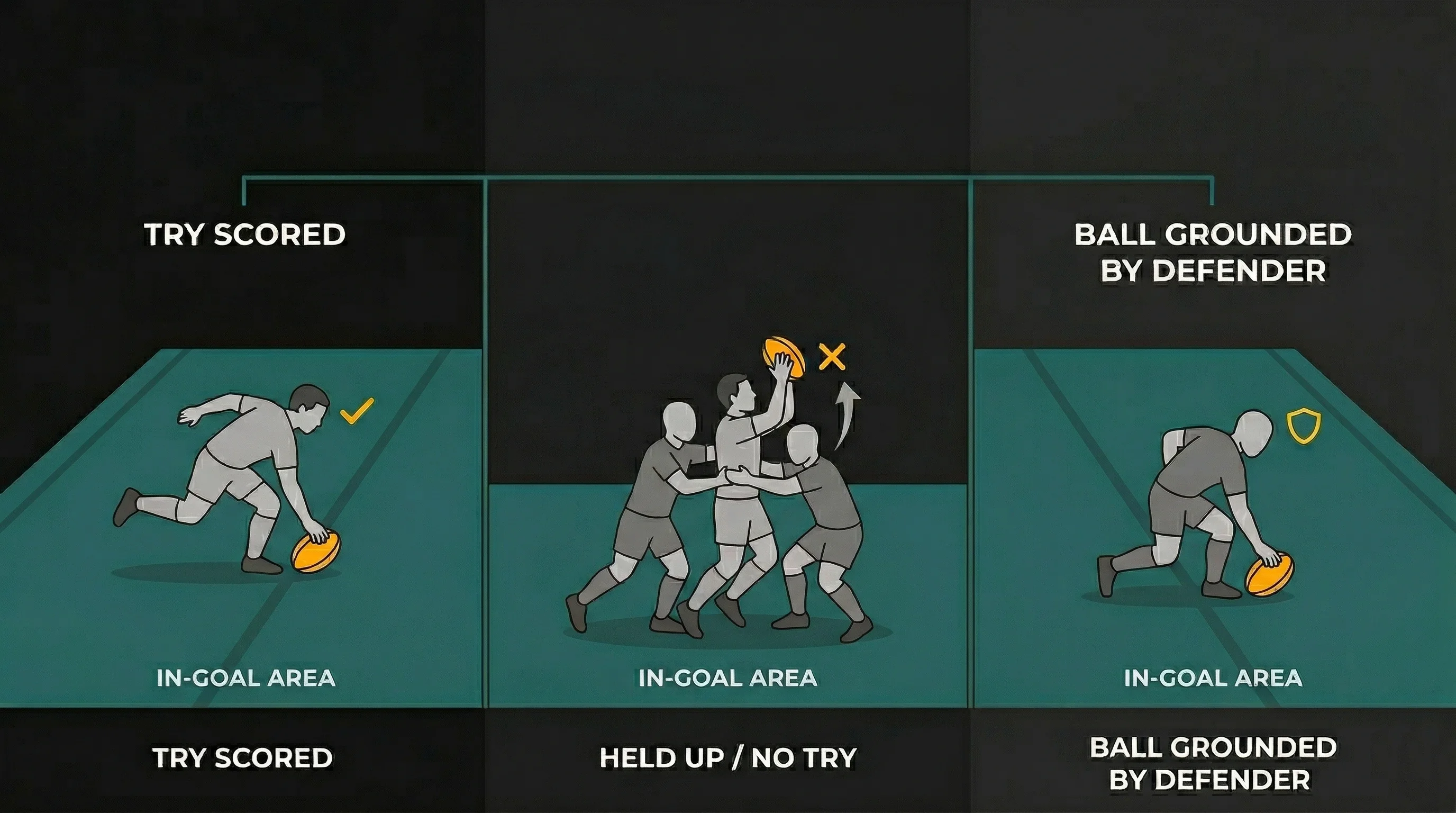
Law 21 in plain English
In-goal is the area at each end of the pitch that runs from the try line back to the dead-ball line, bounded at the sides by the touch-in-goal lines. The try line itself is part of in-goal; the dead-ball line and the touch-in-goal lines are not. It is where tries are scored and where defenders make touch downs.
---
GROUNDING THE BALL A player grounds the ball in in-goal by:
- Keeping hold of it while touching it to the ground, OR
- Pressing down on it with a hand or hands, an arm or arms, or the front of the body anywhere from the waist to the neck
Picking the ball up is not grounding it (Law 21.2). An attacker who grounds the ball scores a try. A defender who grounds it makes a touch down.
A try is NOT scored if:
- The ball-carrier grounds the ball while touching the touch-in-goal line, the dead-ball line or the ground beyond either (Law 21.4)
- The ball-carrier grounds the ball while touching the touchline or the ground beyond it. The ball is then in touch in the field of play and the other team throws in at a lineout (Law 21.5)
- The ball-carrier is held up and cannot ground or play the ball (Law 21.16)
A tackled player whose momentum carries them into in-goal can still score, and a tackled player may stretch out to ground the ball if they do it immediately (Law 21.7, 21.8, 8.2). Defenders may knock that ball backwards or pull it away, but must not kick it (Law 21.10).
---
THE CORNER FLAG Touching the corner flag post does not by itself put the ball or player in touch-in-goal. If the ball or ball-carrier touches it, and is not already in touch or touch-in-goal, play goes on. The one exception is a ball grounded against the post (Law 21.15).
---
HOW PLAY RESTARTS WHEN NO TRY IS SCORED
- Try line drop-out: The attacking team played, kicked or carried the ball into in-goal and it became dead there without a try. Examples are a ball-carrier held up, a defender grounding the attackers' kick, or a ball-carrier going into touch-in-goal (Law 12.12, 21.4, 21.16). It also follows an attacker's charge-down from the field of play that goes dead through in-goal.
- 5-metre scrum, attacking team throws in: The defending team played or took the ball into in-goal and it was made dead there (Law 19.1, 21.4, 21.16). The same scrum is given when the referee is in doubt about which team grounded the ball first (Law 21.17).
- 22-metre drop-out: A missed penalty goal or drop goal is grounded or made dead by the defenders, or goes dead through in-goal (Law 12.11).
- 22-metre drop-out or a scrum where the ball was kicked, defenders' choice: Any other kick through in-goal from the field of play goes dead in touch-in-goal, or onto or over the dead-ball line (Law 21.11). Kick-offs and drop-outs that reach in-goal have their own rules in Law 12.
Offences in in-goal: A penalty or free-kick for an offence in in-goal is taken in the field of play, 5 metres from the try line, opposite where the offence happened (Law 20.1). If foul play stops a probable try, the referee awards a penalty try (Law 8.3).
Law 21 section by section
Ways to Ground the Ball
A player can ground the ball in in-goal in either of two ways:
- Keeping hold of the ball while touching it to the ground.
- Pressing down on the ball with one or both hands or arms, or with the front of the body anywhere from the waist up to the neck.
Picking Up Is Not Grounding
Picking the ball up does not ground it. A player may pick the ball up in in-goal and then ground it somewhere else in in-goal.
Attacker Grounding Scores
If an attacking player grounds the ball in in-goal, that is a try.
Grounding in Touch-in-Goal
If an attacking player holding the ball grounds it in in-goal while also in contact with the dead-ball line, a touch-in-goal line, or the ground beyond either, the ball is dead and no try is scored. The restart depends on how the ball got into in-goal:
- The attacking team took or played it in: a try line drop-out.
- The defending team played or took it in: a 5-metre scrum, with the attacking team throwing in (see Law 19.1).
Grounding While in Touch
If the ball-carrier grounds the ball in in-goal while also touching the touchline, or the ground beyond it, the ball counts as having gone into touch in the field of play. The opposition throws in at a lineout.
Defender Makes a Touch Down
When a defending player grounds the ball in in-goal, it is a touch down. How play restarts depends on how the ball got into in-goal (see Law 12.11, 12.12 and 19.1).
Momentum Into In-Goal
A tackled player whose momentum carries them into an in-goal can make a touch down or score a try (see also Law 8.2).
Reaching Out to Ground
A tackled player may stretch out and ground the ball in in-goal for a touch down, but only if they do it at once (for a try scored this way, see Law 8.2). Sanction: Penalty.
Player Off the Playing Area
A player who is off the playing area, for example standing in touch-in-goal, can still ground the ball in in-goal for a try or a touch down, as long as they are not in possession of the ball.
Defending a Reaching Player
When a tackled player is stretching out to score a try or make a touch down, defenders may knock the ball backwards or pull it out of the player's grasp. They must not kick the ball or try to kick it. Sanction: Penalty.
Kicked Dead Through In-Goal
If a team kicks the ball from the field of play through their opponents' in-goal and it goes dead in touch-in-goal, on the dead-ball line or beyond it, the defending team chooses either:
- A 22-metre drop-out; or
- A scrum where the ball was kicked.
The exception is a missed kick at goal or a missed drop goal attempt. Then the only restart is a 22-metre drop-out by the defending team.
Defender Partly in In-Goal
A defending player with any part of their body in in-goal counts as being in in-goal, unless they are also in touch, or touching or beyond the dead-ball line.
Taking the Ball Into In-Goal
A player in in-goal who gathers or catches a ball while the ball is still in the field of play is treated as having taken it into in-goal.
Making the Ball Dead
If a player standing on or past the dead-ball line, or in touch-in-goal, catches or picks up the ball while it is inside in-goal, they have made the ball dead.
Touching the Corner Post
If the ball or the ball-carrier touches a corner flag or its post, play goes on, provided they are not in touch or touch-in-goal in some other way. The exception is a ball grounded against the post. Touching the post does not, on its own, count as touch-in-goal.
Held Up In-Goal
If a ball-carrier is held up in in-goal so that they cannot ground the ball or play it, the ball is dead. The restart is a try line drop-out or a 5-metre scrum, depending on how the ball got into in-goal (Laws 12.12a and 19.1). If the attacking team put the ball into in-goal, it is a try line drop-out. If the defending team put it there, it is a 5-metre scrum and the attacking team throws in.
Doubt Over Grounding
If the referee is unsure which team grounded the ball first in in-goal, play restarts with a 5-metre scrum opposite where the ball was grounded, and the attacking team throws in.
Real-World Examples
Scenario
A winger sprints to the corner and dives for the try line. She reaches out with both hands and touches the ball down just inside the in-goal, near the corner post, but her feet are clearly in touch-in-goal.
Outcome
No try. She was holding the ball and touching touch-in-goal when she grounded it, so the ball is dead (Law 21.4). Her team carried the ball into in-goal, so play restarts with a try line drop-out by the defending team. Touching the corner flag post on its own would not have stopped play (Law 21.15).
Scenario
A centre reaches the in-goal but a defender wraps both arms around him in a full bear-hug. Despite the tackle, the centre manages to press the ball down onto the turf.
Outcome
Try scored. Being held does not stop a try if the ball is grounded. The ball is only held up when the player cannot ground it or play it (Law 21.16).
Scenario
The attacking team kicks the ball over the try line. A defending fullback recovers it and runs it back, but doesn't ground it. She instead runs back into the field of play.
Outcome
Legal. A defender does not have to ground the ball in in-goal, so play continues. If she had grounded it instead, that would be a touch down, and because the attackers kicked the ball in, play would restart with a try line drop-out (Law 21.6, 12.12).
Scenario
A kick in open play from the opposing team goes through the in-goal and over the dead-ball line without being touched.
Outcome
The defending team chooses a 22-metre drop-out, taken on or behind their 22-metre line, or a scrum where the ball was kicked (Law 21.11). If the kick had been a missed penalty goal or drop goal, the restart would be a 22-metre drop-out only.
Scenario
A defending prop deliberately obstructs a chasing attacker inside his own in-goal, and the referee judges the attacker would probably have scored.
Outcome
Penalty try: 7 points, awarded between the posts, with no conversion attempted. The prop must be shown a yellow card or sent off (Law 8.3). Obstruction is foul play under Law 9.
Common questions
How do you ground the ball for a try in rugby?
There are two ways. You can keep hold of the ball while touching it to the ground, or you can press down on the ball with a hand or hands, an arm or arms, or the front of your body anywhere from the waist to the neck. Picking the ball up is not grounding it.
What is touch-in-goal in rugby?
Touch-in-goal is the area beside the in-goal, including the touch-in-goal lines and everything beyond them. If a player holding the ball grounds it while touching the touch-in-goal line or beyond, no try is scored and the ball is dead. The restart is a try line drop-out if the attacking team took the ball in, or a 5-metre scrum to the attacking team if the defenders did. Touching the corner flag post does not, on its own, count as being in touch-in-goal.
What is the difference between a 22-metre drop-out and a try line drop-out?
Both are drop-kicks by the defending team. A 22-metre drop-out is taken on or behind the 22-metre line and must cross it. It follows a missed penalty goal or drop goal that the defenders ground or make dead, or that goes dead through in-goal. It also follows any other kick through in-goal that goes dead, although then the defenders may choose a scrum where the ball was kicked instead. A try line drop-out is taken on or behind the try line and must cross the 5-metre line. It follows most cases where the attackers put the ball into in-goal and fail to score, such as being held up or a defender grounding their kick.
What does "held up" mean in rugby?
Held up is when a ball-carrier in in-goal is held so that they cannot ground or play the ball. No try is scored and the ball is dead. If the attacking team took the ball into in-goal, the defenders restart with a try line drop-out. If the defending team took it in, the attacking team throws in at a 5-metre scrum. If the carrier still manages to ground the ball, it is a try.
Is the dead-ball line in in-goal?
No. In-goal stops at the dead-ball line, and the line itself is not part of in-goal or the playing area. If the ball touches it or goes over it, the ball is dead. A kick through in-goal that goes dead gives the defenders a 22-metre drop-out or a scrum where the ball was kicked, a missed kick at goal gives a 22-metre drop-out, and an attacker who carries the ball into in-goal and onto or over it gives away a try line drop-out.