
Law 3 of 21
Rugby Team Size and Replacements: Law 3
Covers team size, replacements, uncontested scrums, and player welfare processes.
Law 3 in plain English
Each team can have up to 15 players on the field during play, although a match organiser can allow smaller teams. A union can name up to 8 replacements (substitutes) for an international, and in other matches the match organiser decides how many, again up to 8. A replacement can only come on when the ball is dead and the referee allows it.
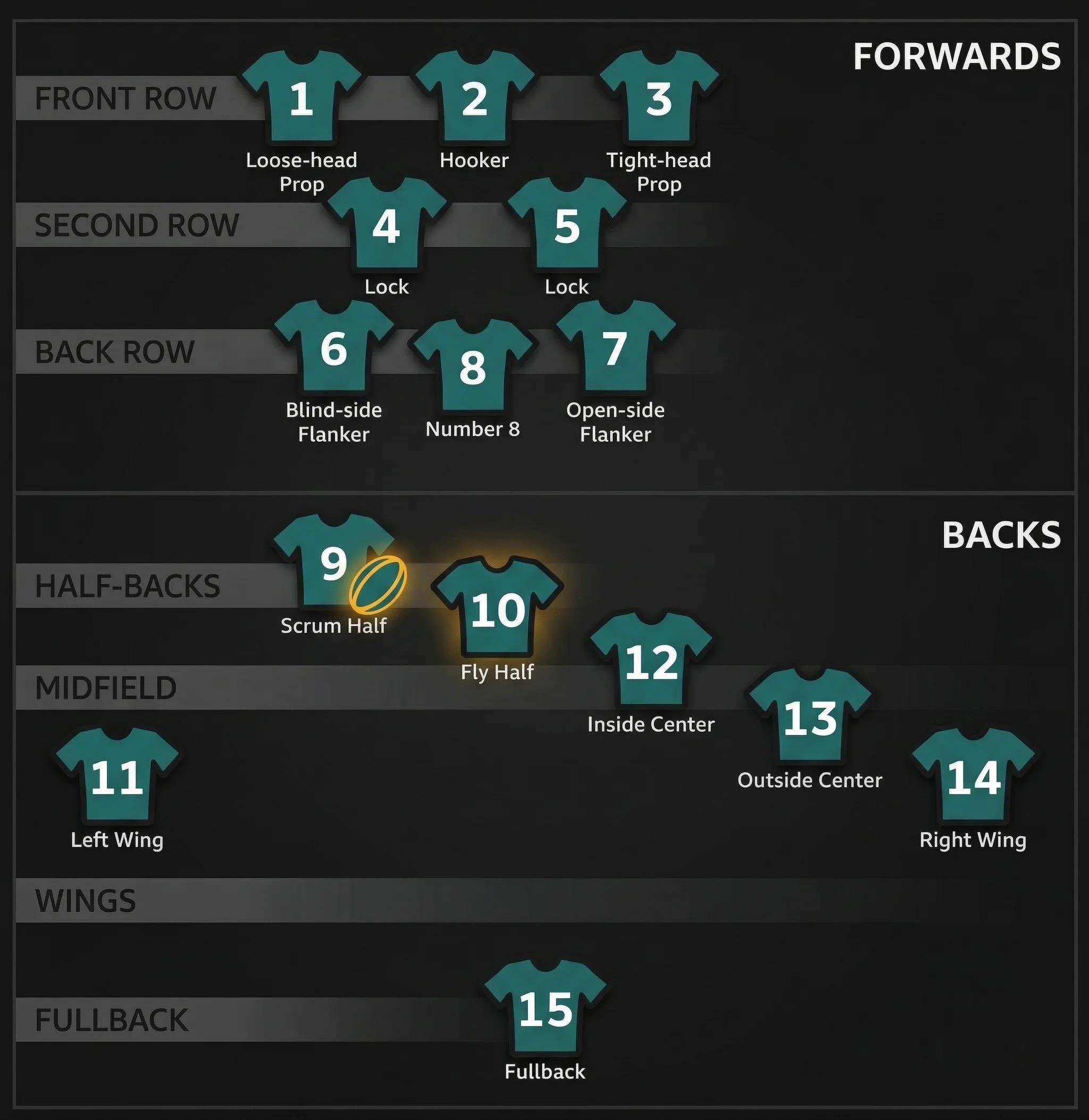
Much of this law is about the front row (the two props and the hooker), the players who lock together at the front of a scrum. A squad must carry a minimum number of front-row players, and that number rises with the size of the squad. Before the match, each team tells the officials who can play in the front row and in which positions. If a team cannot field a suitably trained front row, scrums become "uncontested": neither side may push, and the team throwing in wins the ball without a contest.
The law also protects players' health. A player who is concussed, or might be, must be taken off for the rest of the match ("Recognise and Remove"). Players with a blood injury, or who need a Head Injury Assessment (HIA) in matches approved for it, can be replaced temporarily while they are treated or assessed.
Law 3 section by section
Maximum on the Field
While play is going on, a team may have at most 15 players in the playing area.
Smaller Team Sizes
A match organiser can approve matches in which each side has fewer than 15 players.
Too Many Players
A team can complain to the referee that the other side has more players than it should. If that side does have too many, the referee tells its captain to bring the number down to the right figure. Points already on the scoreboard when the objection was made stay as they are.
Sanction: Penalty.
International Replacements
For an international match, a union can name as many as eight replacements.
Replacements in Other Matches
In any other match, the match organiser sets how many replacements can be named. The limit is eight.
When Replacements Happen
A replacement can come on only while the ball is dead, and only once the referee has said yes.
Joining Without Permission
A player who comes back on, or a replacement who comes on, without the referee's say-so commits misconduct if the referee believes it was done to gain an advantage.
Sanction: Penalty.
Front-Row Numbers by Squad Size
How many front-row players a squad must include, and which front-row positions it must be able to fill the first time it is asked, depends on how big the squad is:
- Squad of up to 15: at least 3 front-row players, with no replacement requirement.
- Squad of 16 to 18: at least 4 front-row players, and cover to replace a prop or a hooker.
- Squad of 19 to 22: at least 5 front-row players, and cover to replace a prop as well as a hooker.
- Squad of 23: at least 6 front-row players, and cover to replace the loosehead prop, the tighthead prop and the hooker.
After taking player welfare into account, a match organiser may change these minimums, and the replacement requirements, for particular levels of the game.
Squads of 23
If the match organiser has set squads of 23 but a team can name just two front-row replacements, that team is limited to a squad of 22.
Naming the Front Row
Before kick-off, each team gives the relevant match official a list of its front-row players and the players who could replace them in the front row, with the front-row position or positions each one can play. When scrums are contested, nobody else may play in the front row, and the listed players may play only in the positions named for them.
Starting in Another Position
A player named as a front-row replacement is allowed to begin the match playing in a different position.
Training and Experience
Each team is responsible for making sure that every one of its front-row players and front-row replacements has suitable training and experience.
When Scrums Go Uncontested
Scrums become uncontested when either team cannot put out a suitably trained front row, or when the referee orders it.
Starting With Uncontested Scrums
A match organiser may lay down the conditions under which a match can begin with uncontested scrums.
Eight Players per Side
When scrums are uncontested because of a sending-off, a yellow card or an injury, each side must still pack down with eight players.
Front-Row Player Leaves
When a front-row player leaves the playing area because of an injury, a yellow card or a red card, the referee asks at the next scrum whether that team can carry on with contested scrums. If the referee is told it cannot, the referee orders uncontested scrums. Contested scrums can start again if the player comes back or a different front-row player comes on.
Causing Uncontested Scrums
In elite rugby, or where the match organiser decides so, a player whose departure led the referee to order uncontested scrums cannot be replaced. World Rugby's Law Application Guidelines also describe situations in which a further player may have to come off as a sanction for causing uncontested scrums.
Filling the Front Row
A player who is not a front-row player may play in the front row only when there is no front-row replacement available.
Yellow Card to a Front-Rower
When a front-rower gets a yellow card and the players still on the field cannot keep the scrums contested, the team picks another player to go off so that an available front-row player can come on. The player who went off can come back only when the suspension is over, or to act as a replacement.
Red Card to a Front-Rower
When a front-rower is sent off and the players still on the field cannot keep the scrums contested, the team picks another player to go off so that an available front-row player can come on. The player who went off may later come on as a replacement.
Replacing an Injured Player
An injured player can be replaced. Once that has happened, the injured player cannot come back on.
When a Player Is Injured
A player counts as injured when:
- (a) At national representative level, a doctor judges that the player should not carry on.
- (b) In other matches where the match organiser has expressly allowed it, a medically trained person judges that the player should not carry on. If no such person is there, the player can be replaced with the referee's agreement.
- (c) The referee, whether or not on medical advice, rules that the player should not carry on. The referee then orders the player off the playing area.
Medical Examination
The referee can also send an injured player off the playing area so that the player can be examined medically.
Recognise and Remove
A player who is concussed, or is suspected of being concussed, at any stage of a match must be taken off the playing area straight away and must not come back. This is called "Recognise and Remove".
Blood Injury Replacement
A player with a blood injury goes off the field of play and can be replaced for the time being. The player goes back on as soon as the bleeding has been brought under control, covered, or both. If 15 minutes of actual time pass after the player left the playing area and the player is still not ready to go back on, the replacement is made permanent.
Blood Injury Decisions
At international level, it is the match-day doctor who rules on whether an injury counts as a blood injury that needs a temporary replacement. In matches World Rugby has cleared in advance to use the HIA process, play does not restart until a temporary replacement is on for the bleeding player.
Head Injury Assessment (HIA)
In matches World Rugby has cleared in advance to use the HIA process, a player who needs a Head Injury Assessment:
- (a) Goes off the field of play.
- (b) Is replaced temporarily, even if the team has no replacements left. Play does not restart until the temporary replacement is on. If the player is not ready to go back on 12 minutes (actual time) after leaving the playing area, the replacement is made permanent. If the player is bleeding too, up to 5 minutes may be spent stopping the bleeding before the 12-minute HIA starts.
- (c) May be replaced again if their temporary replacement is injured while the assessment is going on.
Replacing a Temporary Replacement
A temporary replacement can itself be replaced temporarily, even if the team has no replacements left.
Injured Temporary Replacement
A temporary replacement who gets injured may be replaced as well.
Temporary Replacement Sent Off
If a temporary replacement is sent off, the player they came on for is treated as a tactically replaced player, provided that player has been medically cleared. That player may then return in the cases listed in Law 3.33.
Temporary Replacement Yellow-Carded
If a temporary replacement is shown a yellow card, the player they came on for must stay off the field of play until the suspension has ended. The only exception is to meet Law 3.19 or 3.20, and then only if that player is medically cleared and comes back within the time allowed since leaving the field of play.
Time Running Out at Half-Time
If a temporary replacement's time limit runs out during half-time, the replacement becomes permanent unless the replaced player is back on the field of play as soon as the second half starts.
Tactical Replacements Returning
A player who has been tactically replaced may come back on only to replace:
- (a) A front-row player who is injured.
- (b) A player who has a blood injury.
- (c) A player who has a head injury.
- (d) A player just hurt by foul play, where the match officials confirm the foul play caused the injury.
- (e) The player nominated to go off when Laws 3.18 to 3.20 are applied.
- (f) In elite rugby, a team-mate who has been shown a qualifying red card, once 20 minutes of playing time have passed.
Rolling Replacements
A match organiser can introduce rolling tactical replacements at particular levels of the game under its control. There can be no more than 12 interchanges. The match organiser is responsible for running rolling replacements and for setting their rules.
Real-World Examples
Scenario
A team's hooker is sent off. The team still has one front-row replacement who can play hooker on the bench.
Outcome
Law 3.20 applies. If the players left on the field cannot keep the scrums contested, the team picks another player, for example a flanker, to go off so the replacement hooker can come on, and the scrums stay contested. The player who went off can later come on as a replacement. If no front-row replacement were available, the referee would order uncontested scrums (Law 3.16), and they would still be played with eight players per side (Law 3.15).
Scenario
A player takes a hard knock to the head and appears dazed. The team doctor believes a Head Injury Assessment is needed.
Outcome
In a match World Rugby has approved for the HIA process, the player goes off and is temporarily replaced, even when the team has used all its replacements, and play cannot restart until the temporary replacement is on (Law 3.27). If the player is not available to return 12 minutes (actual time) after leaving the playing area, the replacement becomes permanent.
Scenario
A winger is replaced tactically at half-time. Twenty minutes into the second half, the replacement winger is injured in an ordinary tackle.
Outcome
The original winger cannot come back for an ordinary injury. Under Law 3.33, a tactically replaced player may return only to replace an injured front-row player, a player with a blood or head injury, a player just hurt by foul play that the match officials confirm, the nominated player under Laws 3.18 to 3.20, or (in elite rugby) a team-mate given a qualifying red card once 20 minutes of playing time have passed. Unless the match organiser runs rolling replacements (Law 3.34), the team needs a replacement who has not yet been on.
Scenario
Because of a mix-up on the bench, a team finishes the first half with 16 players on the field.
Outcome
The other captain can object to the referee. The referee tells the offending captain to bring the team back down to 15, and the score at the time of the objection stays as it is. Sanction: Penalty (Law 3.3).
Common questions
How many players are on a rugby team?
Each team can have up to 15 players in the playing area during play (Law 3.1), and a match organiser may allow fewer. Up to eight replacements can be named (Laws 3.4 and 3.5), so a match-day squad can be as large as 23.
How many substitutes are allowed in rugby?
For an international match a union can name up to eight replacements. In other matches the match organiser decides, up to a maximum of eight. A replacement can only come on when the ball is dead and with the referee's permission (Law 3.6).
Why are scrums sometimes uncontested in rugby?
Scrums become uncontested when a team is unable to put out a suitably trained front row, or when the referee orders it (Law 3.13), for example after a front-row player goes off injured or with a yellow or red card (Law 3.16). Neither team may push, and the team throwing in wins the ball without a contest. When it follows a sending-off, yellow card or injury, each side still uses eight players (Law 3.15).
What is "Recognise and Remove" in rugby?
Recognise and Remove is the process in Law 3.24: any player who is concussed, or suspected of being concussed, at any point in a match must be taken off the playing area immediately and permanently. The player cannot return to that match.
What is a Head Injury Assessment (HIA)?
In matches World Rugby has approved in advance for the HIA process, a player who needs a Head Injury Assessment goes off and is temporarily replaced, even when the team has used all its replacements. If the player is not available to return 12 minutes (actual time) after leaving the playing area, the replacement becomes permanent (Law 3.27).