
Law 7 of 21
Advantage in Rugby: Law 7
Allows play to continue after an infringement if the non-offending team benefits.
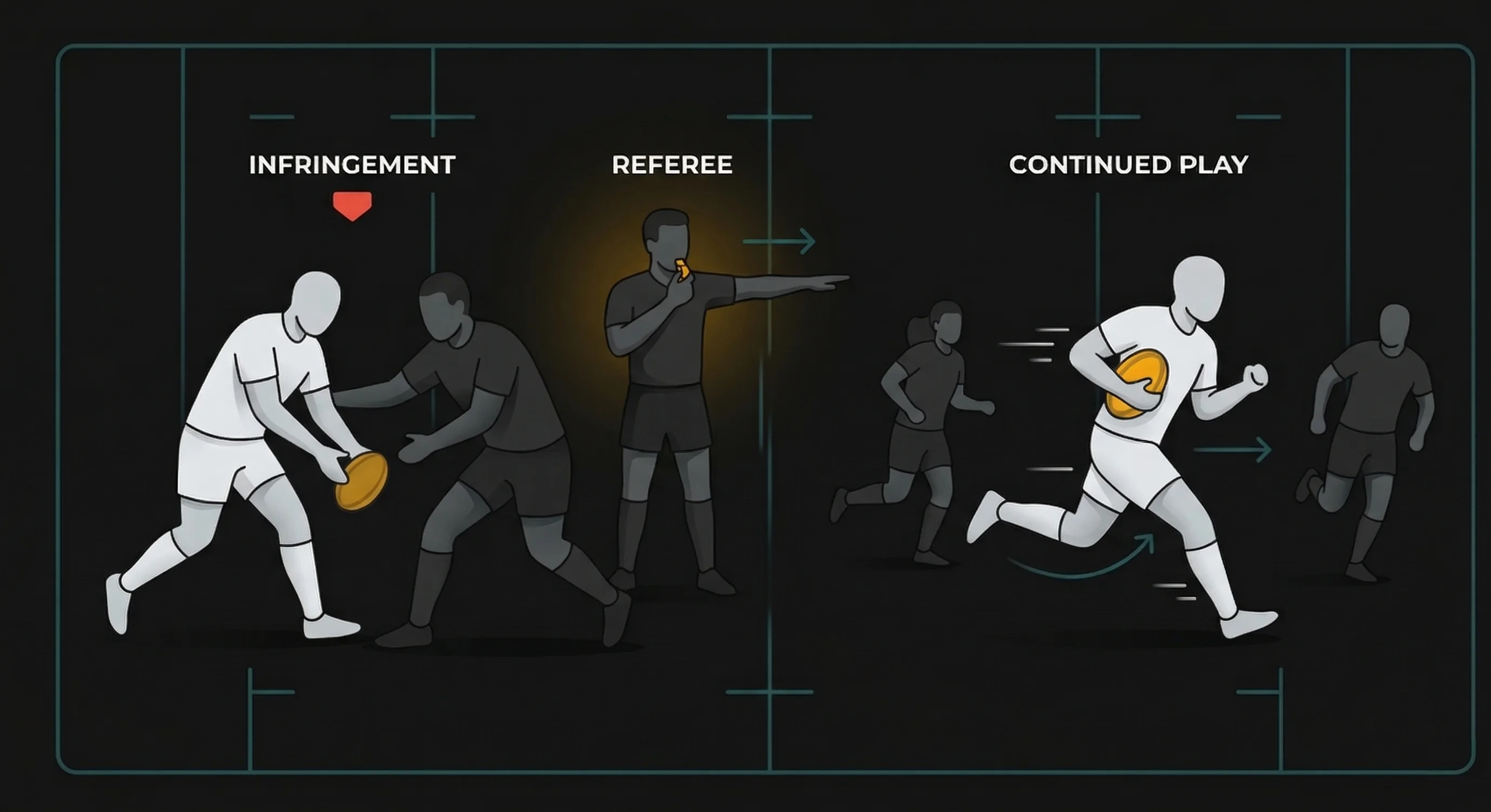
Law 7 in plain English
Advantage exists to keep the game flowing. When one team infringes, the referee does not have to stop play straight away. If the other team stands to gain from carrying on, the referee may let play continue and signals that advantage is being played.
Advantage can be tactical (the non-offending team can use the ball however it likes) or territorial (play has gained ground towards the offending team's dead-ball line), or a mix of the two. It must be clear and real: a mere chance of gaining something is not enough.
Advantage ends in one of four ways:
- The non-offending team gains a real advantage, so play simply carries on.
- The referee decides an advantage is unlikely, so play is stopped and the sanction for the original offence is given.
- The non-offending team infringes before gaining anything, so the referee gives the sanction for the first offence.
- The offending team infringes again in a way that offers no advantage, so play stops and the non-offending captain chooses the most useful sanction.
Some situations never allow advantage. The referee must blow at once when, for example, the ball comes out of either end of the scrum tunnel, a scrum is wheeled through more than 90 degrees, a quick throw, free-kick or penalty is not taken properly, letting play go on would be dangerous, or a player may be seriously injured.
Law 7 section by section
Types of Advantage
Advantage for the non-offending team works like this:
- (a) It can be tactical, meaning the non-offending team can use the ball however it likes.
- (b) It can be territorial, meaning play has gained ground towards the offending team's dead-ball line.
- (c) It can be a mix of tactical and territorial.
- (d) It has to be clear and real. Merely having the chance of an advantage does not count.
When Advantage Ends
Advantage is over when:
- (a) The referee judges that the non-offending team has gained an advantage. Play carries on.
- (b) The referee judges that the non-offending team is unlikely to gain one. The referee stops play and gives the sanction for the offence that advantage was being played for.
- (c) The non-offending team infringes before it has gained an advantage. The referee stops play and gives the sanction for the first offence. If either offence, or both, is foul play, the referee applies the correct sanction for each one.
- (d) The offending team commits another offence from which no advantage can come. The referee stops play and the non-offending team's captain picks whichever sanction suits them best.
No Advantage Allowed
The referee must not play advantage, and must blow the whistle at once, when:
- (a) The ball, or a player carrying it, touches the referee and either team gains an advantage from it.
- (b) The ball comes out at either end of the scrum tunnel.
- (c) A scrum turns through more than 90 degrees.
- (d) A scrum player is lifted or forced up so that they lose contact with the ground.
- (e) A quick throw, free-kick or penalty is not taken properly.
- (f) The ball is made dead.
- (g) Letting play continue would be dangerous.
- (h) A player is thought to be seriously injured.
Real-World Examples
Scenario
The defending team knock the ball forward in their own 22. The attacking team gather it and score a try two phases later.
Outcome
The referee played advantage for the knock forward. Scoring a try is a clear and real advantage, so advantage is over and the try stands (Law 7.2a). There is no going back to the knock forward.
Scenario
The referee is playing advantage for an offside offence. Before the non-offending team has gained anything, one of their own players knocks the ball forward.
Outcome
The non-offending team infringed before gaining an advantage, so the referee stops play and gives the sanction for the first offence: the penalty for offside (Law 7.2c).
Scenario
A scrum is wheeled past 90 degrees. The attacking team pick up the ball and break for the try line.
Outcome
Advantage cannot be played here (Law 7.3c). The referee must blow the whistle as soon as the scrum turns through more than 90 degrees, whatever happens next.
Scenario
A team gives away a penalty. While advantage is being played, the same team commits a second penalty offence and no advantage can come from it.
Outcome
Under Law 7.2(d), the referee stops play and the captain of the non-offending team chooses whichever of the two sanctions is more useful to them.
Common questions
What is the advantage law in rugby?
Advantage lets play continue after an infringement when the non-offending team stands to benefit, so the game keeps flowing. The referee signals that advantage is being played, and only stops play for the original offence if no clear and real advantage comes from it.
What are the two types of advantage in rugby?
Advantage can be tactical, where the non-offending team can use the ball however it likes, or territorial, where play has gained ground towards the offending team's dead-ball line. It can also be a mix of both. Either way it must be clear and real, and just having a chance of an advantage does not count.
When does advantage end in rugby?
Advantage ends when the referee judges the non-offending team has gained one (play carries on), or that it is unlikely to gain one (the sanction for the original offence is given), or when the non-offending team infringes before gaining anything (the sanction for the first offence is given). If the offending team infringes again in a way that gives no advantage, the non-offending captain picks the most useful sanction.
When can advantage NOT be played in rugby?
The referee must blow straight away, with no advantage, when the ball or ball-carrier touches the referee and either team gains from it, the ball comes out of either end of the scrum tunnel, a scrum is wheeled through more than 90 degrees, a player in a scrum is lifted off the ground, a quick throw, free-kick or penalty is not taken properly, the ball is made dead, carrying on would be dangerous, or a player may be seriously injured.