
Law 4 of 21
Rugby Kit and Clothing Rules: Law 4
Defines what players must wear, what is permitted, and what is prohibited.
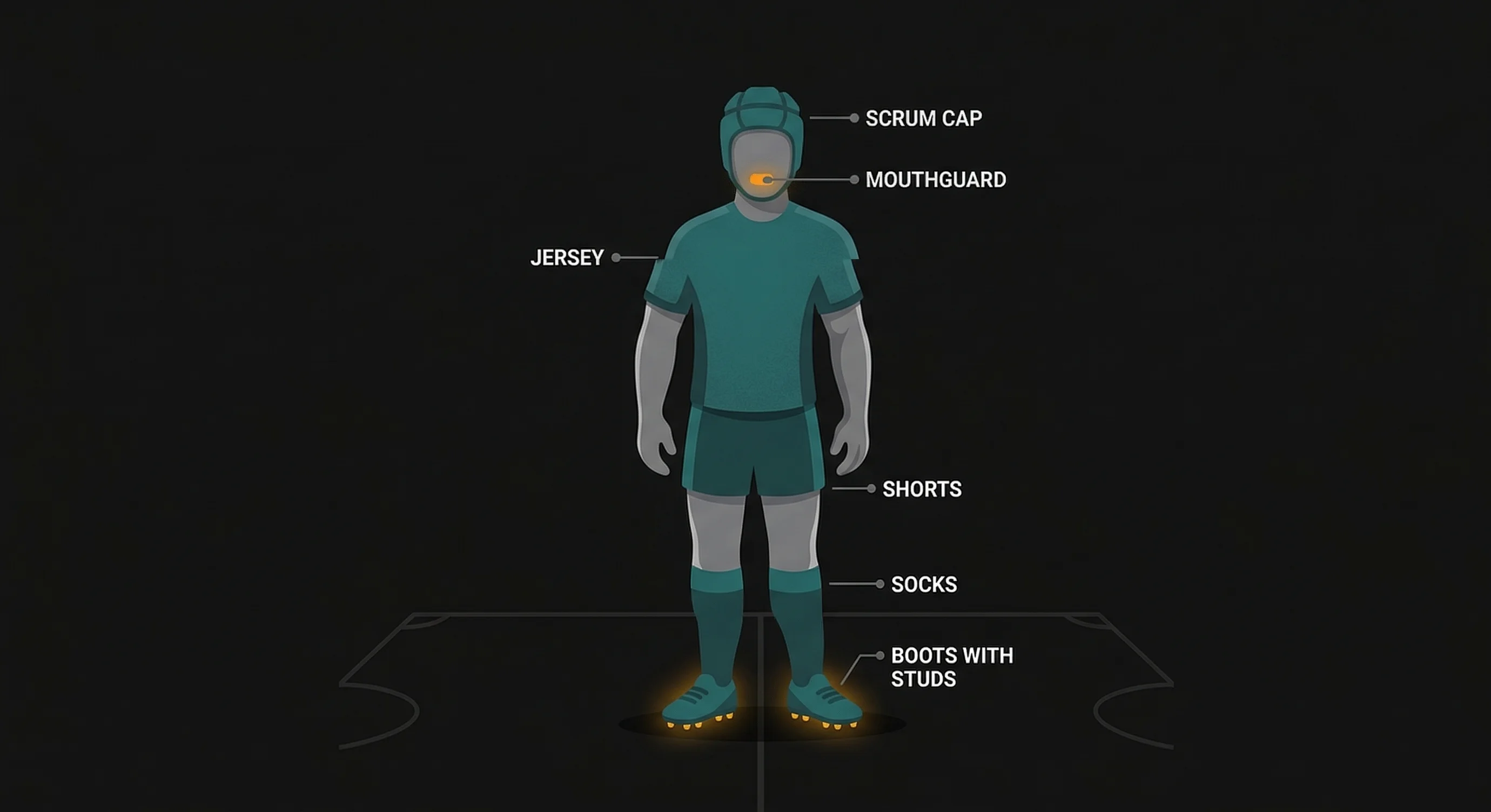
Law 4 in plain English
Every player wears a jersey, shorts, underwear, socks and boots, and the jersey sleeve must come at least halfway down from the shoulder to the elbow. All clothing has to meet World Rugby Regulation 12, and World Rugby recommends that every player wears a mouthguard or dental protector.
Players may add a range of other items: shin guards, headgear, mitts (fingerless gloves), shoulder pads or approved chest pads, ankle supports, washable supports, bandages and thin tape, goggles, cotton-blend tights or leggings under the shorts and socks, headscarves that are not a danger to anyone, and player monitoring devices.
Some items are banned outright: jewellery, gloves, communication devices, anything sharp or abrasive, anything with blood on it, shorts or leggings with padding sewn in, and anything with buckles, clips, rings, hinges, zips, screws or bolts, or with rigid material or projections the law does not otherwise allow. The referee can order a player to take off anything dangerous or illegal at any time, and the player cannot take part until it is removed or made harmless. If a match official pointed out a banned item at the pre-match inspection and the player is then found wearing it on the playing area, the player is sent off for misconduct and a penalty is awarded.
Law 4 section by section
Clothing Regulation
Every item of clothing has to meet World Rugby Regulation 12.
Basic Kit
Every player wears boots, socks, shorts, underwear and a jersey. Jersey sleeves must reach at least halfway from the point of the shoulder to the elbow. World Rugby advises every player to wear a mouthguard or a dental protector.
Permitted Extra Items
Players may also wear these extra items:
- (a) Supports that can be washed, made from elastic or compression material.
- (b) Shin guards.
- (c) Ankle supports under the socks. They may reach no more than a third of the way up the shin, and if they are rigid they must not be made of metal.
- (d) Mitts, which are gloves without fingers.
- (e) Shoulder pads, or chest pads of an approved type.
- (f) A mouthguard or a dental protector.
- (g) Headgear.
- (h) Dressings, bandages, thin tape or anything similar.
- (i) Goggles.
- (j) Boot studs on the soles, including moulded rubber studs.
- (k) Long tights or leggings in a cotton blend, with a single seam on the inside of each leg, worn under the shorts and socks.
- (l) Headscarves or other head coverings, as long as they are not a danger to the wearer or to anyone else.
- (m) Devices that monitor the player.
Banned Items
Players must not wear:
- (a) Anything that has blood on it.
- (b) Anything sharp or abrasive.
- (c) Anything with clips, buckles, hinges, rings, screws, bolts or zips, or with rigid material or a projection that this law does not otherwise allow.
- (d) Jewellery.
- (e) Gloves.
- (f) Padded shorts or leggings, meaning ones with padding sewn into them.
- (g) Something the law normally allows, if the referee thinks it is likely to cause injury.
- (h) Communication devices.
Removing Unsafe Kit
At any time, the referee can decide that something a player is wearing is dangerous or illegal. The referee must then tell the player to take it off, and the player takes no part in the match until it has been removed or made harmless.
Banned Item After Inspection
If a match official checks a player before the match and says they are wearing an item this law bans, and the player is later found wearing it on the playing area, the player is sent off for misconduct.
Sanction: Penalty.
Changing Clothing
A player may leave the playing area to change clothing only if it is bloodstained. The referee must not allow it for any other reason.
Real-World Examples
Scenario
During a match the referee notices a player wearing a ring on their finger.
Outcome
Jewellery is banned under Law 4.4(d). The referee orders the player to take the ring off, and the player takes no further part in the match until it has been removed or made harmless (Law 4.5).
Scenario
A player's jersey is cut during a tackle and becomes bloodstained. The player wants to leave the field to change.
Outcome
This is the one case where Law 4.7 lets a player leave the playing area to change clothing. An item with blood on it cannot be worn (Law 4.4(a)), so the player may go off, change and come back.
Scenario
At the pre-match inspection a match official tells a player that the metal clips on their headgear are not allowed. The player takes the headgear off, but puts it back on before kick-off and is seen wearing it on the field.
Outcome
Items with clips are banned (Law 4.4(c)). Because the player was told about the item at the inspection and was then found wearing it on the playing area, the player is sent off for misconduct and a penalty is awarded (Law 4.6).
Common questions
Can you wear jewellery while playing rugby?
No. Jewellery is banned under Law 4.4(d). The referee orders the player to take it off, and the player cannot take part in the match until it has been removed or made harmless (Law 4.5).
Can rugby players wear gloves?
Gloves are banned (Law 4.4(e)), but mitts, which are fingerless gloves, are allowed (Law 4.3(d)). Bandages, dressings and thin tape are also allowed (Law 4.3(h)).
What protective gear is allowed in rugby?
Law 4.3 allows shin guards, ankle supports, washable supports, a mouthguard or dental protector, headgear, shoulder pads or approved chest pads, bandages and thin tape, goggles, mitts and player monitoring devices. World Rugby recommends that every player wears a mouthguard or dental protector (Law 4.2).
Can rugby players wear leggings or tights under shorts?
Yes. Long tights or leggings in a cotton blend are allowed if they have a single seam on the inside of the leg and are worn under the shorts and socks (Law 4.3(k)). Shorts or leggings with padding sewn into them are banned (Law 4.4(f)).
What happens if a player is found wearing a banned item after a pre-match warning?
Under Law 4.6, a player who was told at the pre-match inspection that an item is banned, and is then found wearing it on the playing area, is sent off for misconduct. A penalty is also awarded.