
Law 13 of 21
Players on the Ground in Rugby: Law 13
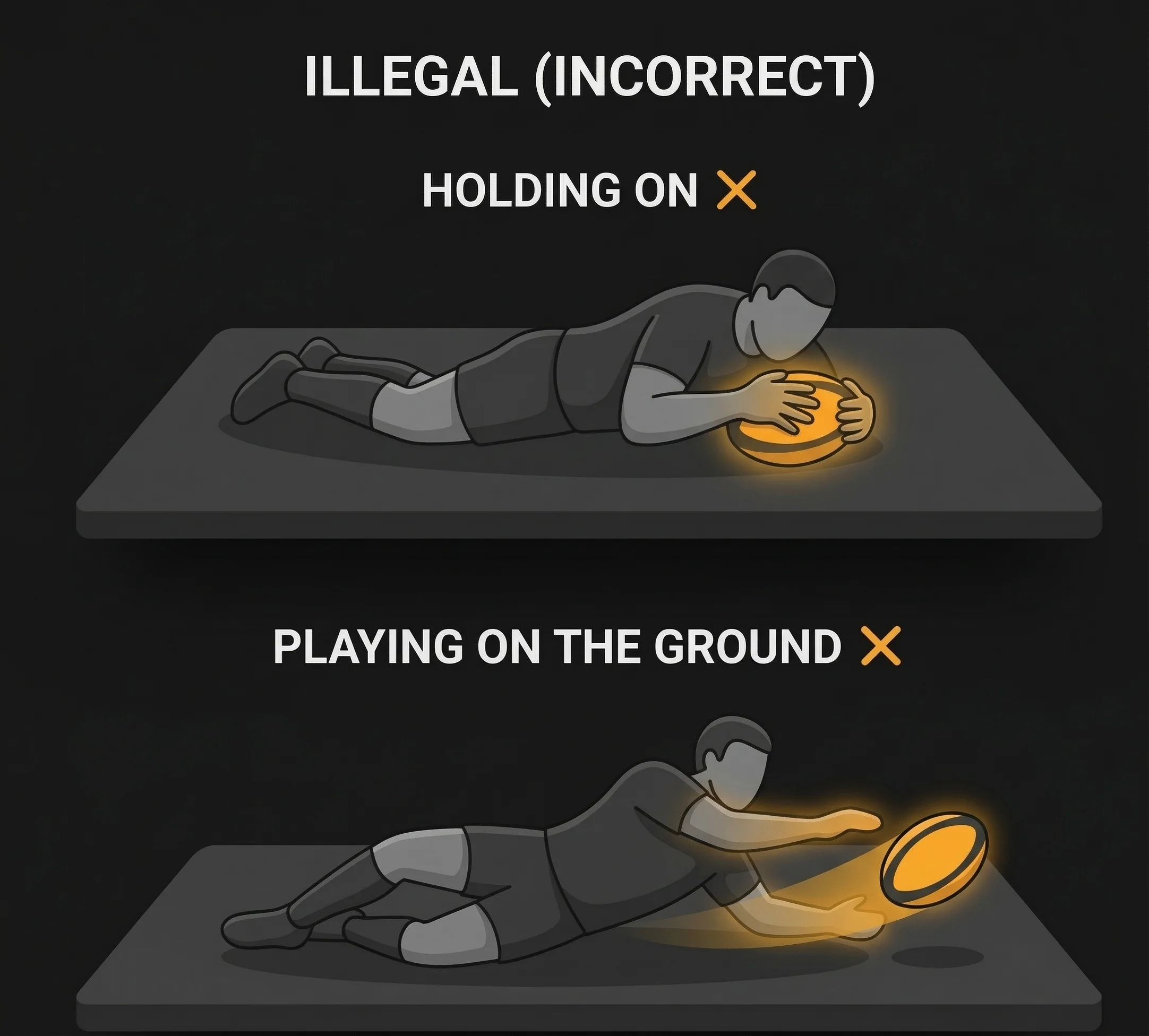
A player who goes to ground with the ball must at once get up, play it without kicking it, or let it go. Players on the ground without the ball are out of the game.
Law 13 in plain English
Law 13 rests on one principle: rugby is played by players who are on their feet. It applies in open play. Tackles, rucks and mauls have their own laws (Laws 14, 15 and 16).
If you go to ground with the ball, or to gather it: You must immediately do one of three things: get up with the ball, play it (but not kick it), or let it go. Once you have played it or let it go, you must at once get up or move away from it.
If you're on the ground without the ball: You are out of the game. You must let opponents who are on their feet play the ball or win it, you must not play the ball yourself, and you must not tackle or try to tackle anyone.
Players on their feet: If you do not have the ball, you must not fall on or over a player on the ground who has the ball or who is near it (within one metre).
Why this matters: the law keeps the ball available to the players who are on their feet. A player on the ground has to get up before they can rejoin play.
Sanction: Penalty for each of these offences.
Law 13 section by section
Going to Ground With Ball
A player who goes to ground to gather the ball, or who goes to ground holding it, must at once do one of these:
- (a) Get up with the ball.
- (b) Play the ball, but without kicking it.
- (c) Let go of the ball.
Sanction: Penalty.
Moving Away After Release
As soon as the ball has been played or let go, a player on the ground must straight away either get up or move away from the ball. Sanction: Penalty.
On the Ground Without Ball
In the field of play, a player who is on the ground and does not have the ball is out of the game. That player must:
- (a) Let opponents who are on their feet play the ball or win possession of it.
- (b) Leave the ball alone and not play it.
- (c) Not tackle, or try to tackle, an opponent.
Sanction: Penalty.
Falling on Grounded Players
A player who is on their feet and does not have the ball must not fall on or over a player on the ground who has the ball or is near it. Near means within one metre. Sanction: Penalty.
Real-World Examples
Scenario
A ball-carrier trips and falls to the ground without being tackled. He stays down, holding the ball and refusing to let it go.
Outcome
Penalty to the other team. Having gone to ground with the ball, he must at once get up with it, play it without kicking it, or let it go (Law 13.1). Staying down and holding on does none of these.
Scenario
An attacking player slips over during open play, gets straight back up and carries on running with the ball.
Outcome
Play continues. Getting up with the ball straight away is one of the options the law allows (Law 13.1a), so there is no offence.
Scenario
A player dives on a loose ball and is lying on the ground holding it. A chasing opponent, still on his feet, deliberately falls on top of him.
Outcome
Penalty against the opponent. A player on his feet without the ball must not fall on or over a player on the ground who has the ball (Law 13.4). The player on the ground must still get up, play the ball or let it go at once (Law 13.1).
Scenario
A loose ball bounces next to a player who is lying on the ground without it. As an opponent on her feet bends to pick it up, the player on the ground knocks it away with her arm.
Outcome
Penalty against the player on the ground. Without the ball she is out of the game, so she must not play it and must let opponents on their feet win possession (Law 13.3a and b).
Common questions
Can you hold the ball on the ground in rugby?
No. A player who goes to ground with the ball, or to gather it, must at once get up with it, play it without kicking it, or let it go. Once the ball has been played or released, the player must get up or move away from it straight away. Breaking either rule is a penalty offence.
What must a player do if they fall over in open play?
If they have the ball, they must immediately get up with it, play it (not kick it) or let it go, and then get up or move away. If they do not have the ball, they are out of the game: they must let opponents on their feet play the ball, must not play it themselves and must not tackle anyone.
Can you fall on the ball in rugby?
A player may go to ground to gather the ball, but must then get up, play it or let it go at once. A player on their feet without the ball must not fall on or over a player on the ground who has the ball or who is within one metre of it. That is a penalty offence.
What is the penalty for lying on the ball in rugby?
A penalty to the other team. If different players from one team keep committing the same offence, the referee gives the team a general warning, and if it happens again, shows a yellow card to the player or players at fault (Law 9.10).