
Law 2 of 21
Rugby Ball Size and Shape: Law 2
Specifies the size, shape, material, and air pressure of a rugby ball.
Law 2 in plain English
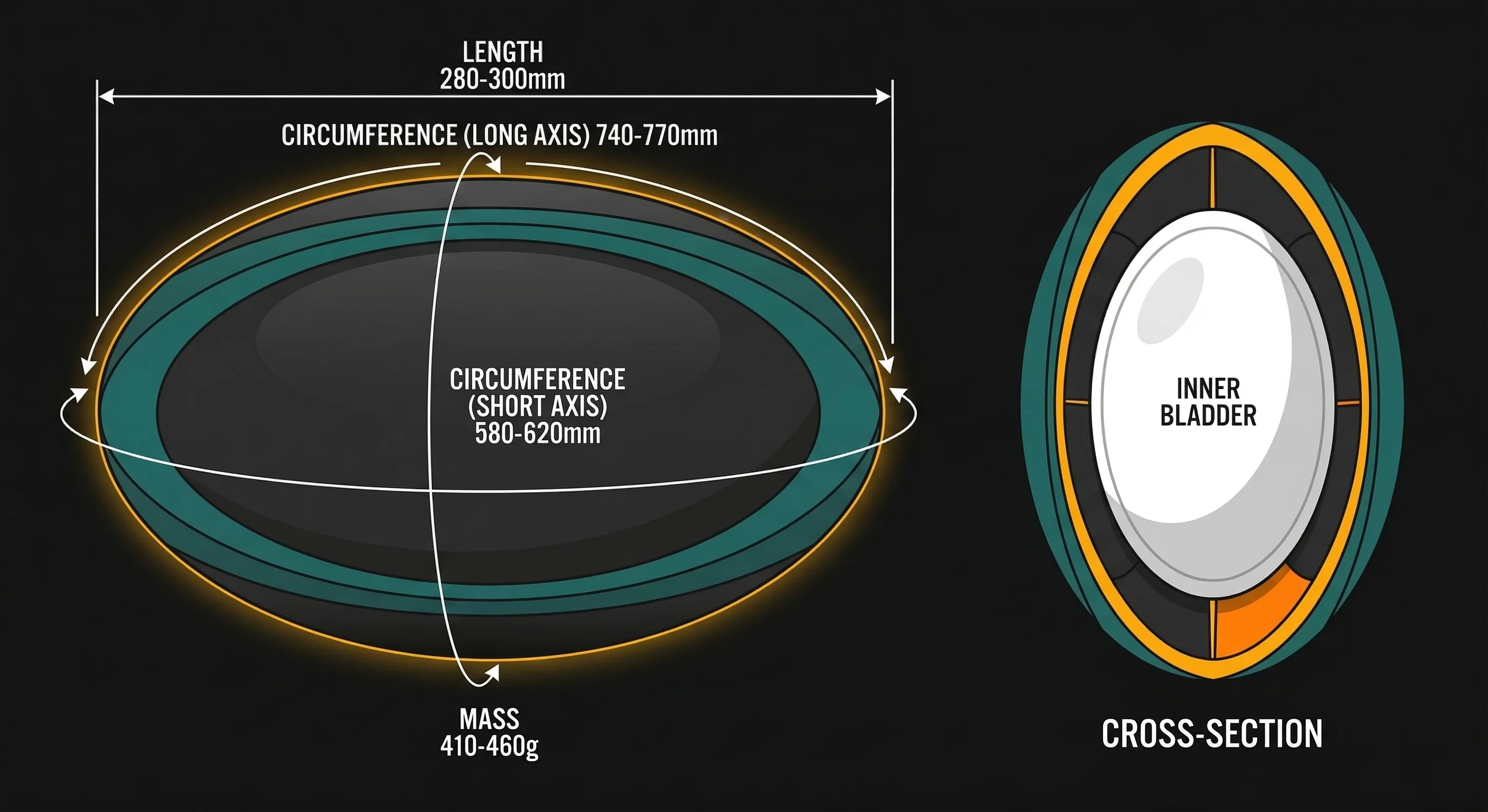
Rugby is played with an oval ball made of four panels. World Rugby's diagram gives it a length of 280 to 300 mm, a circumference of 740 to 770 mm measured around its length, and a circumference of 580 to 620 mm measured around its middle. It weighs between 410 and 460 grams.
The ball is made from leather or a suitable synthetic material, and it can be treated so that it resists water and is easier to grip. At the start of play it is pumped up to 9.5 to 10.0 psi (65.71 to 68.75 kilopascals). A match organiser can allow smaller balls to be used; the printed 2026 law book puts this as smaller balls for matches between young players. Spare balls may be available during a match.
Law 2 section by section
Shape and Panels
A rugby ball is oval, and it has four panels.
Ball Dimensions
World Rugby's ball diagram gives these measurements:
- Length from end to end: 280 to 300 mm.
- Circumference around the length of the ball: 740 to 770 mm.
- Circumference around the middle of the ball: 580 to 620 mm.
Ball Weight
A ball weighs between 410 and 460 grams.
Smaller Balls
A match organiser may allow a smaller ball to be used.
Materials and Treatment
The ball is made from leather, or from a suitable synthetic material. It can be treated so that it resists water and gives a better grip.
Air Pressure
When play starts, the ball is inflated to 9.5 to 10.0 pounds per square inch. In other units, that is 65.71 to 68.75 kilopascals, or 0.67 to 0.70 kilograms per square centimetre.
Spare Balls
A match may have spare balls on hand while it is being played.
Real-World Examples
Scenario
It is pouring with rain, and the home team brings out synthetic balls with a water-resistant, grippy coating. The visiting captain asks whether that is allowed.
Outcome
It is allowed. Law 2.5 permits a leather or suitable synthetic ball, and lets it be treated so that it resists water and is easier to grip. The balls still have to meet the size, weight and pressure rules in Laws 2.2, 2.3 and 2.6.
Scenario
A referee checks the ball before kick-off and finds the pressure is 64 kilopascals.
Outcome
At 64 kPa the ball is below the range Law 2.6 sets for the start of play, which is 65.71 to 68.75 kPa (9.5 to 10.0 psi). It does not meet the law until it has been pumped up into that range.
Scenario
The match organiser of an under-12 festival supplies balls that are smaller than the full-size ball described in Law 2.2.
Outcome
This is allowed. Law 2.4 lets a match organiser permit smaller balls, and the printed 2026 law book words the same rule as smaller balls being used for matches between young players.
Common questions
How big is a rugby ball?
World Rugby's diagram gives a rugby ball a length of 280 to 300 mm, a circumference of 740 to 770 mm around its length, and a circumference of 580 to 620 mm around its middle. It is oval and made of four panels.
How much does a rugby ball weigh?
A rugby ball weighs between 410 and 460 grams (Law 2.3).
What is the air pressure of a rugby ball?
At the start of play a rugby ball is inflated to 9.5 to 10.0 psi, which is 65.71 to 68.75 kilopascals or 0.67 to 0.70 kilograms per square centimetre (Law 2.6).
Are smaller rugby balls allowed for children?
Yes. Law 2.4 lets a match organiser permit smaller balls, and the printed 2026 law book describes this as smaller balls for matches between young players. Law 2 does not set the sizes of those smaller balls.
What is a rugby ball made of?
Law 2.5 says a rugby ball is leather or a suitable synthetic material. It can be treated so that it resists water and is easier to grip.