
Law 15 of 21
Ruck Rules in Rugby: Law 15
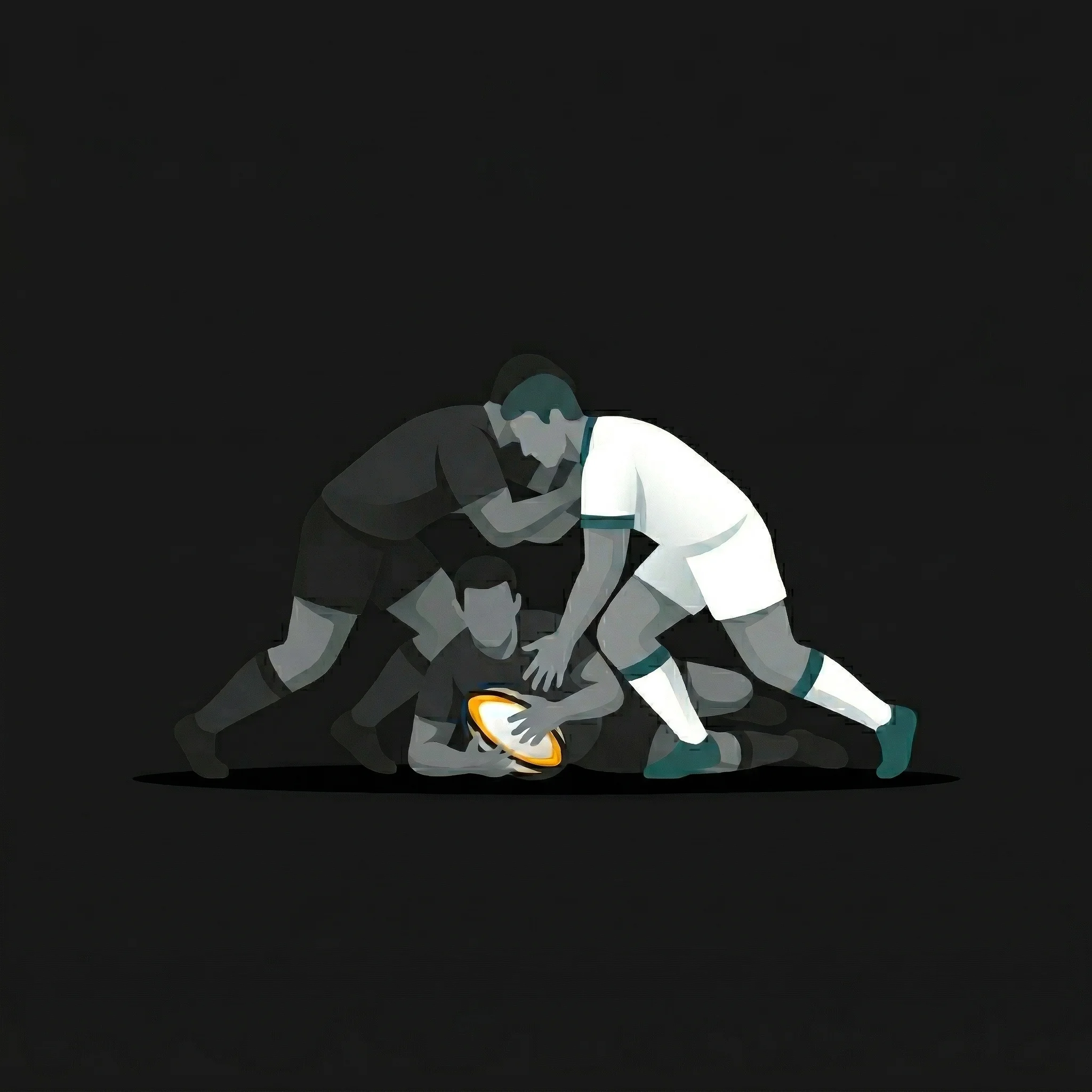
A ruck forms when at least one player from each team is in contact over the ball on the ground. Players must use their feet to move the ball, not their hands.
Law 15 in plain English
A ruck is formed when the ball is on the ground and at least one player from each team is on their feet, in contact with each other and over the ball. This most commonly happens after a tackle. Rucks only happen in the field of play.
Key rules:
- The ball must be on the ground for a ruck to form
- Players joining must bind onto a team-mate or an opponent, and the bind must come before, or at the same time as, any other contact
- Heads and shoulders must be no lower than hips (a free-kick if not)
- Players must try to stay on their feet. A player who goes to ground must try to get away from the ball, and must not play it
- Players cannot handle the ball in a ruck. The one exception is a player who had hands on the ball before the ruck formed and stays on their feet
- The ball is won with the feet (rucking) or by pushing the opponents off it
Offside at the ruck:
- Each team's offside line runs across the field through the hindmost point of anyone in the ruck, from either team: the point nearest that team's own try line
- Players not in the ruck must either join it or get back behind that line straight away
- Players must join from behind their own offside line. They may join alongside the hindmost player, but never in front of them
Ending a ruck: A ruck ends when:
- The ball comes out of the ruck
- The player playing the ball away lifts it from the ground
- The ball, still in the ruck, reaches or crosses the try line
- The ball becomes unplayable (a scrum to the team last moving forward)
Once the ball is clearly won, the referee calls "use it" and the team has five seconds to play it away, or a scrum is awarded. Under a global law trial, a player who is or was in the ruck must not play an opponent within 1 metre of it who is trying to play the ball away.
Sanction: Penalty for most infringements. A free-kick for heads below hips, putting the ball back into the ruck, or pretending the ruck is over. A scrum for not using the ball within five seconds.
Law 15 section by section
Field of Play Only
Rucks only happen in the field of play, never in in-goal.
Forming a Ruck
A ruck forms when the ball is on the ground and at least one player from each team is on their feet, in contact with each other, and over the ball.
Body Position
Every player in the ruck, at every stage of it, must keep their head and shoulders at or above the level of their hips. Sanction: Free-kick.
Offside Line at a Ruck
Each team has its own offside line at a ruck. It is a line across the field, parallel to the try lines, through whichever part of any ruck player (from either team) is closest to that team's own try line. If that part is on or behind their try line, the try line itself is their offside line.
Joining From Onside
A player arriving at a ruck must be on their feet and must join from behind their own offside line. Sanction: Penalty.
Joining Alongside
A player may join next to the hindmost player, but must not join in front of them. Sanction: Penalty.
Binding On
A player joining must bind onto a team-mate or an opponent. Binding means gripping a player's body firmly between shoulders and hips with the whole arm, hand to shoulder. The bind must be made before, or at the same moment as, any other part of the body makes contact. Sanction: Penalty.
Join or Retire
Players must either join the ruck or get back behind their offside line, straight away. Sanction: Penalty.
Rejoining a Ruck
A player who has already been part of the ruck may join it again, as long as they rejoin from an onside position. Sanction: Penalty.
Winning the Ball
A team can win the ball by rucking it, or by pushing the opponents off it. Rucking means using the feet, legally, to win or keep the ball.
No Handling
After a ruck forms, players must not handle the ball. The one exception is a player who already had hands on the ball before it became a ruck, provided they stay on their feet: they may keep handling it. Sanction: Penalty.
Staying on Your Feet
Players must try to stay on their feet for the whole of the ruck. Sanction: Penalty.
Caught In or Bound
Every player in a ruck must be caught in it or bound to it, not just standing alongside it. Sanction: Penalty.
Using the Feet
Players are allowed to use their feet on the ball, as long as they do it safely.
Players on the Ground
A player on the ground must try to move away from the ball. They must not play it, either inside the ruck or as it comes out. Sanction: Penalty.
Banned Actions in a Ruck
Players must not:
- Pick up the ball with their legs. Sanction: Penalty.
- Deliberately collapse a ruck or jump onto it. Sanction: Penalty.
- Deliberately step on another player. Sanction: Penalty.
- Fall on or over the ball as it comes out, while it is on the ground near the ruck. Sanction: Penalty.
- Kick the ball out of a ruck, or try to. Sanction: Penalty.
- Put the ball back into the ruck. Sanction: Free-kick.
- Do anything to make the opponents think the ruck is over when it is not. Sanction: Free-kick.
Use It
Once a team has clearly won the ball at the ruck and it is available to play, the referee calls "use it". That team then has five seconds to play the ball away from the ruck. Sanction: Scrum.
Protecting the Clearing Player
Under a global law trial, a player who is in the ruck, or was in it, must not play an opponent who is near the ruck (within 1 metre of it) and is trying to play the ball away. Sanction: Penalty.
How a Ruck Ends
The ruck is over, and play goes on, when any of these happens:
- The ball leaves the ruck.
- The player playing the ball away has lifted it off the ground.
- The ball in the ruck ends up on or over the try line.
Unplayable Ruck
A ruck also ends when the ball becomes unplayable. If the referee judges that the ball is unlikely to come out within a reasonable time, they award a scrum. The team that was last moving forward throws in.
Real-World Examples
Scenario
A ball carrier is tackled. Two supporting players from her team bind over the ball. One opposing player also binds. A ruck has formed.
Outcome
Players not in the ruck must either join it or get back straight away behind their offside line, which is set by the hindmost point of anyone in the ruck, from either team (Law 15.4, 15.8). Anyone joining must come from behind that line and may not join in front of the hindmost player (Law 15.5, 15.6).
Scenario
In a ruck, a flanker uses his hand to pick up the ball from the ground while his teammates are still competing.
Outcome
Penalty against the flanker. Once a ruck has formed, no one may handle the ball unless they had hands on it before the ruck formed and stay on their feet, and he did not (Law 15.11). The ball has to be won with the feet or by pushing the opponents off it (Law 15.10).
Scenario
A player tries to join a ruck by running around to the far side and entering from the opposition's direction.
Outcome
Penalty. A player must join from behind their own offside line, and may join alongside the hindmost player but not in front of them (Law 15.5, 15.6).
Scenario
The ball is secured at the back of a ruck, at the hindmost player's feet. The scrum-half bends down, lifts it and passes.
Outcome
Legal, and play goes on. The ruck ends as soon as the player playing the ball away lifts it from the ground (Law 15.19). If the referee has called "use it", the ball must be played away within five seconds (Law 15.17). Under a global law trial, players who are or were in the ruck must not play the scrum-half while she is within 1 metre of it, playing the ball away (Law 15.18).
Common questions
What is a ruck in rugby?
A ruck forms when the ball is on the ground and at least one player from each team is on their feet, in contact and over it. It can only happen in the field of play. Players then win the ball with their feet or by pushing the opponents off it. Only a player who had hands on the ball before the ruck formed, and stays on their feet, may handle it (Law 15.2, 15.10, 15.11).
Can you use your hands in a ruck?
Usually not. Once a ruck forms, no one may handle the ball, unless they got their hands on it before the ruck formed and they stay on their feet. Handling in a ruck otherwise gives away a penalty. The ruck ends, and hands can be used again, when the ball leaves it, when the player playing it away lifts it from the ground, or when it reaches the try line (Law 15.11, 15.19).
Where is the offside line at a ruck?
Each team's offside line is drawn across the field through whichever part of any ruck player, from either team, is nearest that team's own try line. If that point is on or behind their try line, the try line becomes their offside line. Players not in the ruck must join it or retire behind their line immediately (Law 15.4, 15.8).
What does "through the gate" mean?
The laws do not use the word gate. Law 15.5 says a player joining a ruck must arrive on their feet and join from behind their own offside line, and Law 15.6 says they may join alongside the hindmost player but not in front of them. Joining in front of the hindmost player, or from the opponents' side, is a penalty.
When does a ruck end?
A ruck ends and play continues when the ball leaves it, when the player playing the ball away lifts it from the ground, or when the ball reaches or crosses the try line while still in the ruck. It also ends if the ball becomes unplayable, and then the referee awards a scrum to the team last moving forward (Law 15.19, 15.20).