
Law 6 of 21
Touch Judge and Referee in Rugby: Law 6
Defines the roles and duties of the referee, assistant referees, touch judges, and TMO.
Law 6 in plain English
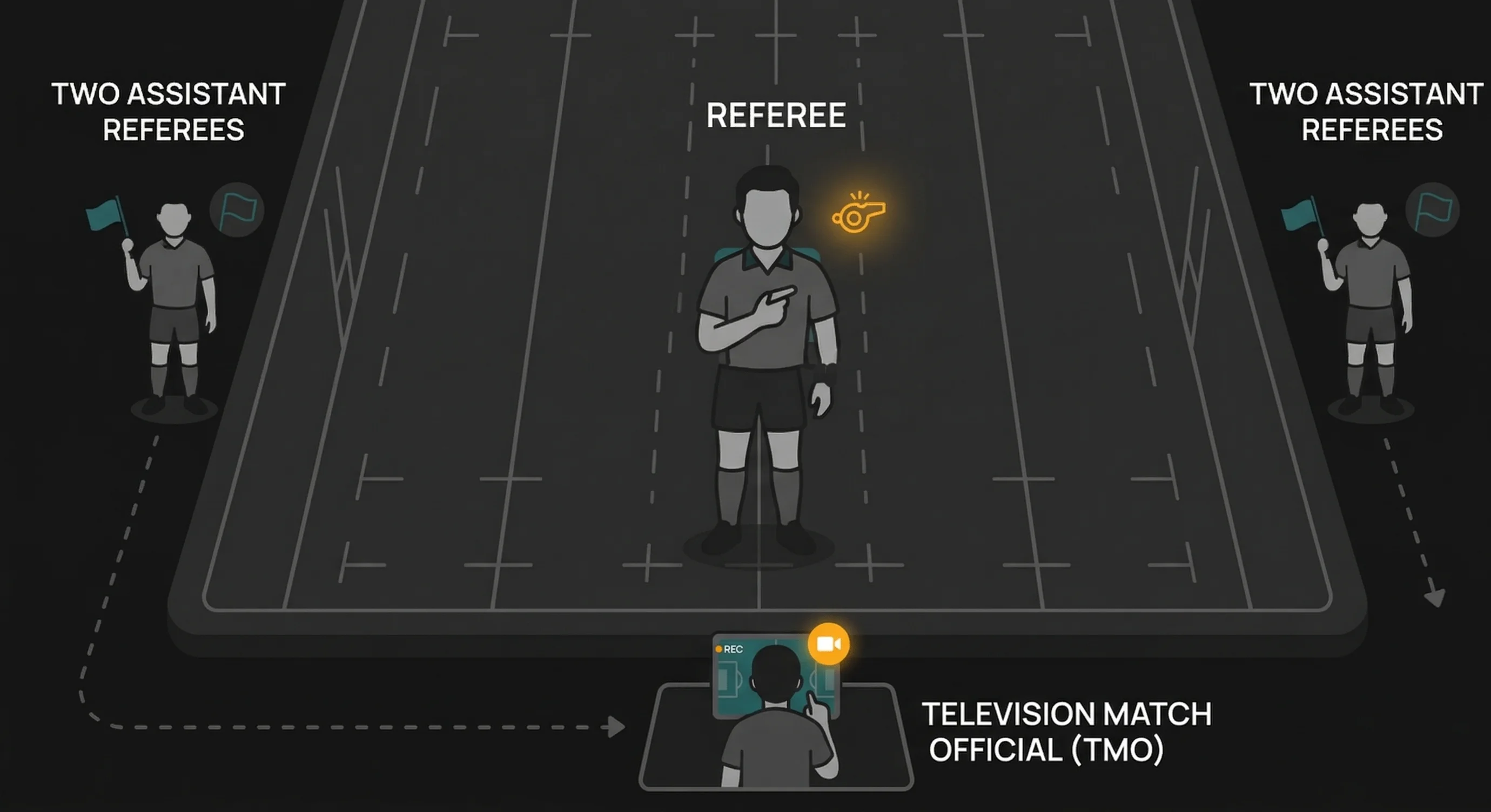
Every match is controlled by the match officials: a referee plus two assistant referees or two touch judges. Touch judges signal touch, touch-in-goal and whether kicks at goal succeed. Assistant referees do the same and also help the referee as directed, which includes reporting foul play. The match organiser may also authorise other people to be involved, such as immediate care staff, team doctors, the teams' non-playing members and ball persons.
Only the referee and the other appointed match officials judge questions of fact and law. The referee keeps the time and the score, runs the coin toss, checks kit and front-row players before kick-off, and uses the whistle to start and end each half, stop play, signal scores and award penalties, free-kicks and scrums. If the referee is hit by the ball or the ball-carrier and a team gains from it, play stops for a scrum to the team that last played the ball. In in-goal, the referee instead decides between a try, a touchdown or a drop-out.
The match organiser can also appoint a Television Match Official (TMO), who uses technology to look at groundings, touch, kicks at goal, offences that led to or prevented a try, and foul play. The TMO's role became full law on 1 July 2026.
Medics, water carriers, a tee carrier and coaches may come onto the field only when the law allows, and they must never touch the ball while it is in play. In elite rugby, water carriers may come on only at a long stoppage or after a try. Any additional person who breaks the laws can be cautioned or sent off, and the match organiser may bring misconduct charges.
Law 6 section by section
Appointing the Referee
The match organiser appoints the referee. If nobody has been appointed, the two teams agree on a referee, and if they cannot agree, the home team chooses one.
Replacing the Referee
If the referee cannot finish the match, the replacement is chosen as the match organiser has instructed. If the organiser has given no instructions, the referee picks the replacement. If the referee is unable to, the home team picks one.
The Coin Toss
The referee runs the coin toss. One captain tosses the coin and the other calls. The captain who wins chooses either to kick off or to pick an end. If they pick an end, the other team must kick off, and the other way round.
Pre-Match Checks
The match officials must check that the players' clothing and studs meet Law 4. They must also check which front-row players are available and their status, so that the front row complies with Law 3.10 and with the Law 19 process for engaging at the scrum.
Judges of Fact and Law
Inside the playing enclosure:
- (a) During the match, questions of fact and law are judged only by the referee and the other appointed match officials. They must apply the laws fairly in every match.
- (b) The referee keeps the time, though the match organiser may appoint a time-keeper to signal the end of each half.
- (c) The referee keeps the score.
Access to the Field
The referee decides when players and replacements may come onto the playing area, and lets them on when it is safe.
Leaving the Field
Players need the referee's permission to leave the playing area. A player may still, without permission, take water from their own technical area, or go behind the dead-ball line for water after a try has been awarded.
The Whistle
The referee carries a whistle and blows it:
- (a) To start and to end each half.
- (b) To stop play. The referee may stop play at any time.
- (c) To signal a score or a touchdown.
- (d) To caution or send off a player, and again when the penalty or penalty try is then awarded.
- (e) When the ball becomes dead, except after a missed conversion.
- (f) When the ball becomes unplayable.
- (g) When awarding a penalty, free-kick or scrum.
- (h) When letting play go on would be dangerous, or when a player may be seriously injured.
When the Ball Is Dead
The referee treats the ball as dead when:
- (a) It is in touch or touch-in-goal, except when a quick throw is allowed.
- (b) It is grounded in in-goal.
- (c) A conversion has been kicked.
- (d) A try, penalty goal or dropped goal has been scored.
- (e) The ball or the ball-carrier makes contact with the dead-ball line or with anything past it.
- (f) The ball strikes something above the playing area.
Contact With the Referee
When the referee or another non-player is touched by the ball or the ball-carrier and neither team gains from it, play goes on. If the contact gives either team an advantage in the field of play, the team that last played the ball gets a scrum.
Ball-Carrier Contact In-Goal
When the ball-carrier runs into the referee or another non-player in in-goal, and this gives either team an advantage:
- (a) If an attacking player has the ball, the referee awards a try at the place of contact.
- (b) If a defending player has the ball, the referee awards a touchdown at the place of contact.
Ball Touching Non-Player In-Goal
If the ball itself is touched by the referee or another non-player in in-goal, or hits an object in in-goal, the referee decides what would have happened next. The referee then awards a drop-out, a try or a touchdown at the place of contact.
Consulting Assistant Referees
The referee may consult the assistant referees on matters within their own duties, on the foul play law and on timekeeping. The referee may also ask them for help with other parts of the referee's job.
Changing a Decision
The referee may change a decision after a flag has gone up for touch or touch-in-goal, or after an assistant referee's signal for foul play.
Television Match Official
The match organiser can appoint a television match official (TMO). The TMO uses technology to clarify:
- (a) Whether the ball was grounded in in-goal.
- (b) Touch or touch-in-goal while the ball was being grounded or made dead.
- (c) Whether a kick at goal was successful, when there is doubt.
- (d) Possible infringements in the playing area that the match officials believe led to a try or stopped one being scored.
- (e) Foul play, including the sanction.
TMO Reviews
Any match official, the TMO included, may recommend a TMO review. Reviews are carried out under the TMO protocol.
Reporting the Score
After the match, the referee gives the score to both teams and to the match organiser.
Send-Off Report
When a player has been sent off, the referee must report the foul play in writing to the match organiser as soon as possible.
Two Assistant Referees
Every match has two assistant referees or two touch judges. If they have not been appointed by the match organiser, or under its authority, each team supplies one touch judge.
Reserve Assistant Referee
The match organiser may name a stand-in for the assistant referees or touch judges. This reserve touch judge or reserve assistant referee waits in the perimeter area.
Control of Touch Judges
The referee is in charge of the assistant referees and touch judges, can set out their duties and can overrule their decisions. The referee may ask for an unsatisfactory touch judge to be replaced. A touch judge the referee considers guilty of misconduct can be sent off by the referee, who then reports it to the match organiser.
Positions During the Match
One assistant referee or touch judge works on each side of the ground. They stay in touch at all times, apart from kicks at goal, for which they stand in in-goal behind the posts.
Reporting Foul Play
An assistant referee may come onto the playing area to report foul play, but only at the next stoppage and with the referee's permission.
Carrying a Flag
Every assistant referee and touch judge has a flag, or a similar object, for signalling decisions.
Signalling Kicks at Goal
For a kick at goal, an assistant referee or touch judge takes up a position at or behind each post. They raise their flags to show a goal when the ball passes over the crossbar between the posts.
Signalling Touch
Signalling touch works like this:
- (a) The flag goes up once the ball, or a player carrying it, has crossed into touch or touch-in-goal.
- (b) The assistant referee or touch judge stands where the throw-in should be taken and points to the team that is entitled to throw in.
- (c) The flag comes down when the ball is thrown in, except when: (i) the thrower steps onto the field of play while throwing; (ii) the team not entitled to the throw has taken it; or (iii) at a quick throw, a different ball is used, or the ball was touched after going into touch by anyone other than the player who carried it there or the player throwing it in.
- (d) The referee, not the assistant referee or touch judge, decides whether the throw was taken from the right place.
Signalling Foul Play
Signalling foul play works like this:
- (a) The match organiser may authorise assistant referees to signal foul play.
- (b) To show they have seen foul play or misconduct, an assistant referee holds the flag out flat, pointing across the field at right angles to the touchline.
- (c) After signalling foul play, the assistant referee stays in touch and carries on with every other duty until play next stops.
- (d) If the referee then invites it, the assistant referee may come onto the playing area and report the offence. The referee then takes whatever action is appropriate.
- (e) If the assistant referee's spoken report leads to a sending-off, the assistant referee writes a report on the incident for the referee as soon as possible once the match is over, and the referee passes it on to the match organiser.
Medics on the Field
First-aid or immediate (pitch-side) care staff with the right training and accreditation may come onto the playing area to treat injured players whenever it is safe.
- (a) Up to two medics, one on each side of the pitch, may follow play.
- (b) These medics may carry water, and give it only to a player they are treating.
- (c) Medics may not field or touch a ball that is live.
Sanction: Penalty, taken where play would have restarted.
Water Carriers and Coaches
These people may come onto the playing area, as long as they do not interfere with play:
- (a) Two nominated water carriers, during a stoppage for an injured player or after a try has been scored. The hot weather guidelines may justify a two-minute break in each half.
- (a)(i) In elite rugby, water carriers may only come on when the referee has made the ball dead for a long stoppage (such as an injury or a TMO review) or when a try is scored. The scoring team's carriers go to an area on or near the 10-metre line in that team's own half. The non-scoring team may take water into in-goal or collect it from behind the dead-ball line. All water carriers must go off when the conversion is taken.
- (a)(ii) No water carriers may come on at a penalty try.
- (a)(iii) If no try has been scored, players should get water only at a natural stoppage, in a neutral spot on the pitch. When that stoppage is for an injury, the water carriers must leave the pitch when the medic does.
- (a)(iv) Players may collect water from the technical zone, or from behind their own dead-ball line. Leaving water in in-goal means this right is taken away.
- (a)(v) A head coach or director of rugby may not be a water carrier.
- (b) A tee carrier: one person bringing just a kicking tee and a single water bottle for the kicker, once a team has said it will kick at goal or after a try. The tee carrier has to be one of the two nominated water carriers.
- (c) Coaches, to see their teams at half-time.
- (d) All of these people must stay in their technical area until they are allowed on as set out above. Nor may they field or touch the ball while it is live, even from inside the technical area.
Sanction: Penalty, taken where play would have restarted.
Approaching Match Officials
No additional person should go up to, speak to or direct comments at the match officials. The only exception is medical staff talking about the treatment of their own player.
Sideline Managers
The match organiser may hand the management of replacements to sideline managers it appoints. Guidance on sideline management is on World Rugby's officiating website (officiating.worldrugby.org).
Real-World Examples
Scenario
A pass hits the referee in midfield and drops straight to an attacking player, who now has a clear run at the line.
Outcome
The attacking team has gained an advantage from the ball touching the referee, so the referee stops play and awards a scrum to the team that last played the ball, here the attacking team (Law 6.10). Advantage cannot be played in this situation (Law 7.3a). If neither team had gained anything, play would simply have continued.
Scenario
The assistant referee on the far side raises their flag during open play to signal foul play.
Outcome
The assistant referee stays in touch and keeps doing every other duty, such as signalling touch, until play next stops (Law 6.27c). The referee may then invite the assistant referee onto the field to report the offence, and will take appropriate action (Law 6.27d). If the report leads to a sending-off, the assistant referee must also give a written report after the match (Law 6.27e).
Scenario
During a try review, the TMO spots a possible forward pass in the build-up.
Outcome
The TMO can look at an infringement in the playing area that led to the try (Law 6.15d), and the review follows the TMO protocol (Law 6.16). If the forward pass is confirmed, the try is not awarded and the referee applies the sanction for a throw forward: a scrum to the defending team (Law 11.6).
Scenario
A water carrier runs onto the pitch during open play to give a player a drink.
Outcome
This is not allowed. Water carriers may come on only during a stoppage for an injury or after a try (Law 6.29a), and in elite rugby only when the referee makes the ball dead for a long stoppage or after a try. The sanction is a penalty, taken where play would have restarted.
Common questions
How many officials are in a rugby match?
Law 6 puts every match under a referee and two assistant referees or two touch judges. The match organiser may also appoint a time-keeper (Law 6.5b), a Television Match Official (Law 6.15) and a reserve assistant referee or touch judge who waits in the perimeter area (Law 6.20).
What is a TMO in rugby?
The Television Match Official (TMO) is an official the match organiser may appoint to use technology to clarify groundings in in-goal, touch or touch-in-goal while the ball is grounded or made dead, doubtful kicks at goal, infringements that led to or prevented a try, and foul play including the sanction. Any match official can recommend a TMO review, which follows the TMO protocol. The role became full law on 1 July 2026.
What does the touch judge do in rugby?
Touch judges and assistant referees signal when the ball or ball-carrier goes into touch or touch-in-goal, and whether kicks at goal succeed. Assistant referees can also signal and report foul play when the match organiser allows it. There is one on each side of the ground, and they stay in touch except for kicks at goal, when they stand behind the posts.
Can the referee overrule the touch judges in rugby?
Yes. The referee is in charge of the assistant referees and touch judges, can set out their duties and can overrule their decisions (Law 6.21). The referee may also change a decision after a flag has been raised for touch or foul play (Law 6.14).
Why does the referee blow the whistle?
The referee blows the whistle to start and end each half, to stop play, to signal a score or touchdown, to caution or send off a player, when the ball becomes dead or unplayable, when awarding a penalty, free-kick or scrum, and when carrying on would be dangerous or a player may be seriously injured.