
Law 8 of 21
Rugby Scoring and Penalty Try: Law 8
Defines how points are scored: tries (5pts), conversions (2pts), penalty goals (3pts), drop goals (3pts), and penalty tries (7pts).
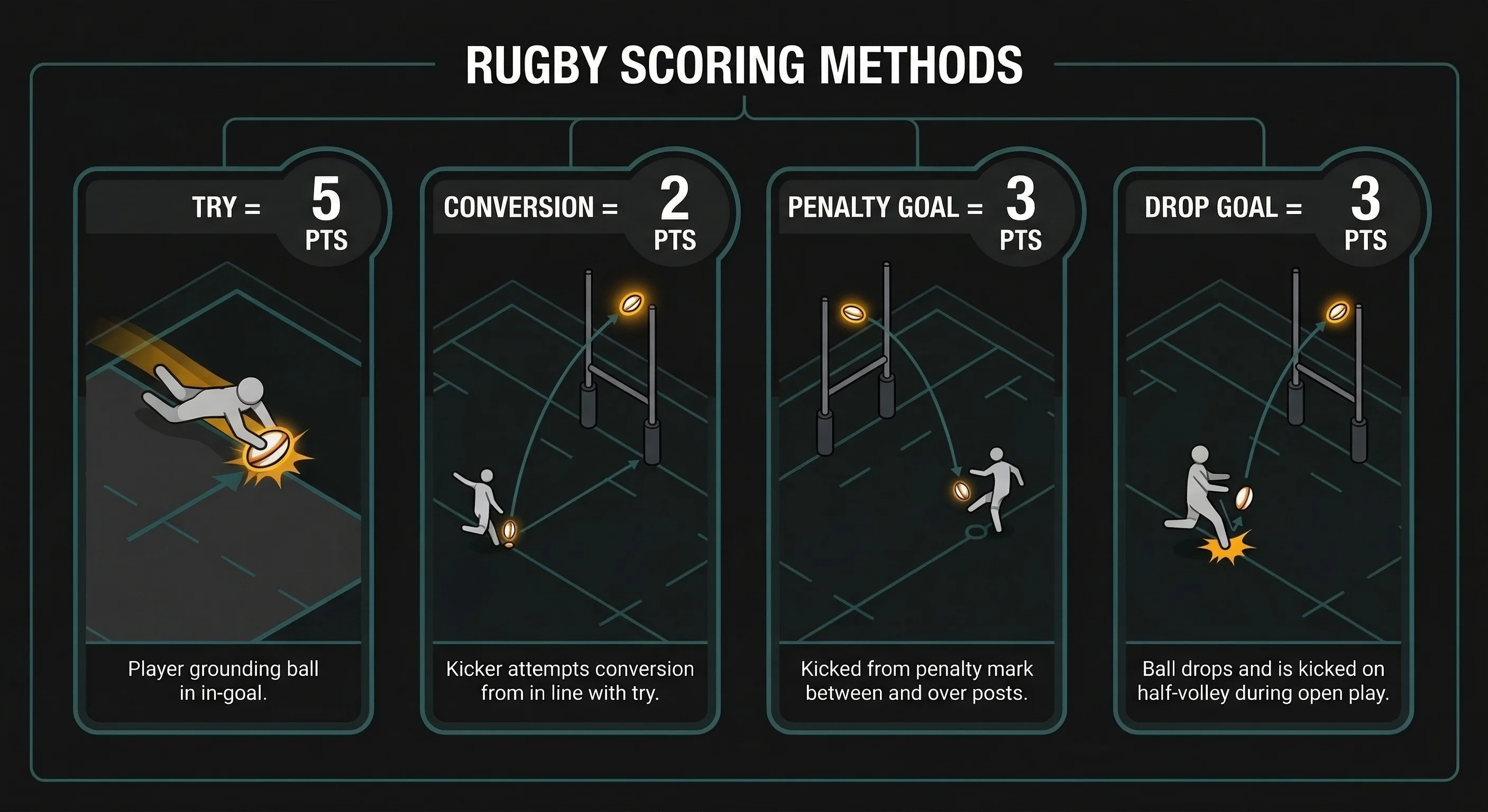
Law 8 in plain English
There are five ways to score points in rugby:
Try (5 points): The main scoring method. An attacking player grounds the ball in the opponents' in-goal, which includes the try line itself. Grounding means touching the ground with the ball while holding it, or pressing down on the ball with a hand, arm or the front of the body between the waist and the neck (Law 21.1). Just carrying it over the line is not enough if you can't ground it.
Conversion (2 points): After scoring a try, the scoring team may take a kick at goal, or turn it down. The kick is taken from a line through where the try was awarded, parallel to the touchlines, as a place kick or a drop kick. Over the crossbar and between the posts = 2 more points.
Penalty Goal (3 points): When your team wins a penalty, you can choose to kick at goal instead of kicking for touch, tapping and running, or taking a scrum. The kick must be a place kick or a drop kick, and must go over the crossbar and between the posts.
Dropped Goal (3 points): In open play, a player drops the ball onto the ground and kicks it as it rises from its first bounce. If it goes over the crossbar and between the posts, it scores 3 points.
Penalty Try (7 points): If the referee decides foul play by the defending team stopped what would probably have been a try, or stopped a try being scored in a better position, a penalty try is awarded between the posts. Seven points are added; no conversion is attempted. The player guilty of the foul play must also either be sent off, or be cautioned and shown a yellow card.
Law 8 section by section
Points for Each Score
There are five ways to score, and each one is worth a set number of points:
- (a) Try: five points.
- (b) Conversion: two points.
- (c) Penalty try: seven points.
- (d) Penalty goal: three points.
- (e) Dropped goal: three points.
How a Try Is Scored
An attacking player scores a try when they:
- (a) touch the ball down in the opposition's in-goal before anyone else does.
- (b) are the first to touch the ball down as a scrum, ruck or maul reaches the try line.
- (c) are tackled with the ball short of the line, slide on in one continuous movement along the ground into the opposition's in-goal, and are the first to touch it down.
- (d) are tackled close to the opposition's try line and at once reach out and touch the ball down.
- (e) are outside the playing area but not holding the ball, and touch it down in the opposition's in-goal.
Penalty Try
The referee awards a penalty try between the posts when the defending team commits foul play that stops a try that would probably have been scored, or stops one being scored in a better position. The offender must either be sent off, or be cautioned and shown a yellow card. No conversion is taken. A penalty try is worth seven points (see Law 8.1).
What Makes a Goal
A goal only counts if the kicked ball passes over the crossbar and between the posts without first touching the ground or one of the kicker's team-mates.
Ball Above the Posts
When the ball passes over the crossbar higher than the tops of the posts, the kick is good if it is judged that the ball would have gone between them had the posts been taller.
Wind Blows It Back
Once the ball has crossed the crossbar, the score stands even if the wind carries it back into the field of play.
Right to a Conversion
Scoring a try earns the team the chance to kick a conversion, by place-kick or drop-kick. The team can choose not to take it (see Law 5.8a).
Taking the Conversion
The kicker must:
- (a) kick from somewhere in the field of play on an imaginary line, parallel to the touchlines, through the spot where the try was awarded.
- (b) rest the ball directly on the ground, or on a kicking tee, sand or sawdust. A team-mate may hold it as the placer, but no other aid is allowed.
- (c) under a global law trial, kick within 60 seconds of playing time from the moment the try was awarded, even if the ball topples over and has to be set up again.
Sanction: Kick disallowed.
Kicker's Team-Mates
Apart from a team-mate holding the ball, the kicker's team must be behind the ball when it is kicked. They must not do anything to trick the opponents into charging early. Sanction: Kick disallowed.
Ball Falls Before Run-Up
If the ball topples over before the kicker starts the run-up, the referee lets the kicker set it up again. The opponents stay behind their try line while this happens.
Ball Falls During Run-Up
If the ball topples over once the kicker has started the run-up, the kicker may still kick it, or may try a dropped goal instead.
Ball Rolls Off the Line
If the fallen ball rolls away from the line through the spot where the try was awarded, and the kicker then sends it over the crossbar, the conversion counts.
Ball Rolls Into Touch
If the ball topples over and rolls into touch after the kicker has started the run-up, the kick is disallowed.
Defenders at a Conversion
The opposing players all go back to their try line and must not cross it until the kicker starts the approach by moving in any direction. Once the kicker has settled in position, their next step, or lifting a foot off the ground, counts as starting the approach, whichever way they move. From that moment the opponents may charge or jump to try to block the kick, but team-mates must not physically hold them up while they do. Sanction: If the kick still goes over, the goal stands. If it misses, the kicker takes it again and the opponents may not charge. For the retake, the kicker may go through all the preparation again and may switch to a different type of kick.
No Shouting at Conversions
The opposing team must not shout while a conversion is being attempted. Sanction: As in Law 8.14. A successful kick stands. A missed kick is taken again with no charge allowed, and the kicker may prepare again and change the type of kick.
Charging a Fallen Ball
If the ball topples over after the kicker has begun the run-up, the opponents may keep charging.
Opponent Touches the Ball
A goal still counts if an opposing player touched the ball on its way over.
Only From a Penalty
Only a penalty kick can produce a penalty goal.
Saying So Without Delay
A team that wants to kick at goal from a penalty must make that clear straight away.
Committed Once Indicated
Once a team has told the referee it will kick at goal, it has to go through with the kick. The team can show its choice by telling the referee, by bringing on the kicking tee or sand, or by the kicker marking the ground. Sanction: The kick is disallowed and a scrum is awarded.
Sixty-Second Limit
The kick has to be taken within 60 seconds of playing time from when the team signalled its choice, even if the ball topples over and has to be set up again. Sanction: The kick is disallowed and a scrum is awarded.
Opponents Stand Still
When the kicker has told the referee they are going for goal, the opposing players must keep still with their hands at their sides from the start of the kicker's run-up until the ball is kicked (see Law 8.27).
Unannounced Drop-Kick Goal
If the kicker did not say they were going for goal but drop-kicks the ball over, the goal still counts.
Placing the Ball
For a penalty kick, the ball rests directly on the ground, or on a kicking tee, sand or sawdust. A team-mate may hold it as the placer, but nothing else may help the kicker. Sanction: Scrum.
Touching to Stop a Goal
A player who deliberately touches the ball to try to stop a penalty goal is touching it illegally (see Law 8.27).
No Shouting at Penalty Kicks
Defenders must not shout while a penalty kick at goal is being taken (see Law 8.27).
Opponents Infringe at the Kick
If the opponents infringe while the kick is being taken and it still goes over, the goal stands and no extra penalty is given. If it misses, the kicking team gets another penalty, with the mark moved 10 metres forward. Sanction: Penalty.
Dropped Goal
A dropped goal is scored when a player drop-kicks a goal in open play.
Dropped Goal After Free-Kick
A team given a free-kick cannot score a dropped goal until the ball is next dead, or until an opponent has played or touched the ball or tackled the ball carrier. This also applies if the team takes a lineout instead of the free-kick. Any such kick is treated as unsuccessful, and play goes on.
Real-World Examples
Scenario
A winger dives for the corner and, holding the ball, touches it down on the try line itself without touching the touchline or touch-in-goal. The winger's body is still short of the line. Has a try been scored?
Outcome
Yes, a try is scored. The try line is part of the in-goal, and touching the ground with the ball while holding it is grounding (Law 21.1), wherever the rest of the body is.
Scenario
A try is scored 20 metres from the left touchline. The kicker takes the conversion attempt from the touchline rather than moving infield.
Outcome
Not allowed. The kick must be taken in the field of play on a line through where the try was awarded, parallel to the touchlines (Law 8.8a). Here that line is 20 metres in from the touchline. The kicker can go as far back along it as they like, but cannot move across to the touchline, and a kick from the wrong place is disallowed.
Scenario
The defending prop deliberately collapses a scrum 3 metres from the try line, preventing the attacking team from scoring. The referee judges a try would probably have been scored.
Outcome
A penalty try is awarded. 7 points are scored for the attacking team, between the posts. No conversion is taken. The prop who collapsed the scrum must also either be sent off, or be cautioned and shown a yellow card (Law 8.3).
Scenario
A fly-half attempts a dropped goal in open play. The ball hits the upright and bounces back onto the field. No other player touches it.
Outcome
No goal is scored. The ball must pass over the crossbar and between the posts (Law 8.4). Hitting the upright without crossing over does not count. Play continues.
Common questions
How many points is a try in rugby?
A try is worth 5 points. After a try, the scoring team has the option to attempt a conversion for an additional 2 points.
How many points is a penalty try?
A penalty try is worth 7 points and is awarded between the posts when foul play by the defending team stopped what would probably have been a try, or stopped it being scored in a better position. No conversion is attempted, and the player guilty of the foul play must either be sent off, or be cautioned and shown a yellow card.
How many points is a drop goal in rugby?
A dropped goal scores 3 points. The kicker drops the ball and kicks it as it rises from the first bounce, over the crossbar and between the posts, in open play. A team given a free-kick cannot score one until the ball is dead, or an opponent has played or touched the ball or tackled the ball carrier.
How many points is a conversion in rugby?
A successful conversion is worth 2 points. It is taken from anywhere on a line through the spot where the try was awarded, parallel to the touchlines, using either a place kick or a drop kick.
What counts as grounding the ball for a try?
Grounding means touching the ground with the ball while holding it, or pressing down on the ball with a hand or arm, or with the front of the body between the waist and the neck. Picking the ball up is not grounding it.