
Law 14 of 21
Tackle Rules in Rugby: Law 14
Defines the tackle, and the duties of the tackler, tackled player, and other players arriving at the tackle. All must act quickly to keep the game moving.
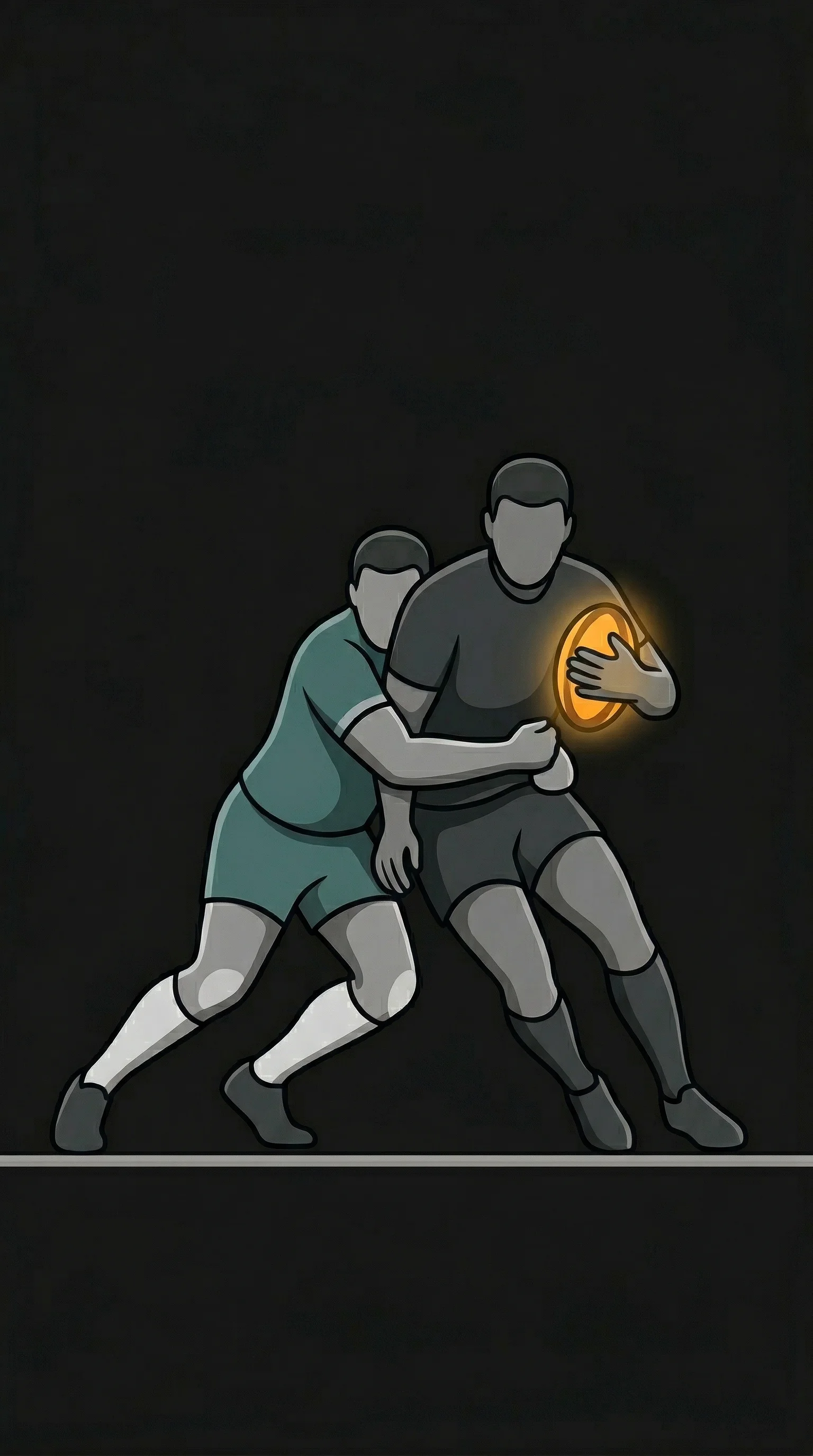
Law 14 in plain English
A tackle happens when one or more opponents hold the ball carrier and bring them to the ground. It is one of the most common and most regulated events in rugby. Tacklers must tackle below the sanction line: the shoulder line in elite rugby, and the waist or base of the sternum in community rugby. Ball carriers must also go into contact safely.
What is "being brought to ground"? The ball carrier is lying or sitting on the ground, has at least one knee on it, or is on top of another player who is on the ground. The tackler must keep hold all the way down. Simply being grabbed is not a tackle unless the player goes to ground.
The tackled player must immediately:
- Make the ball available by releasing, passing or pushing it in any direction except forward (it can be placed in any direction)
- Get up or move away from the ball
- Not lie on, over or near the ball to stop the opponents getting it
The tackler must:
- Release the ball and the tackled player as soon as both are on the ground
- Get up or move away from the tackled player and the ball
- Let the tackled player release, play or move away from the ball
- Be back on their feet before playing the ball, and then only from the direction of their own try line and before a ruck forms
Other players arriving at the tackle:
- Must stay on their feet and come in from their own side, from the direction of their own try line (coaches call this the "gate", though the laws do not use the word)
- Must stay on or behind the offside line, which runs through the hindmost point of anyone in the tackle or standing over the ball
- Must not play the ball, or tackle, while on the ground near the tackle
- Must not roll, twist or pull an opponent in the tackle to the ground (the crocodile roll)
- Must not fall on or over a player on the ground who has the ball or is close to it (Law 13.4)
Ruck or play from tackle: A player on their feet who wins the ball must play it straight away. A ruck forms when players from both teams are on their feet, in contact, over the ball. Once a ruck forms the tackle is over and Law 15 applies.
Sanction: Penalty for any infringement.
Law 14 section by section
What Makes a Tackle
A tackle happens when one or more opponents hold the ball-carrier and bring them to ground. Tacklers must tackle below the high-tackle sanction line that applies. In elite rugby that line is the shoulder line. In community rugby it is the waist or the base of the sternum, as the match organiser decides. The ball-carrier must also go into the tackle safely. (See Laws 9.13 and 14.5a and the Game-On variation.)
Brought to Ground
A ball-carrier has been brought to ground when they are lying or sitting on the ground, or have at least one knee on it. Being on top of another player who is on the ground also counts.
Being Held
Being held means the tackler keeps hold of the ball-carrier all the way until the ball-carrier reaches the ground.
Players in a Tackle
The players in a tackle are:
- (a) The tackled player.
- (b) The tackler or tacklers.
- (c) Other players: (i) anyone who holds the ball-carrier in the tackle but stays on their feet, known as a tackle assist; (ii) anyone who arrives to compete for the ball; (iii) anyone already on the ground.
Tacklers' Duties
Tacklers must:
- (a) Tackle below the sanction line that applies: the shoulder, the base of the sternum or the waist.
- (b) Let go of the ball and the ball-carrier immediately once both players are on the ground.
- (c) Get up, or move away from the tackled player and the ball, straight away.
- (d) Be on their feet before they try to play the ball.
- (e) Let the tackled player release or play the ball.
- (f) Let the tackled player move away from the ball.
Sanction: Penalty.
Tackler Playing the Ball
A tackler who has met all of those duties may play the ball, as long as they come from the direction of their own try line and a ruck has not formed.
Tackled Player's Duties
A tackled player must immediately:
- (a) Make the ball available so play can go on, by releasing it, passing it or pushing it in any direction other than forward. They may place it in any direction.
- (b) Get up or move away from the ball.
- (c) Not lie on, over or near the ball in a way that keeps opponents from getting it.
Sanction: Penalty.
Other Players' Duties
Other players must:
- (a) Stay on their feet and let go of the ball and the ball-carrier immediately.
- (b) Stay on their feet when they play the ball.
- (c) Before playing the ball, come into the tackle from their own side (from the direction of their own try line).
- (d) Not play the ball, or try to tackle an opponent, while they are on the ground near the tackle.
- (e) Not roll, twist or pull an opponent in the tackle down to the ground (the crocodile roll).
- (f) Stay on or behind their offside line.
Sanction: Penalty.
Gaining Possession
A player who wins possession of the ball:
- (a) Must play it straight away, by moving away with it or by passing or kicking it.
- (b) Must stay on their feet, and must not go down at or near the tackle unless an opponent tackles them.
- (c) Can be tackled, but the tackler must come from the direction of their own try line when doing so.
Sanction: Penalty.
Offside Lines at a Tackle
A tackle creates offside lines once at least one player is on their feet over the ball while it is on the ground. Each team's offside line is a line parallel to the try lines, drawn through the hindmost point of anyone in the tackle or anyone on their feet over the ball (hindmost means nearest that team's own try line). If that point is on or behind a team's try line, that team's offside line is the try line.
End of the Tackle
The tackle is over when:
- (a) A ruck forms.
- (b) A player from either team who is on their feet wins the ball and moves away with it, passes it or kicks it.
- (c) The ball leaves the tackle area.
- (d) The ball becomes unplayable. If it is unclear which player failed to keep to the laws, the referee awards a scrum, and the team that was last moving forward before play stopped throws in.
Real-World Examples
Scenario
A ball carrier is tackled to the ground and immediately places the ball behind them (toward their own team). The tackler stays on top of the ball carrier for 3 seconds.
Outcome
Penalty against the tackler for not releasing immediately (Law 14.5). Once both players are on the ground, the tackler must let go of the tackled player and the ball, then get up or move away. The tackled player was right to place the ball: it may be placed in any direction (Law 14.7).
Scenario
A flanker arrives at a tackle from the side, rather than from his own side of the ball, and picks up the ball.
Outcome
Penalty against the flanker. Players arriving at a tackle must come from the direction of their own try line before they play the ball (Law 14.8c). Coming in from the side gives an unfair advantage and disrupts the contest.
Scenario
A ball carrier is held and brought to ground. She keeps both hands on the ball and gets back to her feet with it before any opponent arrives.
Outcome
Penalty against her for holding on. A tackled player must immediately make the ball available by releasing, passing or pushing it, and then get up or move away from it (Law 14.7). Law 14 gives a tackled player no option to get up with the ball. A player who goes to ground with the ball without being tackled is different: Law 13.1 lets them get up with it.
Scenario
A number eight is tackled. Before the tackler releases him, a teammate from the same team arrives over the ball and a ruck forms with players from both sides.
Outcome
The tackler gives away a penalty if he did not let go at once: a tackler must release the ball and the tackled player immediately (Law 14.5b). Once the ruck forms, the tackle is over (Law 14.11) and Law 15 applies. In the ruck, no one may handle the ball unless they had hands on it before the ruck formed and stay on their feet (Law 15.11).
Scenario
A winger is tackled near the touchline. As she goes to ground, she deliberately places the ball in touch to slow down the opposition.
Outcome
Penalty against the winger. Deliberately knocking, placing, pushing or throwing the ball out of the playing area with the hand or arm is unfair play (Law 9.7b). A tackled player must make the ball available so that play can go on (Law 14.7).
Common questions
What is a tackle in rugby?
A tackle happens when one or more opponents hold the ball carrier and bring them to ground. Brought to ground means lying or sitting on the ground, having at least one knee on it, or being on top of another player who is on the ground, and the tackler must keep holding the ball carrier until then. A player who goes to ground without being held has not been tackled (Law 14.1 to 14.3).
What must the tackled player do?
The tackled player must immediately make the ball available by releasing, passing or pushing it in any direction except forward (they may place it in any direction), and then get up or move away from it. They must not lie on, over or near the ball to stop opponents getting it (Law 14.7). Deliberately putting the ball out of the playing area with the hand or arm is a penalty under Law 9.7b.
What must the tackler do?
The tackler must immediately release the ball and the ball carrier once both are on the ground, then get up or move away from the tackled player and the ball. They must let the tackled player release, play or move away from the ball. A tackler may then go for the ball, approaching from the direction of their own try line, but only once back on their feet and before a ruck has formed (Law 14.5, 14.6).
What is the gate at a tackle in rugby?
The gate is a coaching term, not a word the laws use. Law 14.8c says players arriving at a tackle must approach from the direction of their own try line before they play the ball, so coming in from the side is penalised. At a ruck, players must join from behind their offside line and not in front of the hindmost player (Law 15.5, 15.6).
Can you jackal in rugby?
Yes. The laws call this player the jackler or stealer: the first team-mate of the tackler to arrive at the tackle. They must stay on their feet and contest directly for the ball, and anyone who helped make the tackle must clearly let go of the ball carrier before going for the ball. Once a ruck forms, no one may handle the ball unless they already had their hands on it before the ruck formed and stay on their feet (Law 15.11).