
Law 1 of 21
Field of Play in Rugby: Law 1
Defines the dimensions, markings, goal posts, and flag posts of a rugby field.
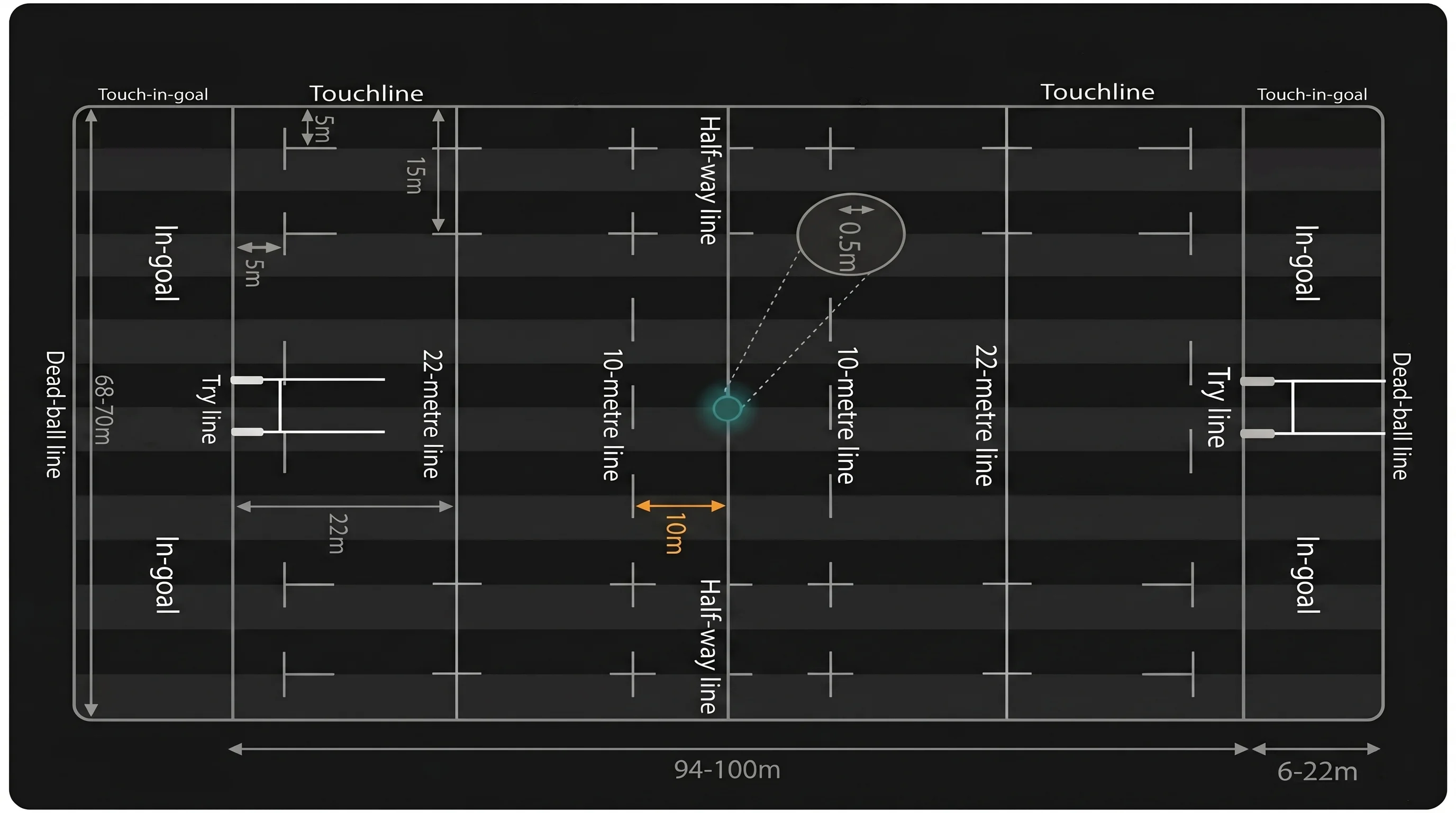
Law 1 in plain English
The ground is where the match is played, and its surface must be safe. The field of play is 94 to 100 metres long, and the playing area is 68 to 70 metres wide. At each end there is an in-goal area, 6 to 22 metres deep, where tries are scored. Around the playing area runs a perimeter area, which should be five metres wide where that is practicable.
Solid lines mark the touchlines, the try lines, the 22-metre lines, the half-way line, the dead-ball lines and the touch-in-goal lines. Dashed lines run 5 metres and 15 metres in from each touchline, 10 metres either side of the half-way line, and 5 metres into the field of play from each try line. The goal posts stand on the try line, 5.6 metres apart, with the top of the crossbar 3 metres off the ground and the posts at least 3.4 metres tall. Fourteen flag posts, each at least 1.2 metres high, mark the corners of the in-goal areas and stand level with the 22-metre lines and the half-way line.
Teams must raise any objection about the ground with the referee before the match. The referee will not start a match on ground that is unsafe in any part.
Law 1 section by section
Safe Playing Surface
Every part of the playing enclosure's surface has to be safe.
Permitted Surfaces
The surface can be grass, clay, sand or snow, or it can be artificial turf that meets World Rugby Regulation 22.
Dimensions of the Playing Area
The ground diagram shows the size of the playing area. The limits are:
- Field of play length: 94 to 100 metres.
- In-goal length: 6 to 22 metres.
- Width: 68 to 70 metres.
These rules also apply:
- The playing area is a rectangle.
- Any change to these dimensions needs approval from the relevant union for domestic competitions, or from World Rugby for international matches.
- If the field of play is shorter than 100 metres, the gap between each 10-metre line and the nearby 22-metre line is cut down to match.
- If the playing area is narrower than 70 metres, the gap between the two 15-metre lines is cut down to match.
- Where practicable, the perimeter area should be five metres wide. It should be no narrower than 3.5 metres for the men's game and 3.0 metres for the women's game.
Solid Lines
Solid lines are marked as the ground diagram shows. There is a solid line along:
- Each touchline.
- Each try line.
- Each 22-metre line.
- The half-way line.
- Each dead-ball line and each touch-in-goal line.
Dashed Lines
Dashed lines are marked as the ground diagram shows, and every dash is five metres long. A dashed line runs parallel to:
- Each touchline, 5 metres in from it.
- Each touchline, 15 metres in from it.
- The half-way line, 10 metres away on each side of it.
- Each try line, 5 metres into the field of play.
Centre Mark
A short line, 0.5 metres long, crosses the half-way line at its centre point.
Goal Post Padding
If the goal posts are padded, the outer edge of the padding can be no more than 0.5 metres away from the post. World Rugby's goal posts diagram also shows the posts 5.6 metres apart, the top edge of the crossbar 3 metres above the ground, and a minimum post height of 3.4 metres.
Number of Flag Posts
The ground has 14 flag posts. Each one carries a flag and stands at least 1.2 metres tall.
In-Goal Corner Flags
Eight of the flag posts mark the corners of the two in-goal areas: one wherever a touch-in-goal line meets a try line, and one wherever a touch-in-goal line meets a dead-ball line.
Touchline Flag Posts
The other six flag posts stand on both sides of the pitch, two metres outside the touchline but still inside the playing enclosure. On each side there is one level with each 22-metre line and one level with the half-way line.
Raising Objections
If a team has an objection about the ground, it must tell the referee before kick-off.
Unsafe Ground
The referee tries to sort out any problem that has been raised. If the referee considers that any part of the ground is unsafe, the match does not start.
Real-World Examples
Scenario
The groundskeeper has left a sprinkler head sticking up from the surface near the 22-metre line. A team captain notices it during warm-ups.
Outcome
The captain should tell the referee before the match starts (Law 1.11). The surface must be safe (Law 1.1), so the referee will try to resolve the problem and will not start the match while that part of the ground is unsafe (Law 1.12).
Scenario
A conversion is kicked high from in front of the posts. The ball goes over the crossbar but is higher than the tops of the posts as it passes them.
Outcome
The kick can still count. Under Law 8.5, when the ball passes over the crossbar higher than the posts, the kick is good if it is judged that the ball would have passed between the posts were they taller. Law 1 only sets how tall the posts must be at minimum: 3.4 metres in World Rugby's diagram.
Scenario
A stadium has a field of play 96 metres long and a playing area 69 metres wide, with 8-metre in-goal areas.
Outcome
This is legal, because every measurement is within the Law 1.3 limits (94 to 100 metres long, 68 to 70 metres wide, 6 to 22 metres of in-goal). As the field of play is shorter than 100 metres, the gap between each 10-metre line and its 22-metre line is reduced to match. As the playing area is narrower than 70 metres, so is the gap between the 15-metre lines.
Common questions
How big is a rugby field?
The field of play is 94 to 100 metres long and the playing area is 68 to 70 metres wide, with an in-goal area 6 to 22 metres deep at each end (Law 1.3). From one dead-ball line to the other, the playing area is therefore between 106 and 144 metres long.
How wide are rugby goal posts?
In World Rugby's goal posts diagram the posts are 5.6 metres apart, the top edge of the crossbar is 3 metres above the ground, and the posts are at least 3.4 metres tall. Any padding on a post must not stick out more than 0.5 metres from the post (Law 1.7).
Does a kick at goal count if the ball goes higher than the posts?
It can. Under Law 8.5, if the ball passes over the crossbar but above the tops of the posts, the kick is successful if it is judged that the ball would have passed between the posts had they been taller.
How many flag posts are on a rugby pitch?
There are 14, each at least 1.2 metres high (Law 1.8). Eight mark the in-goal corners, where the touch-in-goal lines meet the try lines and the dead-ball lines. The other six stand two metres outside the touchlines, three on each side, level with the two 22-metre lines and the half-way line.
What surfaces can rugby be played on?
Law 1.2 allows grass, clay, sand, snow, or artificial turf that meets World Rugby Regulation 22. Whatever the surface, it must be safe, and if the referee considers any part of the ground unsafe the match will not start.