
Rugby term
Penalty kick
Definition
A penalty kick is awarded after a serious infringement and lets the team kick at goal for 3 points, kick to touch, tap and play, or take a scrum.
When a penalty is awarded
The referee awards a penalty kick for a serious infringement, such as offside, not releasing at the tackle, or foul play. It is taken at the mark, usually where the infringement happened, or anywhere behind it on a line parallel to the touchlines (Law 20). Opponents must immediately retreat 10 metres towards their own try line, or to that line if it is closer (Law 20).
The four options
The non-offending team chooses one:
- kick at goal: a place kick or drop kick over the crossbar and between the posts scores 3 points (Law 8)
- kick to touch: the kicking team throws in at the lineout where the ball went out (Law 18)
- tap and play: kick the ball a visible distance, then run, pass or kick (Law 20)
- scrum: take a scrum instead of the kick (Law 20)
A team that wants to kick at goal must say so without delay, and then has 60 seconds to take the kick (Law 8).
Why kicking to touch is popular
Normally the opponents of the team that put the ball into touch get the throw-in (Law 18). A penalty is the exception. Kick a penalty into touch and your own team throws in, wherever the kick was taken from, even if the ball goes out on the full (Law 18). That is why teams often kick a penalty deep into the opposition half and set up a lineout close to the try line.
What the referee does and signals
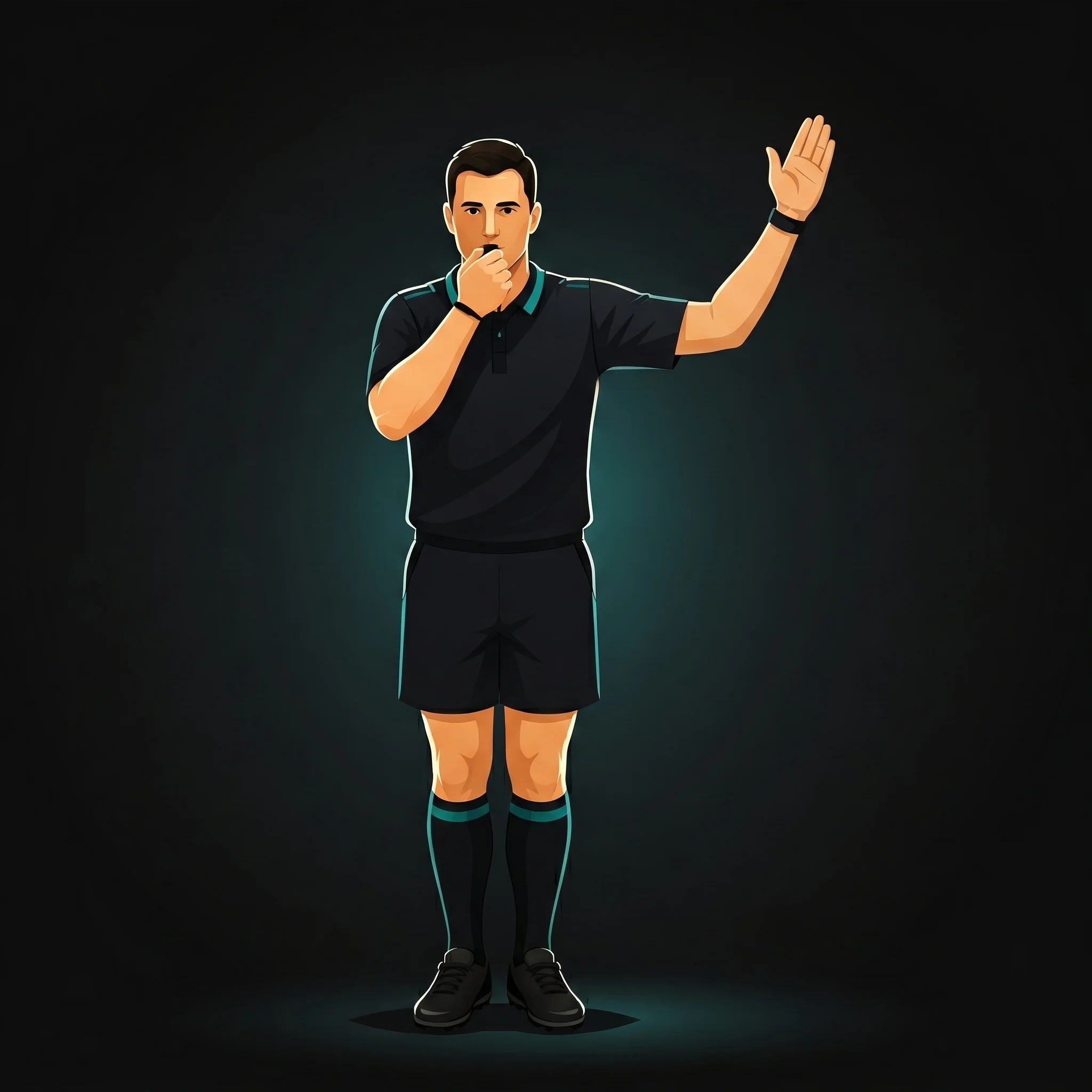
The referee blows the whistle (Law 6) and signals the penalty with an arm raised towards the team that has been awarded it. The signal is shown below.
Penalty or free-kick?
A free-kick is the lesser sanction, for offences such as a crooked feed at the scrum (Law 19). The big differences are that a goal cannot be scored directly from a free-kick (Law 8), and kicking a free-kick into touch does not keep the throw-in (Law 18). Since 2024 a team awarded a free-kick can no longer choose a scrum instead (Law 20).
Referee signal
Common questions
What is a penalty kick in rugby?
It is the sanction for a serious infringement. The non-offending team can kick at goal, kick to touch, tap and play, or take a scrum (Laws 8, 18 and 20).
How many points is a penalty kick worth?
A successful penalty kick at goal, called a penalty goal, is worth 3 points (Law 8). The ball must go over the crossbar and between the posts.
Who throws in after a penalty kick to touch?
The team that kicked it. After a penalty is kicked into touch, the kicking team throws in at the lineout, wherever the kick was taken from (Law 18).
How far back must players go at a penalty?
All opponents must immediately retreat 10 metres towards their own try line, or to that line if it is closer. They must keep retreating even if the kick is taken quickly (Law 20).
What is the difference between a penalty and a free-kick?
A penalty can be kicked at goal for 3 points, or kicked to touch with the throw-in kept. A free-kick is given for lesser offences and cannot score directly (Laws 8 and 18).
Updated