
Rugby term
Kick-off
Definition
A kick-off is the drop kick from the centre of the halfway line that starts each half of a match and restarts play after a score.
When there is a kick-off
A kick-off starts each half. Who kicks off at the start is decided by the coin toss: the winner chooses to kick off or to choose an end, and if they choose an end the opponents kick off (Law 6). The opponents of the team who kicked off the match start the second half (Law 12).
After a score, the team that conceded the points restarts play with the same drop kick from the centre of the halfway line. The laws call this one a restart kick (Law 12).
The rules for a kick-off
Law 12 sets the rules:
- it is a drop kick taken on or behind the centre of the halfway line
- the kicker's team-mates must be behind the ball when it is kicked
- the receiving team must be on or behind their own 10-metre line
- the ball must reach the receiving team's 10-metre line
If the ball reaches the 10-metre line and is then blown back, or a receiving player plays it before it gets there, play simply continues.
When the kick-off goes wrong
If the ball does not reach the 10-metre line, the receiving team chooses between having the kick retaken and a scrum (Law 12). The scrum is in the middle of the halfway line, and the receiving team throws in (Law 19).
If the ball goes straight into touch, the receiving team chooses between a retake, a scrum, a lineout or a quick throw (Law 12).
What the referee does and signals
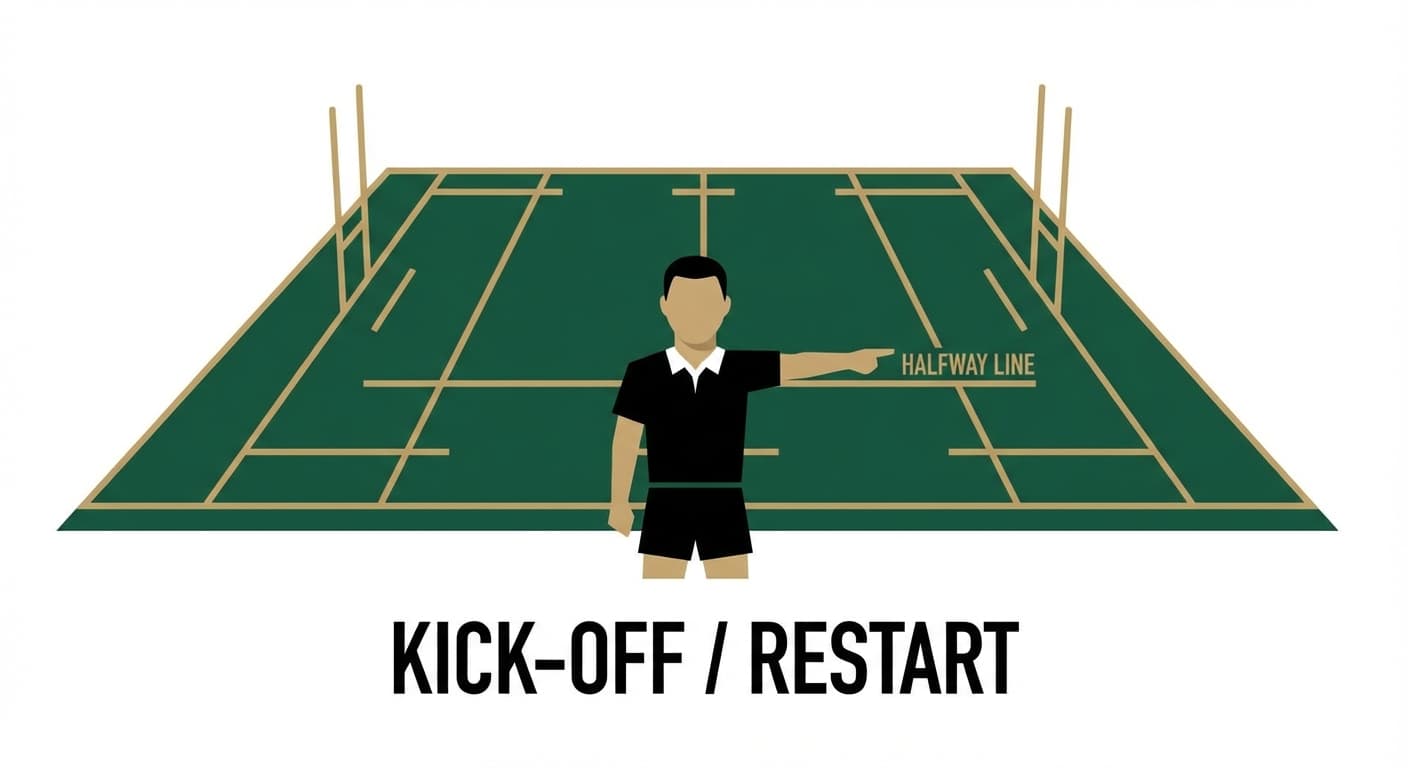
The referee blows the whistle to start each half (Law 6) and checks both teams are in position before the kick is taken. The kick-off and restart signal is shown below.
Kick-off or drop-out?
A kick-off is not the same as a drop-out. The kick-off is taken from the centre of the halfway line. A drop-out is a drop kick from on or behind the defending team's 22-metre line or try line, used to restart play after the ball has been made dead in in-goal in certain situations (Law 12).
Referee signal
Common questions
How does a kick-off work in rugby?
A player drop-kicks the ball from the centre of the halfway line. The kicker's team-mates must be behind the ball, the receivers on or behind their 10-metre line, and the ball must reach that line (Law 12).
Who kicks off after a try in rugby?
The team that conceded the try kicks off to the team that scored it, once the conversion has been taken or declined (Law 12). Sevens is the exception: there, the team that scored restarts.
What happens if a kick-off does not go 10 metres?
The receiving team chooses: have the kick retaken, or take a scrum in the middle of the halfway line with the put-in (Laws 12 and 19).
What happens if the kick-off goes straight into touch?
The receiving team chooses between a retake, a scrum, a lineout or a quick throw (Law 12).
Updated