
Foul Play
Prohibits obstruction, unfair play, dangerous play, and misconduct. Sanctions include penalties, yellow cards (10-minute suspension), and red cards (permanent dismissal).
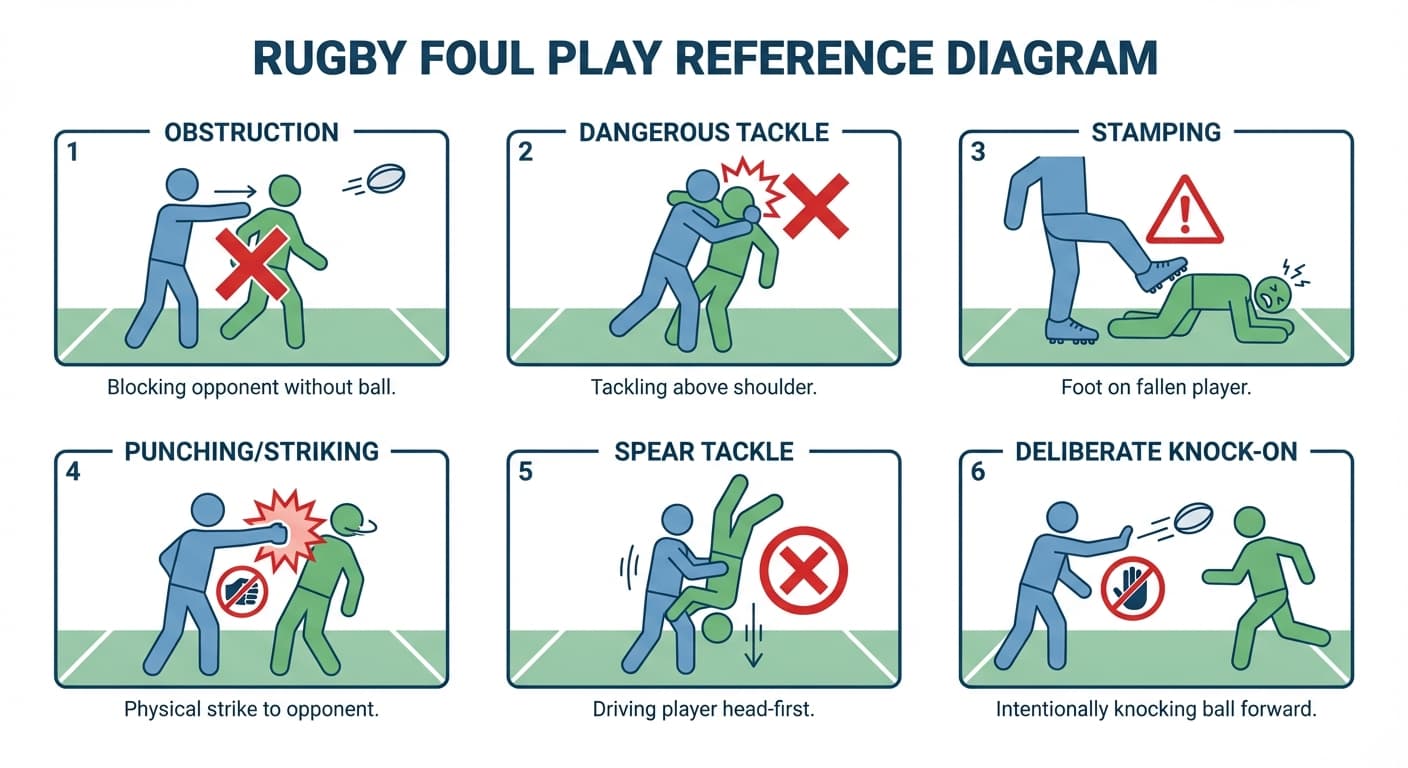
Foul play covers anything a player does that is against the spirit or rules of the game. The main categories are:
Obstruction: Running in front of the ball carrier to block opponents, or getting in the way of players who are going for the ball. Blocking a charging player without the ball is obstruction.
Unfair play: Time-wasting, deliberately throwing the ball into touch, persistent infringements, or any act designed to cheat the opposition out of a fair contest.
Dangerous play: This is the most serious category. It includes high tackles (contact above the shoulder line), tip tackles (lifting a player and dropping them on their head/neck), stamping or trampling, punching or striking, biting, eye-gouging, and dangerous scrummaging. These actions risk injury to others and carry the harshest penalties.
Misconduct: Using abusive or offensive language, showing deliberate disrespect to officials, or behaving in a way that brings the game into disrepute.
Sanctions:
- Penalty — awarded to the non-offending team for most foul play
- Yellow card — 10-minute temporary suspension from the field of play (sin bin). The team plays with one fewer player while the player is off.
- Red card — Permanent dismissal from the match for the most dangerous or egregious acts. The team plays with one fewer player for the rest of the game.
Multiple or persistent infringements can lead to escalating sanctions. Referees can use a graduated approach — warning, yellow card, red card — or go straight to red for the most dangerous acts.
Real-World Examples
Scenario
A defending winger runs across the field without the ball to block the path of an attacker who is chasing a kick.
Outcome
Obstruction. The winger is illegally preventing the attacker from contesting the ball. Penalty awarded to the attacking team at the point of obstruction.
Scenario
A flanker makes multiple infringements at the breakdown — coming in from the side, not releasing the ball, and offside — over the course of several minutes despite the referee's warnings.
Outcome
After warnings, the referee issues a yellow card for persistent infringement. The flanker spends 10 minutes in the sin bin while their team plays with 14 players.
Scenario
A prop attempts to tackle the opposing fly-half and makes contact above the shoulder line, hitting the fly-half in the head area.
Outcome
Dangerous tackle (high tackle). Minimum sanction is a penalty. If the contact is above the shoulder and causes a realistic risk of injury (red zone), a red card is mandatory. If below the shoulder but above the neck, a yellow card may be appropriate (yellow zone).
Scenario
A defensive player picks up a ball carrier, lifts them to beyond horizontal, and drives them into the ground head-first.
Outcome
Tip tackle. This is one of the most dangerous acts in rugby. If the player's head makes contact with the ground, the law requires a red card (permanent dismissal). No replacement may be made — the team plays with 14 for the rest of the game.
Scenario
A scrum-half deliberately throws the ball into touch from a penalty to waste time when her team is leading with 30 seconds left.
Outcome
Deliberate throw into touch is unfair play. Penalty awarded to the opposing team. A second similar act by the same player or team could lead to a yellow card.