
Scoring
Defines how points are scored: tries (5pts), conversions (2pts), penalty goals (3pts), drop goals (3pts), and penalty tries (7pts).
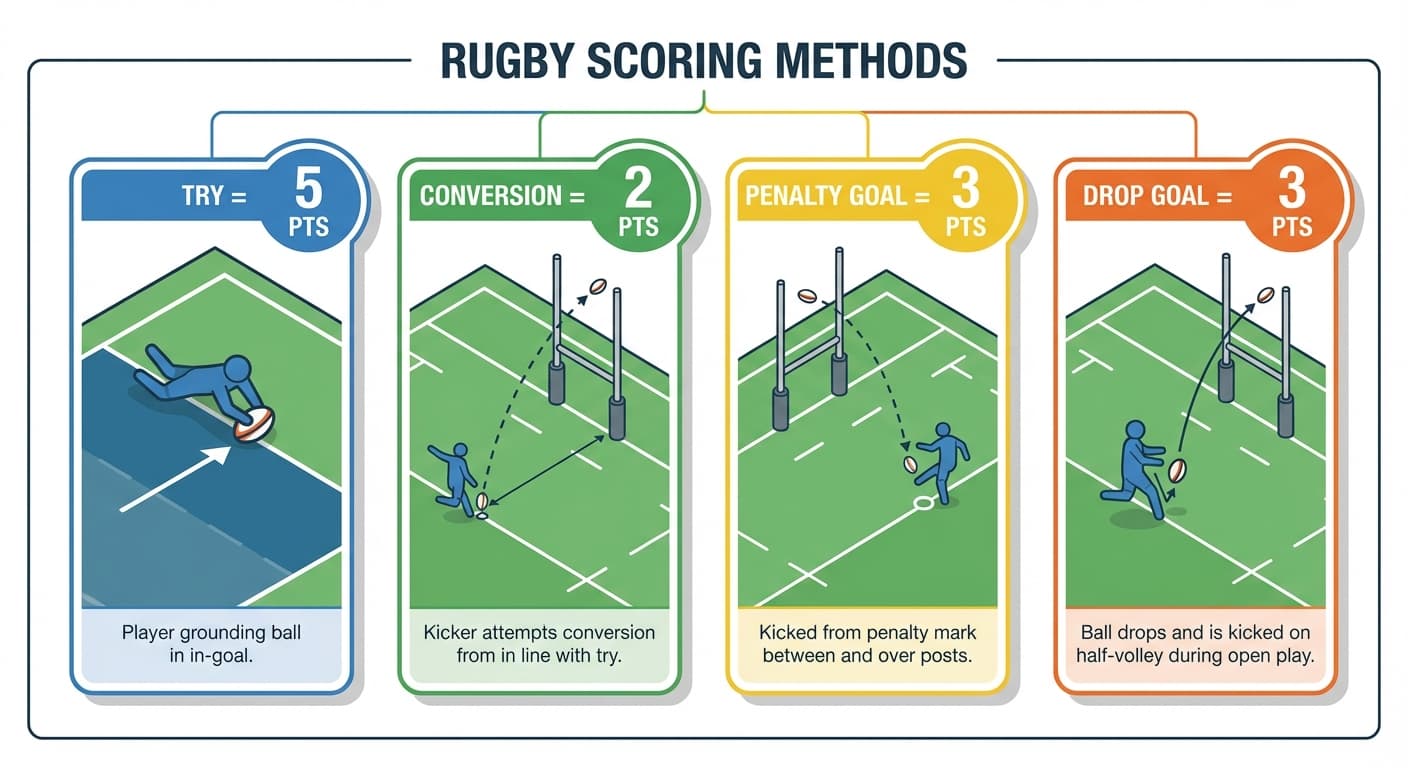
There are five ways to score points in rugby:
Try (5 points): The main scoring method. A player grounds the ball on or over the opponent's try line (in-goal area). You must have downward pressure on the ball — just carrying it over the line is not enough if you can't ground it.
Conversion (2 points): After scoring a try, the scoring team gets a free kick at goal. The kick is taken from a line through where the try was scored, parallel to the touchlines. Both posts and over the crossbar = 2 more points.
Penalty Goal (3 points): When your team wins a penalty, you can choose to kick at goal instead of a scrum, lineout, or tap kick. The kick must go between the posts and over the crossbar.
Dropped Goal (3 points): In open play, a player drops the ball onto the ground and kicks it as it bounces up. If it goes between the posts and over the crossbar, it scores 3 points. Rare and spectacular.
Penalty Try (7 points): If the referee decides foul play by the defending team prevented what would probably have been a try, a penalty try is awarded directly under the posts. Seven points are added — no conversion is attempted.
Real-World Examples
Scenario
A winger dives for the corner but only manages to slide the ball along the ground into the in-goal. The ball is touching the try line but the winger's body is not over the line. Has a try been scored?
Outcome
Yes, a try is scored. Downward pressure on the ball on or over the try line counts. The ball touching the try line (which belongs to the in-goal) with downward pressure from the attacking player is sufficient.
Scenario
A try is scored 20 metres from the left touchline. The kicker takes the conversion attempt from the touchline rather than moving infield.
Outcome
The kicker may take the kick from the touchline if they choose — they may kick from any point on a line extending from where the try was scored, parallel to the touchlines. Taking it from touch is a valid but very difficult choice.
Scenario
The defending prop deliberately collapses a scrum 3 metres from the try line, preventing the attacking team from scoring. The referee judges a try would probably have been scored.
Outcome
A penalty try is awarded. 7 points are scored for the attacking team, placed under the posts. No conversion is taken. The prop who collapsed the scrum may also be given a yellow or red card depending on severity.
Scenario
A fly-half attempts a dropped goal in open play. The ball hits the upright and bounces back onto the field. No other player touches it.
Outcome
No goal is scored. The ball must pass between the posts and over the crossbar. Hitting the upright without crossing over does not count. Play continues.