
Match Officials
Defines the roles and duties of the referee, assistant referees, touch judges, and TMO.
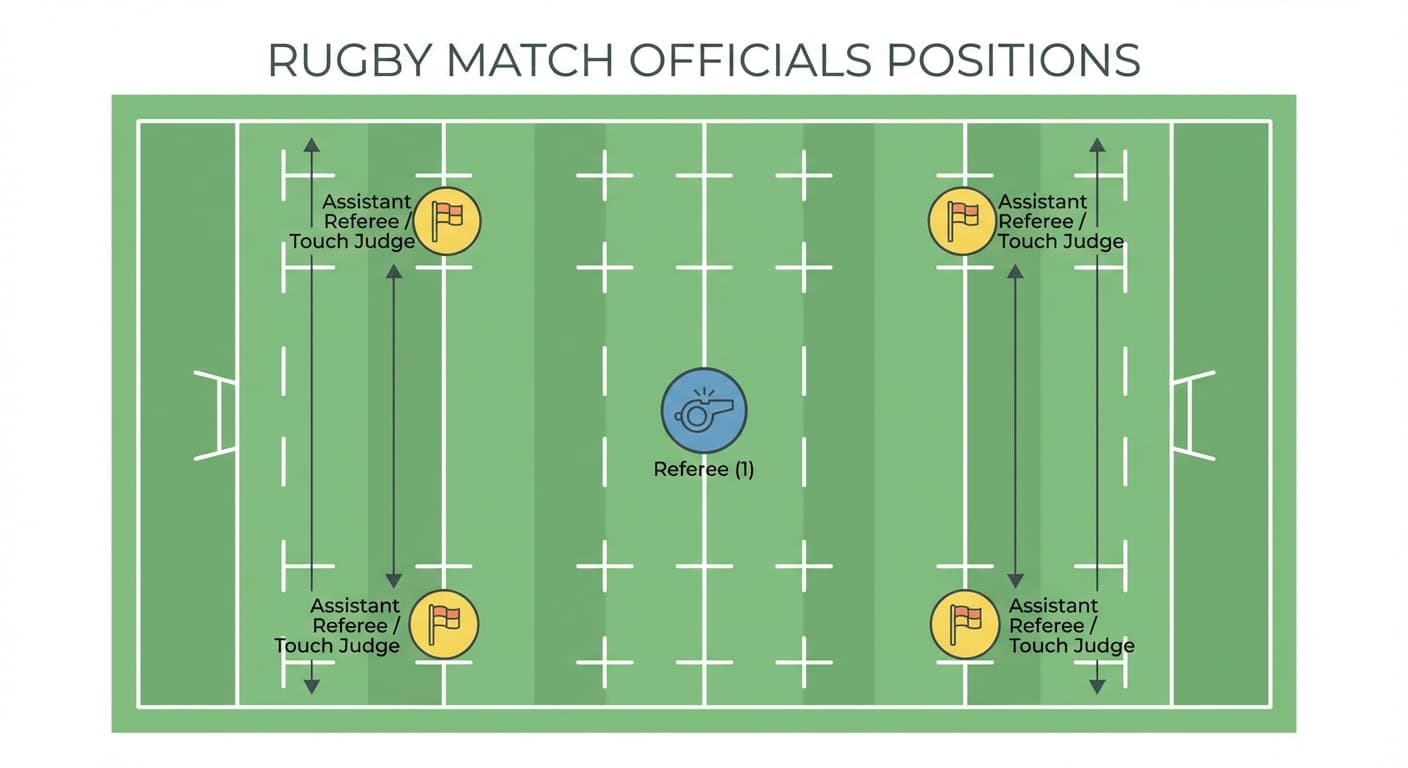
Every match is controlled by a referee and two assistant referees (also called touch judges). The referee is the sole judge of fact and law on the field — their decision is final. They keep score, keep time, control access to the field, and use their whistle to signal the start/end of play, penalties, stoppages, and scores.
The two assistant referees/touch judges patrol the touchlines on each side of the pitch. They signal when the ball goes into touch, judge kick-at-goal attempts, and can report foul play. In top-level matches, a Television Match Official (TMO) can review decisions on video — such as whether a try was scored, whether the ball was in touch before grounding, or whether there was foul play.
An important principle: the referee is the final authority. They can overrule assistant referees, but they may also seek their assistance. The referee's duty is to apply the laws fairly and consistently in every match.
Real-World Examples
Scenario
The ball-carrier crashes into the referee accidentally in midfield. The ball spills forward.
Outcome
The referee assesses advantage. If neither team gained an advantage from the contact, play continues. If a team gained an advantage, a scrum is awarded to the team that last played the ball.
Scenario
The assistant referee on the far side raises their flag during open play to signal foul play.
Outcome
The assistant referee stays in touch and continues their normal duties (signalling touch, watching kicks at goal) until the next stoppage. When play stops, the referee may invite the assistant referee onto the field to report the offence, and will then take appropriate action.
Scenario
The TMO spots a potential forward pass in the build-up to a try during a review.
Outcome
Under the TMO protocol, the review can extend to an infringement in the playing area leading to the try. If the forward pass is confirmed, the try will be disallowed and a scrum awarded to the defending team from where the forward pass occurred.
Scenario
A water carrier runs onto the pitch during open play to give a player a drink.
Outcome
This is prohibited. Water carriers may only enter during a stoppage in play (for an injury) or after a try has been scored. Entering during live play results in a penalty where play would restart.