
Penalty and Free-Kick
Penalties are awarded for serious infringements and allow the kicker to attempt a goal or kick to touch. Free-kicks are for minor infringements and cannot score directly.
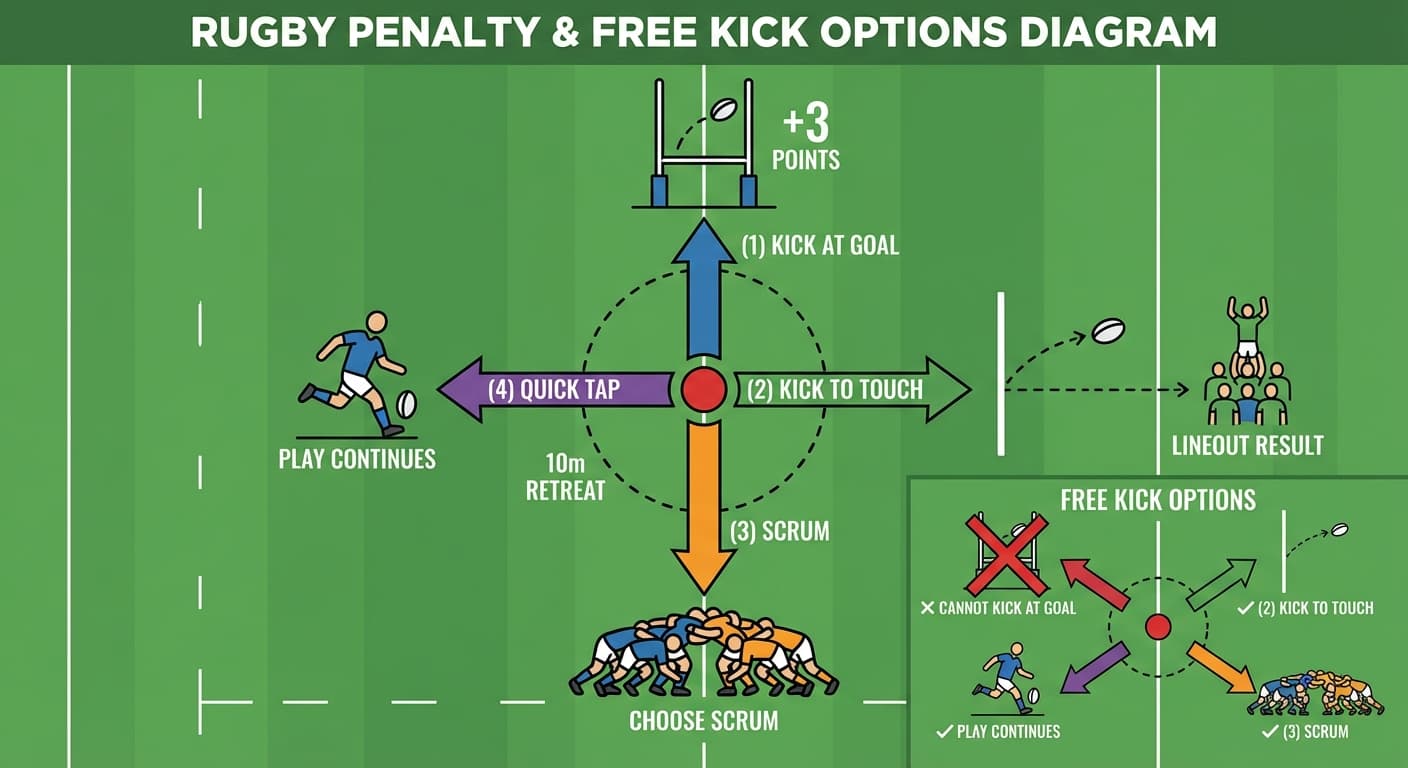
Penalties and free-kicks are both awarded when the opposing team commits an infringement, but they differ in what options are available.
---
PENALTY KICK A penalty kick gives the non-offending team several options:
1. Kick at goal — Attempt a penalty goal (3 points). The ball must be kicked between the posts and over the crossbar. 2. Kick to touch — Kick the ball into touch to gain field position. The kicking team throws in at the resulting lineout. 3. Take a tap and play — Tap the ball with the foot and play on (this is the "tap penalty"). 4. Scrum — Optionally take a scrum at the mark instead.
The kick may be taken from the mark (where the infringement occurred), or from further back.
---
FREE-KICK A free-kick is a less severe sanction. Options: 1. Kick the ball (but cannot score directly from a free-kick — no drop goal, no direct goal) 2. Take a tap kick and play on 3. Take a scrum at the mark
Cannot score directly: A player cannot kick a dropped goal directly from a free-kick. However, if a ruck, maul, or tackle then occurs and possession is retained, a drop goal can be attempted later.
---
Rules for both:
- All opponents must retreat 10 metres from the mark, or back to their goal-line if closer
- Once the kick is taken, opponents may advance
- The kicker must use the original ball
- The kick must be taken without delay
- A quick tap kick may be taken before opponents retreat — but opponents are then not required to be 10 metres away
Penalty try: If a player would have certainly scored a try but for foul play by the opposition, a penalty try is awarded directly under the posts (see Law 8).
Sanction for delay: Yellow card for persistent infringement after a penalty.
Real-World Examples
Scenario
A team is awarded a penalty 35 metres out in front of the posts. The fly-half places the ball on a kicking tee and kicks it between the posts and over the crossbar.
Outcome
3 points scored. A successful penalty goal.
Scenario
A team receives a penalty on their own 40-metre line. Instead of kicking at goal, the scrum-half quickly taps the ball with her foot before any opponent has retreated.
Outcome
Legal quick tap. Opponents are not required to have retreated. Play continues immediately. The team aims to use the quick tap to gain a positional advantage.
Scenario
A fly-half attempts a drop goal directly from a free-kick awarded for a crooked lineout throw.
Outcome
No score. A drop goal cannot be scored directly from a free-kick. A scrum is awarded to the defending team.
Scenario
A team is awarded a penalty on their own 22. They kick to touch, and the ball bounces into touch on the opposition's 10-metre line.
Outcome
The kicking team gets to throw in at the lineout on the opposition's 10-metre line. Kicking from a penalty always gives the kicking team the throw-in, regardless of where the ball goes.