
Scrum
A scrum is a set piece where 8 forwards from each team bind together and contest for the ball. It is used to restart play after minor infringements. The engagement sequence is: crouch, bind, set.
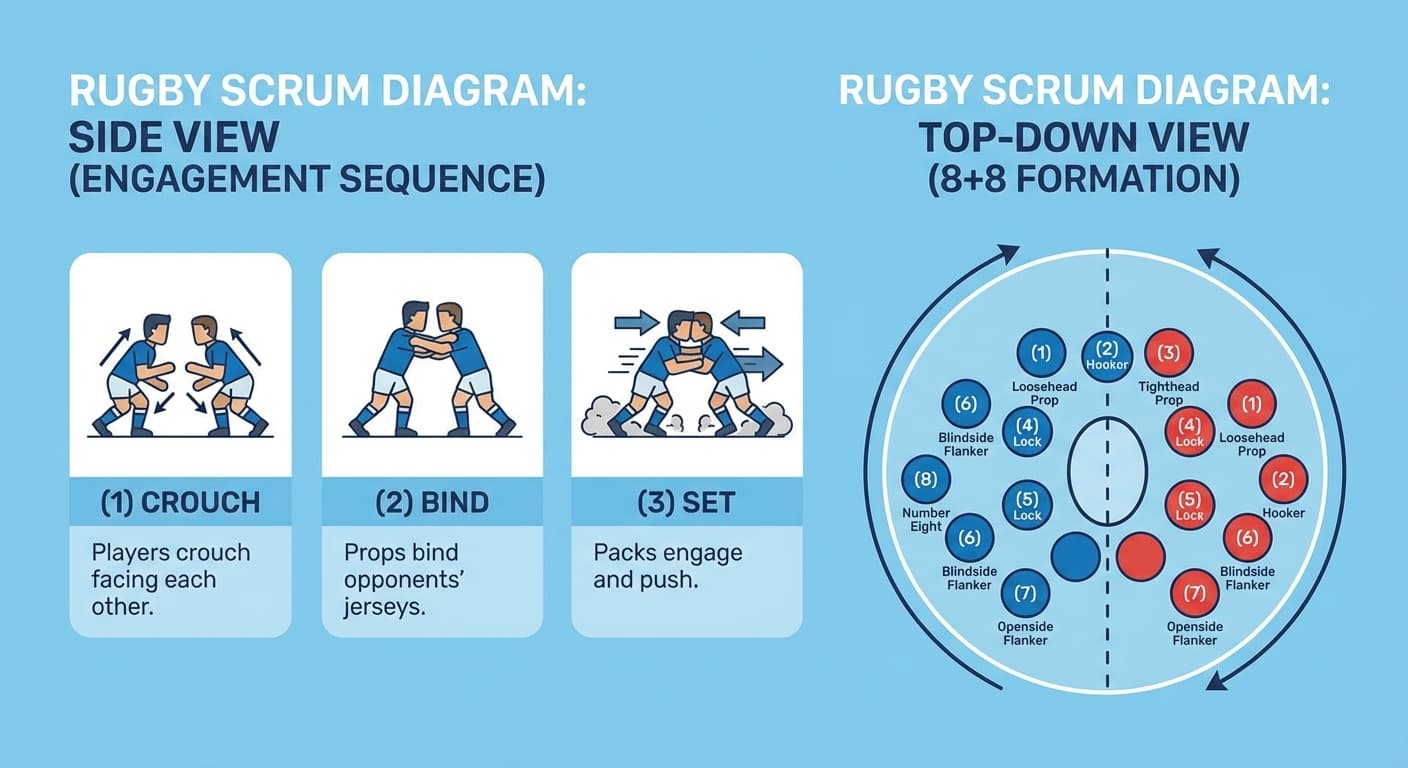
The scrum is one of rugby's most distinctive features — a tightly packed formation of forwards from both teams pushing against each other to contest for the ball.
When is a scrum awarded?
- After a knock-on or forward pass
- After certain infringements
- When a ruck or maul becomes unplayable
- When a player is held in a tackle and cannot release the ball
Formation:
- 8 forwards per team (hooker flanked by two props, then locks, then flankers and number 8)
- The front rows bind together ("front row union")
- All 8 players must be bound correctly
Engagement sequence: The referee calls: "Crouch… Bind… Set"
- Crouch: Both front rows crouch, heads down
- Bind: Props bind on opposing props before engagement
- Set: On the call of "Set," the two packs engage (come together)
- Props may not charge or strike before "Set"
Feeding the ball:
- The scrum-half of the team awarded the scrum puts the ball into the scrum
- The ball must be thrown in straight down the middle of the tunnel between the front rows
- The throw must be in a single, smooth movement without delay
- The hooker may hook the ball with their foot once the ball is in the tunnel
Playing the ball:
- The number 8 can pick up the ball from the base of the scrum
- The scrum-half can collect the ball when it reaches the rear of the scrum
- The ball must not go past the last foot of the scrum (the number 8's feet)
- Non-scrum players must stay behind the offside line (the hindmost foot of the last player in the scrum)
- The scrum-half of the team NOT putting in must stand behind the scrum or beside their hooker
Collapsed scrum: If a scrum collapses, the referee calls "Down" and resets. Players must not deliberately collapse a scrum — this is extremely dangerous.
Uncontested scrums: If a team cannot field a legal front row, uncontested scrums are played. No pushes or hooking — the ball is automatically given to the feeding team.
Sanction: Penalty for most infringements.
Real-World Examples
Scenario
A centre knocks the ball forward. The referee stops play and awards a scrum to the defending team.
Outcome
The defending team feeds the scrum at the location of the knock-on. The engagement sequence (Crouch, Bind, Set) follows. The defending team's scrum-half throws the ball into the tunnel.
Scenario
During engagement, the loosehead prop charges forward before the referee calls "Set."
Outcome
Penalty against the charging prop. Players must not charge or move forward until the referee calls "Set."
Scenario
The scrum-half feeds the scrum, but the ball enters the tunnel angled toward her own hooker's feet.
Outcome
Free-kick to the opposition. The ball must be thrown straight down the midline of the tunnel, not angled toward either hooker.
Scenario
The ball comes out at the base of the scrum between the number 8's feet. The blindside flanker picks it up before the number 8 does.
Outcome
Legal. The scrum has ended as the ball has emerged. The flanker can pick it up and play continues.
Scenario
A defending loosehead prop deliberately drops to one knee to bring down the scrum.
Outcome
Penalty for deliberately collapsing the scrum. This is extremely dangerous and is a serious infringement.