
Touch, Quick Throw-in and Lineout
Covers when the ball is in touch, how to take a quick throw-in, and all lineout rules including formation, throw-in, offside, and lifting.
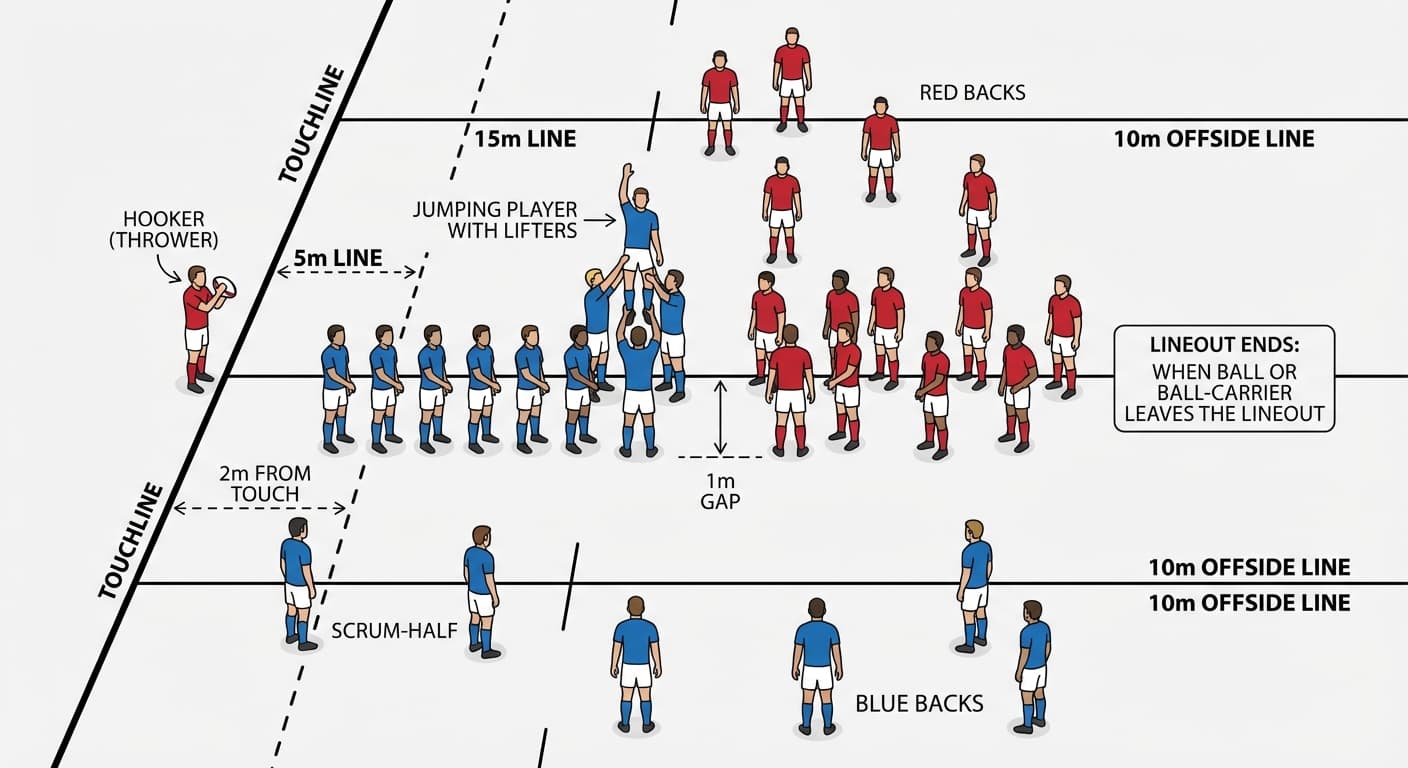
Touch is when the ball or ball carrier goes out of the field of play over the touchline. This law covers three related topics: what counts as "in touch," how to take a quick throw-in, and the full lineout rules.
---
TOUCH — When is the ball in touch?
- The ball is in touch when it lands or is grounded on the touchline or beyond
- A player is in touch when they are on or beyond the touchline and they touch the ball
- A player in the air (e.g., jumping for a catch) is only in touch if they land in touch
---
- Before a lineout forms, the team throwing in may take a quick throw-in using the same ball
- The same ball that went into touch must be used (if fans or ball-boys touch it, quick throw is not allowed)
- Any player from the throwing team may throw it
- The ball must be thrown straight, not forward, along the line of touch
- The throw must reach the 5-metre line
---
LINEOUT A lineout restarts play after the ball goes into touch (when a quick throw is not taken).
Formation:
- At least 2 players from the throwing-in team
- A minimum of 2 players from the opposing team (may match the numbers)
- Players must stand in single file, 1 metre apart, between the 5-metre and 15-metre lines
- A gap of 1 metre must be maintained between the two lines of players
Throwing in:
- The throw must travel at least 5 metres and be straight (along the line of touch)
- The hooker throws the ball in (usually), but any player may do so
- The throw must be straight — it must not be directed towards a team-mate's side
Peeling off:
- Once the ball is thrown, the last player in the lineout may move, but others must wait until the ball is caught or touched
Lifting:
- Players may be lifted in the lineout to catch the ball
- Lifters must use both hands and support the lifted player safely
- Players in the lineout: offside line is the line of touch (the touchline)
- Players not in the lineout: must stay behind the 10-metre line (from the line of touch)
- The scrum-half of the team not throwing in must stay behind the ball or behind the 10-metre line
Ending a lineout:
- When the ball or a player carrying the ball leaves the lineout
- When the ball is thrown beyond the 15-metre line
Sanction: Penalty for most infringements. Free-kick for some throw-in infringements.
Real-World Examples
Scenario
A winger jumps to collect a kick near the touchline. She catches the ball in the air with both feet off the ground. She lands clearly in touch.
Outcome
The ball is in touch from the moment she lands. The lineout or quick throw-in is taken from where she landed (or where the ball crossed the line if different).
Scenario
The ball is kicked into touch. A ball boy hands a different ball to the winger to take a quick throw-in.
Outcome
Quick throw-in not allowed. The same original ball must be used for a quick throw. A lineout must be formed instead.
Scenario
At a lineout, the hooker throws the ball but it curves toward her own team's side rather than travelling straight.
Outcome
Free-kick to the opposition for a crooked throw-in. The ball must travel straight along the line of touch.
Scenario
A prop is lifted early in the lineout — before the ball leaves the hooker's hands.
Outcome
Penalty for lifting before the ball is thrown. Lifting can only occur once the ball is in flight.
Scenario
A defensive winger, not in the lineout, drifts to within 8 metres of the line of touch while waiting for a lineout to develop.
Outcome
Penalty for being offside. Non-lineout players must remain at least 10 metres back from the line of touch.