
Knock Forward or Throw Forward
The ball must not be knocked or thrown forward (toward the opponents' dead-ball line). Accidental knock-ons result in a scrum; intentional ones are penalised.
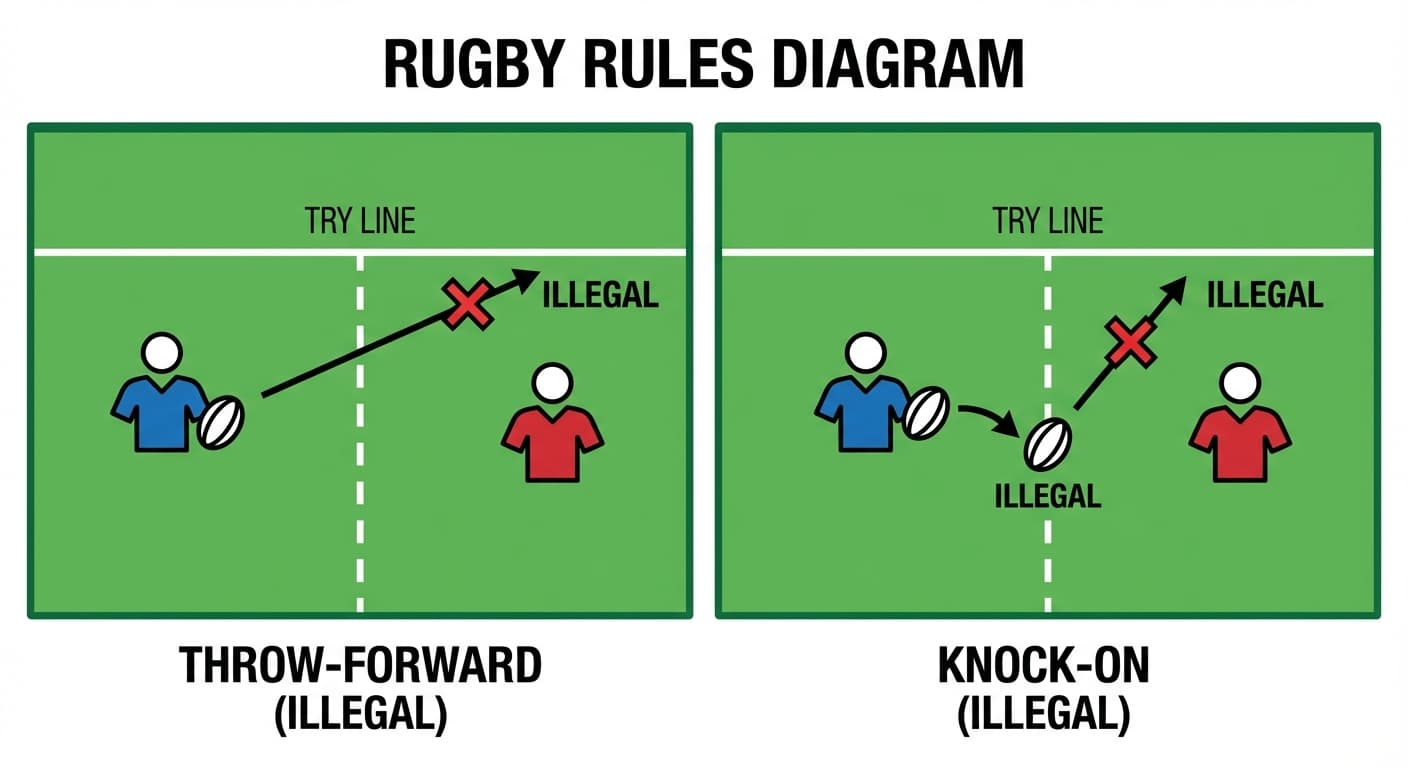
Knock forward (also called "knock-on"): When a player fumbles the ball and it travels forward — toward the opponents' dead-ball line — off their hand or arm before hitting the ground or another player.
Forward pass: When a player throws or passes the ball forward, toward the opponents' dead-ball line.
Both are illegal because rugby must be played by passing or kicking backward.
Sanction for accidental knock-on or forward pass: A scrum is awarded to the non-offending team at the place of the infringement.
Sanction for intentional knock-on or forward pass: A penalty is awarded to the non-offending team. If a player intentionally knocks or throws the ball forward in their own in-goal, the referee may award a penalty try.
Special cases:
- If the ball hits a goalpost, crossbar, or match official and goes forward, it is NOT a knock-on.
- At a lineout, if the ball comes off a player's hands accidentally and goes forward toward the opposing team's goal, a scrum is awarded. But if a player at a lineout catches the ball and it then hits another player or the ground, play continues as a knock-on.
- A player can knock the ball forward accidentally as long as they or a teammate can regather it before it touches the ground — but if it hits the ground or another player it is a knock-on.
Real-World Examples
Scenario
A centre receives a pass and, under pressure, fumbles it. The ball bounces off their hands and rolls forward along the ground toward the opponents' line.
Outcome
Knock forward (knock-on). A scrum is awarded to the non-offending team at the point of the infringement.
Scenario
A fly-half deliberately bats the ball forward with his palm to prevent the opposition scrum-half picking it up after a breakdown.
Outcome
Intentional knock-on. A penalty is awarded to the non-offending team. The referee may also caution or yellow card the fly-half depending on the context.
Scenario
A winger receives a pass that she juggles but manages to regather without the ball touching the ground.
Outcome
No infringement. If the player can catch the ball before it hits the ground, there is no knock-on even if the ball moved forward momentarily.
Scenario
A defending player in their own in-goal sees a rolling ball about to be grounded for a try. They deliberately knock the ball over the dead-ball line to prevent the try.
Outcome
Penalty try awarded. The player has intentionally knocked the ball forward in their own in-goal to prevent a try, which triggers the mandatory penalty try rule. 7 points are awarded to the attacking team.