
Offside and Onside in Open Play
A player is offside if they are in front of the ball when it was last played by a teammate. An offside player must not interfere with play.
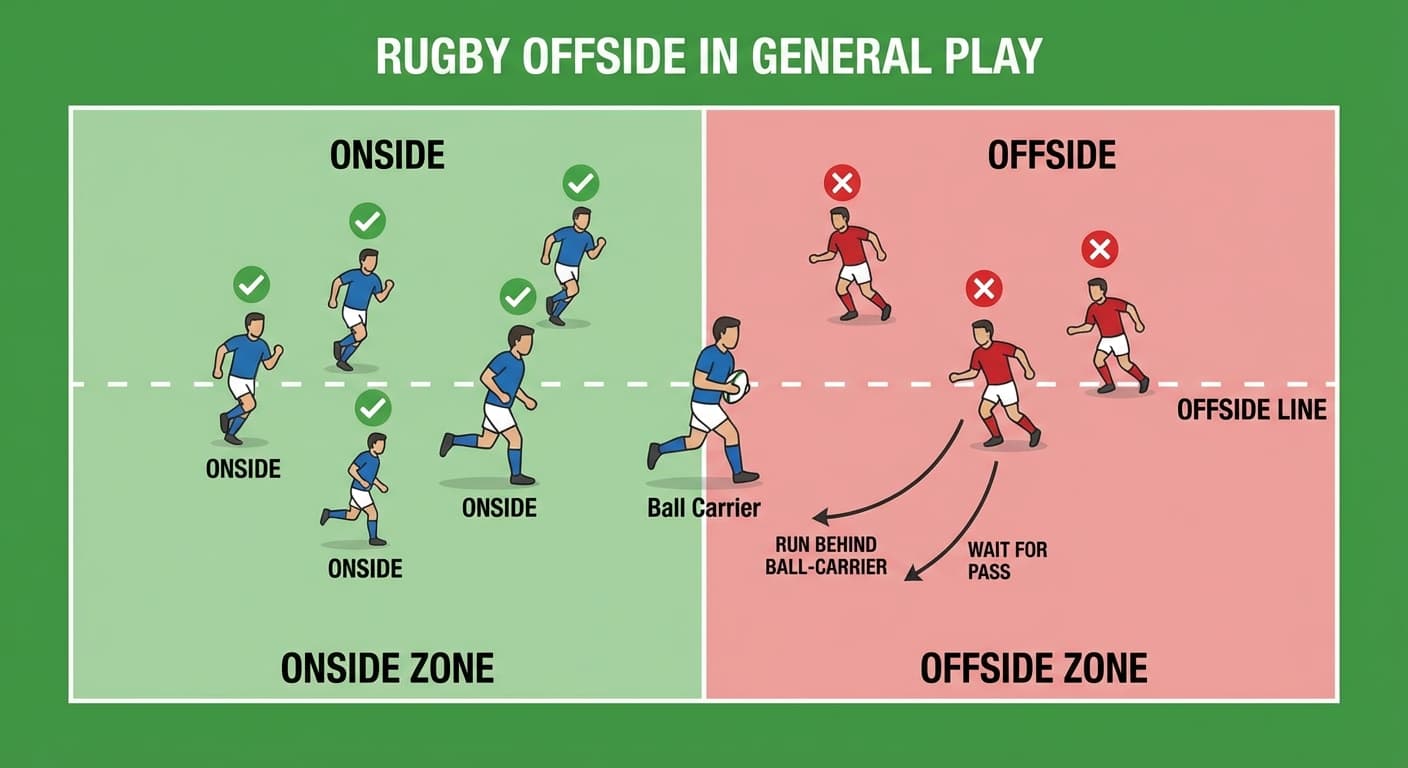
Offside is one of rugby's most important — and most misunderstood — laws.
The basic rule: You are offside if you are in front of the ball when a teammate last played it. "In front of the ball" means closer to the opponents' goal line than the ball.
Being offside isn't always an offence. You can be in an offside position as long as you don't:
- Interfere with play
- Move towards the ball
- Move towards the area of play
Accidentally getting onside: An offside player is put onside automatically when: 1. They run behind the teammate who last kicked the ball 2. An opponent (who is not the kicker or catcher) carries the ball 5 metres or more 3. An opponent kicks the ball 4. A teammate (other than the kicker) runs past them and becomes the furthest forward player
The 10-metre rule for kicked balls: If a teammate kicks the ball and the player in front is within 10 metres of where the ball lands, they must immediately retreat to become onside. They cannot interfere with play while doing so.
Sanction: Penalty awarded to the non-offending team.
Real-World Examples
Scenario
A fly-half kicks the ball upfield. Three of her backs were in front of her at the moment she kicked. They run forward toward the ball.
Outcome
These three players are offside and must stop running toward the ball. They must wait until a teammate who was behind the kicker (or the kicker herself) runs past them to put them onside, or until an opponent plays the ball. If they don't stop or they interfere, it's a penalty.
Scenario
A winger is 5 metres in front of the kicker when a chip kick is made. The ball lands 8 metres in front of the winger.
Outcome
The winger is within 10 metres of where the ball lands. They must immediately retreat to get at least 10 metres from where the ball will land. They cannot attempt to play the ball until put onside by their own team.
Scenario
A centre is in an offside position following a kick. The opposition fullback catches the ball and runs forward more than 5 metres.
Outcome
The centre is now onside. An opponent running 5 metres with the ball is one of the ways an offside player is automatically put onside.
Scenario
During open play, a prop forward passes the ball backward to a scrumhalf. Three teammates who were in front of the prop when he passed are now behind the scrumhalf.
Outcome
The players are still offside. Being "in front of the ball" is measured from the position of the ball when it was played — the player must be behind that point. However, as the scrumhalf then plays the ball forward, those players will be put onside by the new ball position if the scrumhalf is now behind them or carries forward to their position.